 Before reading this novel I had a sketchy knowledge of the Irish War of Independence. ‘The Soldier’s Farewell’ has brought it to life for me. Set in England and Ireland in 1921 this novel follows the Ryan brothers through these momentous historical times. Stephen is an Irishman who fought for the British during the First World War, he is subsequently sent to London as part of the Irish Delegation to help with negotiations for the independence of Ireland. Joe, his brother, is jailed for his actions as a member of the IRA. Through the two brothers we follow the political and military upheavals of the early 1920’s, the ending of one war and the beginning of a new, more sinister conflict.
A sub-plot follows Stephen’s girlfriend, Lillian. A gifted mathematician, her work is stolen and her career progress blocked because of her gender. This provides an interesting look at the role and position of women in the early twentieth century, noting some changes (such as women’s suffrage in Ireland) and predicting some of the changes which would ultimately come. This sub-plot is expertly woven into the story of independence and helps to create a full, rounded character in Stephen.
As a historical novel ‘The Soldier’s Farewell’ is well researched, the real-life facts and characters portrayed through the story in an engaging way which never lectures. The fictional characters are believable and the dialogue well written. The descriptive scenes are compelling; from streets scenes to a prolonged journey on foot through snowy mountains, from formal meetings and court scenes to desperate military actions, from scenes of love to scenes of murder, Mr. Monaghan has created a world which brings to life a period of history which all British people should become more familiar with.
I can heartily recommend this book to anyone who wants to know more about the history of Ireland, the dreams and aspirations of the IRA, and how the Anglo-Irish conflict of the twentieth century was born in Dublin in 1921. (The Soldier’s Farewell is part three of Alan Monaghan’s trilogy set during the Irish Civil War).
Mr Monaghan’s website can be found here
‘The Soldier’s Farewell’ can be found on Amazon
 Henry VIII’s divorce from Catherine of Aragon, and subsequent marriage to Anne Boleyn, are well known facts of history. Most people even know the names of some of the other people who played key roles in this matter. What Hilary Mantel has done in ‘Wolf Hall’ is to breathe life into these people. To flesh out the brief, dusty biographies of history into living, breathing people. People we can love or hate, laugh with or laugh at, care for or hope for their downfall.
 ‘The Royalist’ is the first book about William Falkland by S. J. Deas, set during the English Civil War. The main character, William Falkland, fought for the king but was captured and, as the novel opens, he is in prison awaiting execution. Falkland is led out, presumably to his death, but instead he has a surprising meeting with Oliver Cromwell who wants him to investigate some suspicious deaths in an army camp. To do what Cromwell wants is the only way that Falkland can save his own life, and return to his family.
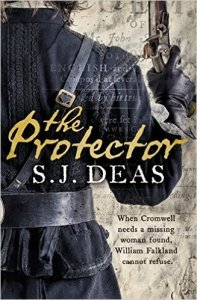 ‘The Protector’ continues the story of William Falkland which began in ‘The Royalist’. Still searching for his family, Falkland is once more called upon by Cromwell, this time to investigate the disappearance of a woman – the sister of the renowned John Milton. Once again the author creates a compelling mystery. Why would someone kidnap Milton’s sister? Is it to silence the writer, or for some other reason? What happened to Ann’s husband? What secrets are hidden in a ruined manor house in Lincolnshire? Deas masterfully weaves a detective story with a picture of life during the English Civil War. Rather than a straight history, details of the war are revealed through conversations amongst the characters, as part of the plot rather than a telling of facts. Deas also conjures the feelings of insecurity, threat, suspense and suspicion which were rife in England at the time as friends, neighbours and families chose sides and fought for what they believed was right.
 ‘The Taming Of The Queen’ by Philippa Gregory opened my eyes to the importance of a little known character in English history, Kateryn Parr. Many will know that she was one of the six wives of Henry VIII, but that is all. I had previously imagined her to be a quiet, submissive woman of the time, who would have kept her thoughts and beliefs to herself in order to keep safe from a mercurial king. But I was wrong. In reading this book I discovered a woman who was deeply religious, intelligent and scholarly.
 Dorinda Balchin - Author