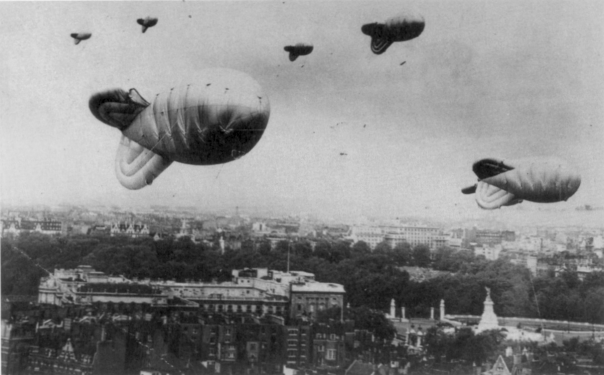
We have all seen pictures of barrage balloons floating high over London during the Blitz. But did you know that these balloons were the inspiration for a simple yet effective weapon used by the British against the German mainland?
At the outbreak of war there had been complaints about the damage caused to electrical power cables by the tethers of barrage balloons which had broken free from their moorings. As a result it was suggested that Britain should launch balloons from France to try to cause similar damage in Germany. The idea was not pursued at the time, then the airfields in France fell into enemy hands and the plan was shelved. If not for a gale on 17th -18th September 1940 it is likely that nothing further would have been done, but on that night a number of barrage balloons in England broke free and were blown across the North Sea. The rogue balloons caused damage to power-lines in Sweden, Denmark and Finland. On hearing this, Churchill gave the go-ahead for a study on using similar balloons as weapons against Germany; as he said, the loss of the barrage balloons had been a bit of a disaster but ‘we may make a virtue of our misfortune’.
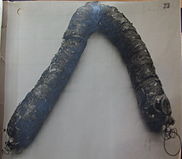
‘Operation Outward’ was given the go-ahead to use free-flying hydrogen balloons which were cheap and simple to make. There were two types of these ‘balloon weapons’. The first trailed steel wires behind them to catch in high voltage power lines and damage them by creating a short circuit. Others carried incendiary devices which were intended to start fires in the countryside. Just before the balloons were released a fuse was lit which would burn through a cord holding the trailing wire in place, causing it to drop free over the target zone. For the incendiary devices, the fuse burnt through restraints to allow the ‘bombs’ to fall in the target area – Germany’s vast pine forests and heathland. Some of the devices contained phosphorus in bottles – when the bottle smashed on landing the contents spontaneously caught fire. Others (known as ‘socks’ because their design looked like a pair of socks tied together) were intended to catch in the branches of trees where they would burn for 15 minutes, hopefully starting a forest fire. The plan was that, as well as causing physical damage, the balloons would mean large numbers of people would have to keep watch for fires instead of doing more productive work, thus disrupting the enemy’s war effort even further. It wasn’t long before the Germans were also sending up fighter planes to try to shoot down the balloons, again tying up resources which could have be more profitably used elsewhere.
Incendiary sock
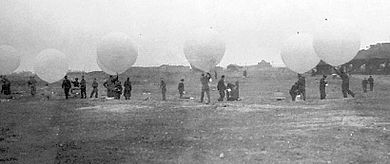
In August 1942 as many as 1,000 balloons were launched every day, sometimes up to 1,800 went up in just 3 or 4 hours. The only thing that halted the flights was if a bombing raid was going out to Germany – there was always a danger that the balloons could bring down allied aircraft. Over 99,000 balloons were launched during Operation Outward, flying at around 16,000 feet and using simple systems of venting gas or dropping ballast to stay at the right height. Such simple balloons cost just 35/- each (35 shillings, or the equivalent today of about £85). It is impossible to know quite how much damage was caused, but it was certainly far more costly to Germany than the expense to Britain in producing them. The latex rubber needed for balloons was in short supply in an England struggling to bring in shipments of supplies through seas where German U-boats roamed, but luck was on the side of the British as the navy had over 100,000 weather balloons in storage, and these were perfect for the job. The first balloons were launched on 20th March 1942 from Felixstowe Ferry Golf Club in Suffolk. In July 1942, a second launch site was set up at Oldstairs Bay near Dover, then a third at Waxham in Norwich. Balloons continued to be launched until September 1944 when supplies of hydrogen were needed for the beachhead in Normandy, and there were also worries that too many balloons might interfere with Allied planes as they followed up the retreating German army.
Launching balloons for Operation Outward
After the war German records showed just how much disruption had been caused to the electrical network by Operation Outward. The Germans said that around £1,500,000 of damage was caused (approximately £49 million in today’s money) although the actual damage was really much higher as many of the war-time records were incomplete. One of the major successes of the attacks was on 12th July 1942 when a balloon trailing a wire struck an 110,000 volt power line near Leipzig causing a fire that totally destroyed the power station at Bohlen.
So, next time you see a simple balloon at a birthday party or other celebration, just remember that they have not always been quite as peaceful as they seem!
Before reading this novel I had a sketchy knowledge of the Irish War of Independence. ‘The Soldier’s Farewell’ has brought it to life for me. Set in England and Ireland in 1921 this novel follows the Ryan brothers through these momentous historical times. Stephen is an Irishman who fought for the British during the First World War, he is subsequently sent to London as part of the Irish Delegation to help with negotiations for the independence of Ireland. Joe, his brother, is jailed for his actions as a member of the IRA. Through the two brothers we follow the political and military upheavals of the early 1920’s, the ending of one war and the beginning of a new, more sinister conflict.
A sub-plot follows Stephen’s girlfriend, Lillian. A gifted mathematician, her work is stolen and her career progress blocked because of her gender. This provides an interesting look at the role and position of women in the early twentieth century, noting some changes (such as women’s suffrage in Ireland) and predicting some of the changes which would ultimately come. This sub-plot is expertly woven into the story of independence and helps to create a full, rounded character in Stephen.
As a historical novel ‘The Soldier’s Farewell’ is well researched, the real-life facts and characters portrayed through the story in an engaging way which never lectures. The fictional characters are believable and the dialogue well written. The descriptive scenes are compelling; from streets scenes to a prolonged journey on foot through snowy mountains, from formal meetings and court scenes to desperate military actions, from scenes of love to scenes of murder, Mr. Monaghan has created a world which brings to life a period of history which all British people should become more familiar with.
I can heartily recommend this book to anyone who wants to know more about the history of Ireland, the dreams and aspirations of the IRA, and how the Anglo-Irish conflict of the twentieth century was born in Dublin in 1921. (The Soldier’s Farewell is part three of Alan Monaghan’s trilogy set during the Irish Civil War).
Spring will soon be with us and many people’s thought will be turning to their gardens. What will you plant this year? Some will plant flowers only, others vegetables, some a mixture of both. But during World War 2 your choices would have been very different.
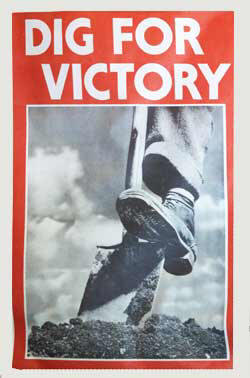
How to feed the population of Britain was one of the perennial questions during the Second World War. About 55 million tons of food was imported into the UK at the outbreak of war, but the German U-boats began to hunt the convoys which crossed the Atlantic, causing great losses in lives and supplies. Essential foodstuffs were rationed, and within a month of the outbreak of war the Ministry of Agriculture launched its ‘Dig For Victory’ campaign.
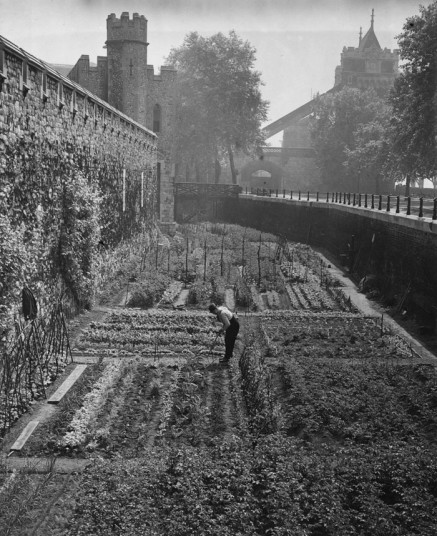
Everyone was encouraged to dig up their flower beds and lawns to create vegetable gardens. The idea was twofold – to provide much needed food for the local community whilst, at the same time, freeing up space in the merchant ships for military supplies. Gardens, sports grounds and parks were soon full of vegetables, even Buckingham Palace gardens and the lawns and moat at the Tower of London became large allotments.
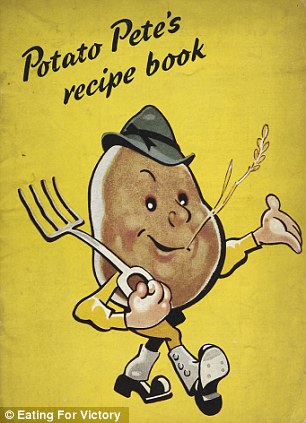
By 1943 over one million tons of vegetables were being grown in the ‘Dig For Victory’ drive, all encouraged by Ministry of Agriculture ‘food flashes’, literature and poster displays. Two key cartoon characters who encouraged the gardeners were ‘Dr Carrot’ and ‘Potato Pete’ who often appeared on posters in railway and bus stations, and in leaflets. Over 10 million leaflets were distributed during the war. The government also provided innovative recipes, including curried carrot and carrotade (a drink made from carrots and swedes). When there was a glut of carrots Lord Woolton had a novel idea to encourage people to eat more. He said that RAF pilots were eating carrots to help them see better in the dark. Radar was still a secret so the general population had no idea what was behind the increasing success of the pilots. They knew that, like everyone else, pilots were eating a lot of carrots so Woolton’s propogandists got to work. Within no time at all everyone was eating carrots to improve their vision!
People were also encouraged by Lord Wooton and others to try innovative recipes, and to scrub instead of peeling potatoes to avoid waste. As one poem put it:
Those who have the will to win, Cook potatoes in their skin, Knowing that the sight of peelings, Deeply hurts Lord Woolton’s feelings.
As well as growing vegetables, people also kept their own chickens, rabbits, goats and pigs. About 6,000 pigs were raised; they were especially popular because they could be fed kitchen waste, and by the end of the war 900 ‘pig clubs’ had been set up to coordinate the collection of waste, and to purchase pigs for groups of families who couldn’t afford one of their own.
Chickens were also popular. By 1943-44, people who kept hens in their gardens were producing around 25% of the country’s fresh eggs. By the end of the war there were over 250,000 members of the Domestic Poultry Keepers’ Council, raising in excess of twelve million birds.
In my novel Heronfield we get a clear feel for what life was like for civilians when Sarah’s mother turns her garden over to vegetable, bemoaning the loss of her beloved roses. But the importance of ‘Dig For Victory’ is then seen in the aftermath of the bombing of Coventry when people shared the supplies from their gardens in the first few desperate days before help arrived.
As the war progressed it became clear to everyone that the ‘Dig For Victory’ campaign had been far more successful than could ever have been imagined. However, it was recognised that there would still be a need for home grown food for a long time to come. Civilians were encouraged to keep gardening, keep digging, long after the war was over.
Rationing continued for the British people long after the war was over, and with it the work of growing vegetables. It was a number of years before roses once again replaced radishes, carnations replaced cabbages, and what had been lettuce beds were once more lawns for families to enjoy.
Henry VIII’s divorce from Catherine of Aragon, and subsequent marriage to Anne Boleyn, are well known facts of history. Most people even know the names of some of the other people who played key roles in this matter. What Hilary Mantel has done in ‘Wolf Hall’ is to breathe life into these people. To flesh out the brief, dusty biographies of history into living, breathing people. People we can love or hate, laugh with or laugh at, care for or hope for their downfall.
At the centre of it all is Thomas Cromwell. A man of humble origins, a traveller in his youth, a lawyer, friend of archbishops and, ultimately, confidant of the king. Ms Mantel has managed to get into the character of Cromwell, teasing out possible motives for his actions, deftly drawing the psychology of a man and of an age. History depicts Cromwell as a ruthless self-seeker, and there are aspects of that in this book, yet Ms Mantel digs deeper – a loyal friend, a family man, a loving husband and father, a cultured man who knew many languages, loved art and poetry, loved to hunt with his falcons, was keen to find and train young minds. This bringing to life of Cromwell, and many other characters, makes ‘Wolf Hall’ compelling reading, even though we already know the outcome of the story. Added to this is the in-depth depiction of life at court – the ladies in waiting, the kings gentlemen, intrigue and indulgence, banquets and religious disagreement, hunting and jousting – the list is endless. Along with the background of Cromwell this gives a fascinating insight into life in Tudor times for both rich and poor.
‘Wolf Hall’ is an historical novel with an emphasis on history, both in the plot and the descriptions. Ms Mantel has taken a story we all know and masterfully made it into something new, which any lover of history will enjoy. With one caveat. I enjoyed reading this book, but for some the style may be a little strange. Cromwell is always referred to as ‘he’, which can be confusing at times; so much so that, on occasion, the author resorts to writing ‘he, Cromwell, said…’. For myself, this is not a problem as the style is quite unique and gives a feeling of being in another time with another turn of phrase, another way of saying and doing things. For those who initially find this style difficult to follow I would ask you to persevere, a few pages in and you will cease to notice this most of the time as you become gripped by the story.
‘Wolf Hall’ is a fascinating read, and a great introduction to Thomas Cromwell. I am very much looking forward to following his story through Anne Boleyn’s time as Henry’s wife, and on to yet another queen in Ms Mantel’s sequel, ‘Bring Up The Bodies’.
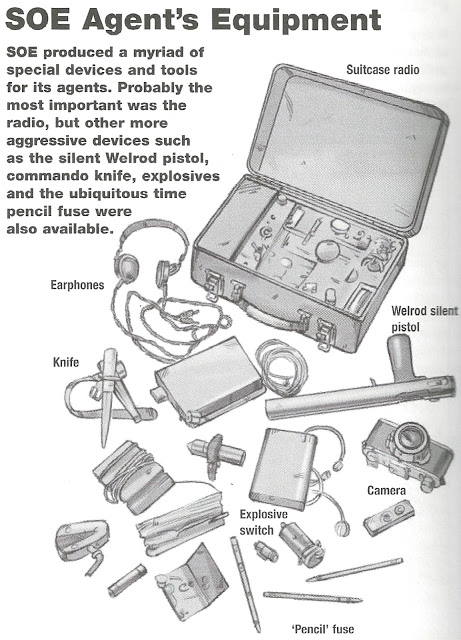
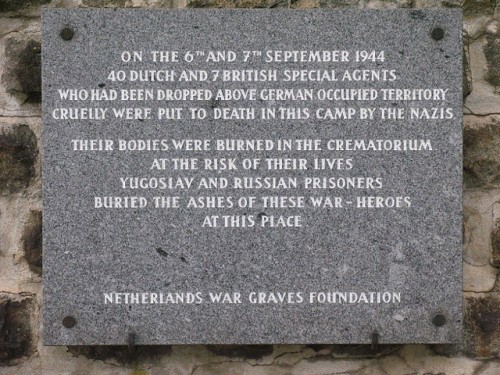
1941 found Britain standing alone against Hitler’s Germany. Britain had had no troops in Europe since Dunkirk, and there was no prospect of troops being able to land in the foreseeable future. Churchill was frustrated by this and set up the Special Operations Executive to train volunteers who were willing to parachute into occupied territories, where they would help the local population to fight the Nazis. More than 400 SOE operatives served in France where they played a decisive role in the preparations for, and days following, the D Day Landings. More than 25% of SOE agents who parachuted into France never returned home.
So how did someone become a secret agent during the Second World War? The initial choice was not of soldiers with military expertise, that training would come later. The key factor was whether someone had any special qualities which would be useful in occupied territory. Maybe they were fluent in a foreign language? Maybe they had a background living in France or one of the other occupied countries? Whatever first attracted the SOE recruiters, all volunteers initially underwent an interview in a foreign language, talking about nothing more sinister than their background. The possibility that they might be asked to work as a secret agent was never mentioned, and it can be assumed that all interviewees left the strange meeting in a London hotel room feeling very confused and, no doubt, curious. If the interviewer felt that the candidate had potential then another meeting would be arranged in the same hotel. If successful, working for the SOE was proposed to them, and any willing to serve their country in such a dangerous and secretive role started their basic training.
Training in Scotland
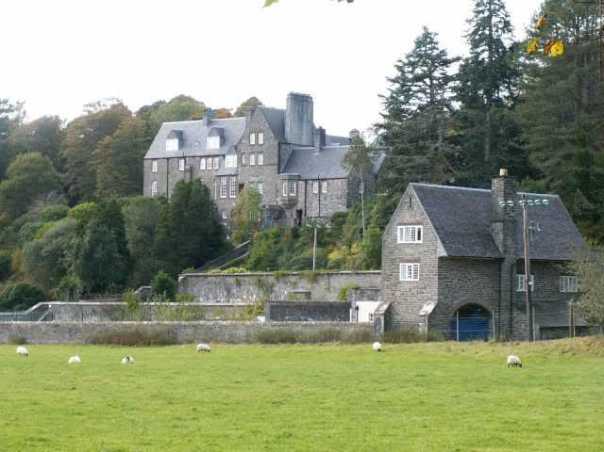
Training needed to be long and hard if operatives were to have the best chance of survival. The first stage was military based, with an emphasis on fitness, handling weapons, map reading, unarmed combat, demolition, how to operate in the field and basic radio communications. Not everyone made it through this first stage of training, but those who did headed north to Scotland. SOE’s staff HQ was at Arisaig in Invernessshire, located on a rugged coastline in a remote part of Scotland. The location was a perfect place to train secret agents – in secret! Trainees spent between three and five weeks living in local accommodation in and around Arisaig whilst continuing their weapons training, and working on other skills they had already started developing. By the end of the course they would be familiar with a large number of weapons from all countries, meaning that they would be able to make effective use of any guns they managed to ‘liberate’ whilst behind enemy lines. Alongside this they learnt unarmed combat and how to kill silently, as well as beginning to learn rudimentary coding. As sabotage would play a large role in an agent’s work Arisaig was the place where they learnt and developed their skills with explosives – from simple bombs, to planning and blowing up railway lines or arms dumps. The physical training was hard, with both men and women undertaking the same courses over difficult terrain, although everyone recognised its importance. Who knew when they might have to move silently and swiftly through the countryside to conduct a raid, or make an escape across country with the Germans in hot pursuit?
Arisaig HouseParachute training
Many a recruit failed the physical training. Those who made it through headed south once again, to learn how to jump out of a plane. Training took place at Altricham, with the planes for their five jumps leaving from Ringway (now Manchester Airport). To pass this part of the training the recruits would have to conduct four daylight and one night time jump. Low altitude jumps were the norm as any flight into occupied country would be low in an attempt to avoid German radar.
The next stage of training involved specialization – from demolition to radio operation, industrial sabotage to silent killing. And all the time, more weapons practice, more physical training, more field craft. The training was intense and unremitting. As well as the obvious training recruits underwent tests of which they were totally unaware. Strong drinks were readily available, something which ordinary soldiers undergoing basic training would never experience. The ulterior motive? Could the potential agent drink sensibly and hold his or her drink? Were they likely to talk too much (and too loudly)? Would this be a liability? Any who failed the test would be reassigned elsewhere and never serve behind enemy lines.
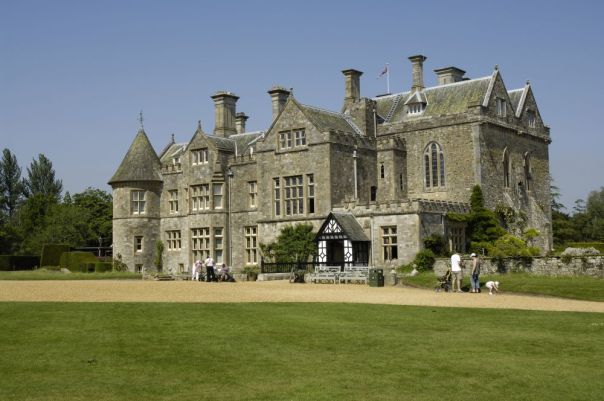
The final training took place on Lord Montague’s estate at Beaulieu in the New Forest, where agents studied techniques for passing messages, how to live a secret life in enemy territory, personal security, how to act if they felt they were under surveillance and, of course, how to maintain their cover story. All agents received a new identity with a complete history and family for their ‘previous life’ in occupied territory. This was the most frightening thing for many agents, for it was the little things that could give one away. It was said that one agent looked right first when crossing a road instead of left, momentarily forgetting that the French drive on the other side of the road to the English. This small mistake was said to have been enough for him to give himself away to the enemy.
Beaulieu House
Final testing took place at Beaulieu with agents undergoing mock raids, or making contact with trainers posing as resistance members, or losing a tail – the list was endless. But, at last, those who had made it through from the initial strange interview in London to this final testing were given home leave, before preparing to embark on a journey into enemy territory from which many never returned.
The courage of the men and women who served behind enemy lines was remarkable, but people often forget that life for agents was not easy when they were back in England. No one knew their secret work, and this could take its toll on family life. The main character in my novel, ‘Heronfield’, is Tony, a young man who is proud to serve his country by joining the SOE. He knows that it will be difficult but the conflict within his family is far more than he ever dreamed it would be, compared by his father to his older brother who was a fighter pilot, and falling short of what was wanted and expected. As for the girl he loved… Could she love a man who seemed afraid to join an active unit and fight? I wrote Heronfield as a tribute to the brave SOE agents, both men and women, who offered so much for their country, suffered so much, and in many cases, made the ultimate sacrifice.
Unusually, I am recommending two books for you to read this month.
‘The Royalist’ is the first book about William Falkland by S. J. Deas, set during the English Civil War. The main character, William Falkland, fought for the king but was captured and, as the novel opens, he is in prison awaiting execution. Falkland is led out, presumably to his death, but instead he has a surprising meeting with Oliver Cromwell who wants him to investigate some suspicious deaths in an army camp. To do what Cromwell wants is the only way that Falkland can save his own life, and return to his family.
‘The Royalist’ is a real page-turner, with many plot twists which keep you guessing to the very end. Are the deaths suicides, or something more sinister? What is the reason for Cromwell calling on a royalist to investigate, rather than one of his own men? Falkland finds the answers Cromwell wants (no spoilers here!) and is free to return to his family.
‘The Protector’ continues the story of William Falkland which began in ‘The Royalist’. Still searching for his family, Falkland is once more called upon by Cromwell, this time to investigate the disappearance of a woman – the sister of the renowned John Milton. Once again the author creates a compelling mystery. Why would someone kidnap Milton’s sister? Is it to silence the writer, or for some other reason? What happened to Ann’s husband? What secrets are hidden in a ruined manor house in Lincolnshire? Deas masterfully weaves a detective story with a picture of life during the English Civil War. Rather than a straight history, details of the war are revealed through conversations amongst the characters, as part of the plot rather than a telling of facts. Deas also conjures the feelings of insecurity, threat, suspense and suspicion which were rife in England at the time as friends, neighbours and families chose sides and fought for what they believed was right.
These two books about William Falkland are thoroughly enjoyable historical mysteries. The characters are well-rounded and totally believable. Falkland is a sympathetic hero, Milton is a complex character who draws out conflicting emotions in Falkland (and the reader!), Miss Cain is a resourceful woman who ably assists in the investigations, and the initially simple Warbeck turns out to be a more complex character than first imagined.
I thoroughly enjoyed the history and mystery in these two books, and hope that there will be more novels about William Falkland in the future.
‘The Taming Of The Queen’ by Philippa Gregory opened my eyes to the importance of a little known character in English history, Kateryn Parr. Many will know that she was one of the six wives of Henry VIII, but that is all. I had previously imagined her to be a quiet, submissive woman of the time, who would have kept her thoughts and beliefs to herself in order to keep safe from a mercurial king. But I was wrong. In reading this book I discovered a woman who was deeply religious, intelligent and scholarly.
Kateryn Parr was fluent in Latin and French. She was a keen student of philosophy and theology at a time when the king was see-sawing between reform and renewing closer links with Rome. Kateryn was the first woman to publish her own writings under her own name in English, focussing on prayer and the liturgy.
Kateryn also acted as regent for King Henry, showing his trust in her at that time. But, of course, Henry’s feelings for his wives were as changeable as the English weather. This novel paints a portrait of the king as selfish, manipulative, and often cruel; one cannot help but be drawn into the whirlpool of emotions which must have surrounded him at all times. Ms. Gregory has researched this period of the English court in great detail, which brings to life the day-to-day experiences of Kateryn. As a reader I felt fully immersed in the Tudor court – the food, dancing, etiquette, intrigue – which I found fascinating.
It is not possible to know what went on ‘behind closed doors’ in the past, so we cannot know the intimate details of Kateryn Parr’s personal relationship with Henry VIII, or with Thomas Seymour. As this book is historical fiction, Ms Gregory has taken what we know of the character of the people involved to create a more personal view of Queen Kateryn, showing how she must have used her intelligence to keep safe at court, despite attempts to turn the king against her.
I enjoyed the historical perspective in this book. The sinking of the Mary Rose, and attempts to raise her, just one example of the historical accuracy here. I also enjoyed the interplay of the characters and the realistic speech, which was never stilted and which helped the story to flow.
All in all, ‘The Taming Of the Queen’ is an enjoyable read which I can happily recommend.
The First World War ended at 11am on 11th November 1918. Each year we take time to remember those who died. Each year we buy a poppy to help support the work of the Royal British Legion.
But do you know why the poppy is the symbol of remembrance?
And do you know how to wear your poppy correctly?
Many know of the poem ‘In Flanders Fields’ by John McCrae, written in May 1915 after his friend, Lieutenant Alexis Helmer, had been killed during the Second Battle of Ypres. The poem describes poppies growing between the graves of British soldiers.
The poppy was later chosen as a symbol of remembrance because it was the first of the flowers to re-appear on the battlefields, and because of the three colours in this simple, yet beautiful, flower:
the deep red petals represent the blood of those who gave their lives for their country
the black represents the mourning of those whose loved ones never returned from the conflict
the green leaf represents the grass which covered the graves, and also hope for the future – crops being grown in a time of peace, and future prosperity after so much destruction
But did you know that the leaf should be worn in a particular position? Imagine that the poppy is a clock face, the leaf should be positioned at 11. This is a reminder that the death and destruction of World War One ended at the eleventh hour of the eleventh day of the eleventh month.
And did you know that, whilst men wear their poppy on their left, many people say that women should wear the poppy on their right side? This is because it has always been traditional for women to wear broaches on the right. Many women still feel they should wear the poppy on the right, but the British Legion say you can wear it anywhere, as long as you wear it with pride.
So much symbolism in such a small thing.
As the years pass, fewer and fewer remember the symbolism of the poppy. I hope that this year you will take a few moments at 11am on 11th November to think of the poppy and what it represents.
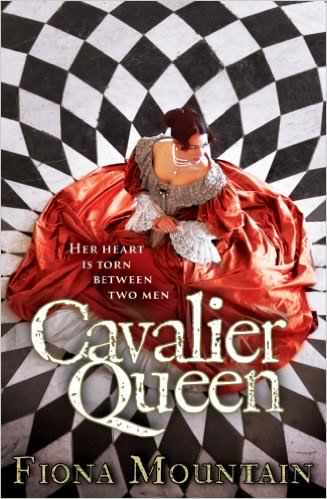
My Recommended Read for November is ‘Cavalier Queen’. It is the first book I have read by Fiona Mountain – but it won’t be the last!
The English Civil War is a fascinating period of history, but the focus is usually on King Charles, or Oliver Cromwell, or Parliament. This book has a different perspective, focusing on Queen Henrietta Maria, her arranged marriage to the king, and her support for him during the war. I previously had only a superficial knowledge of Henrietta Maria’s life and loves, but this book has brought her to life for me. She was a multi-faceted woman, strong and supportive, deeply religious, loving and caring.
Through her story of the queen’s life Ms. Mountain gives a good description of the reasons for the war, and Henrietta’s constant struggle to raise money and arms for the king. The raising of the Queen’s Army in the north, and its journey south to meet up with the king, is fascinating. The description of Charles’ Headquarters in Oxford is also very interesting, as is the link to France with its own political turmoil at the time.
‘Cavalier Queen’ is an incredibly well-researched novel. The care for historical detail is superb with cameos of the queen’s life, (for example meeting the daughter of Shakespeare) bringing the whole period to life. One of the key players in the queen’s household was Henry Jermyn, someone whom I knew little about but who is a key character in English history, and who also played a key role in moulding Henrietta Maria into the person she was to become. I found learning about his life just as fascinating as the life of Henrietta Maria herself. (Please remember here, though, that the book is historical fiction. Although there is plenty of primary evidence for the role that Jermyn played politically at the court of King Charles, we cannot know the details of his personal relationship with the queen.).
Ms. Mountain is a skilled writer. Her characters are sympathetically drawn and believable, her dialogue realistic. The descriptions of palaces are vivid, and one feels the discomfort of those who suffered through some terrible sea crossings. ‘Cavalier Queen’ is enjoyable on so many levels – history, romance, love and duty. This is a book you can immerse yourself in; and one which, I believe, you will find difficult to put down.
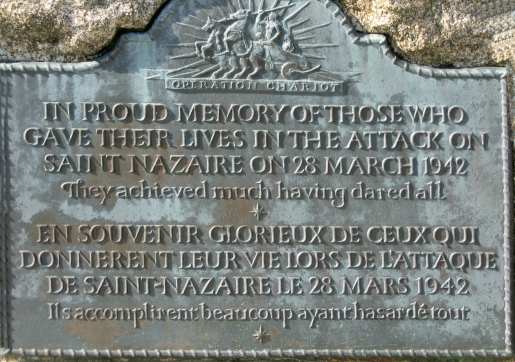
The Second World War saw many acts of bravery, but the raid on St. Nazaire in March 1942 remains one of the outstanding acts of heroism during the war. So much so that ‘Operation Chariot’ has been called ‘The Greatest Raid of All Time’, and immortalised in film and book. So, why was the raid necessary? And what happened?
In 1942 Britain was dependent on supplies from across the Atlantic if she was to survive the war, but that lifeline was constantly under attack. Supply convoys were frequently attacked by German submarines and surface raiders, but the biggest threat to shipping was the Tirpitz. No British or American ship could compete with her 15-inch guns and massively armoured structure. The Royal Navy hoped that a fleet could possible sink her, or at least damage her so much that she would be in need of extensive repairs, so relieving some of the pressure on the convoys. If they managed to damage the ship there was only one port in Axis held Europe large enough to accommodate her – St. Nazaire on the Atlantic coast of France. A massive dry dock had been built there before the war to accommodate a passenger ship called the Normandie. The port was now being used by the Germans to bolster their war in the Atlantic.
The British decided that this facility must not be available to the Tirpitz, and so an attack was planned to take it out. It would not be an easy task. Huge 35 foot thick gates, 167 feet wide and 54 feet high, moved on massive rollers to enclose a dock measuring 1,148 feet by 164 feet. This dock played host to small German warships and a fleet of U-boats which sortied out to seek and destroy the Allied supply convoys. To service and supply these was a collection of wharves, bridges and locks, a power station and underground storage for fuel. Minesweepers and searchlights constantly combed the area to prevent any Allied attack. In support of these were around 100 massive guns. To try to take out such an installation would seem impossible.
German U-boats entering St Nazaire
Bombing the dry docks was not an option as chances of a successful raid were remote. 80 anti-aircraft guns surrounded the area, and bombing would need to be accurate to do the necessary damage, but such pinpoint targeting was not possible in 1942. Even blanket bombing the area would not work as there could be no guarantee of success, and such a raid was likely to result in many civilian casualties. An attack by the navy was also impossible as the ships would not be able to get close, thanks to the narrow and shallow estuary protected by submarine nets, which also ruled out an underwater attack.
It was therefore decided that a force of commandos would attack the docks at St Nazaire during the last week of March 1942, which would give them a two hour window of full moon and a flood tide, vital for the attack to succeed. The plan was for some of the commandos to travel on motor launches with a shallow draught so that they could move in the waters of the estuary without entering the heavily fortified areas. The lead boat was to be a motor gunboat which could use radar and sonar to help the attack. The final boat was a motor torpedo boat which would lay torpedoes with delayed fuses.
A British Atlantic convoy
It was a good plan, but the dock was so huge that it was believed that the boats and commandos would not be able to put it out of action alone. That was when it was decided to take a leaf from the history books. England had caused devastation to the Spanish Armada through the use of fire-ships; perhaps something similar could work in St Nazaire? An old ship reaching the end of her life, HMS Campbeltown, was chosen for this role and underwent a facelift which left her looking a little like one of the German Mowe class warships. Unlike a warship, Campbeltown was lightly armoured and gunned, but she did have 24 depth charges which were the key to the plan. The ship was to smash her way through the massive gates to be scuttled in the dock with her explosives set on a timed fuse. When this triggered it would, it was hoped, put the dock out of commission for the rest of the war. Whilst Campbeltown was being scuttled, the commandos were to target the guns, bridges, lock gates and power stations which made St Nazaire such a dangerous asset for the Germans.
The landing force of what was considered by most to be a suicide mission, was made up of 256 officers and men. Vice Admiral Louis Mountbatten, Chief of Combined Operations, told Lieutenant Colonel Newman (leader of the attacking force) that he and his men were, in effect, being sacrificed. He told him that ‘I’m confident that you can get in and do the job, but we cannot hold out much hope of you getting out again. Even if you are all lost, the results of the operation will have been worth it. For that reason I want to tell you to tell all the men who have family responsibilities, or who think they should stand down for any reason, that they are free to do so, and nobody will think any worse of them.’ Not one man took up the offer.
The training for the mission was intense, as was security. It would be a disaster if news of the target got out, so rumours were spread about that the force was going to North Africa, or possibly submarine hunting in the mid-Atlantic. No one mentioned France. By the middle of March, everything was ready. The force set sail from Falmouth on 26th March, heading out into the Atlantic ocean. The next day, the ships hoisted the German flag and changed course for St Nazaire.
At 11pm on 28th March the timer for the explosives on the Campbletown was set as the force made its way into the Loire estuary. Careful navigation of the sandbanks and shallows was essential, which slowed the flotilla down, and the force was spotted just before 1.30am. When the German guns opened up the false German colours were run down and the ships sailed into St Nazaire under the white ensign. As the Campbletown sped towards the dock gates she was raked with gunfire, but did not slow down, smashing into the gates at 1.34am, just 4 minutes behind schedule.
Many commandos never made it to shore, but those who did encountered fierce opposition from the defenders. They fought heroically as they planted their charges, all the time aware of the German guns pouring heavy fire onto the British boats which should have been there to extricate them and take them home. Newman was aware that the boats had been forced to withdraw and that he and his men were, effectively, stranded. He managed to gather together around 70 men, most of them wounded, and gave them the news that they would have to make a break across country, to make for Spain if at all possible, a journey of 350 miles. But the enemy were everywhere and, one by one, the raiders were shot or taken prisoner.
Captured members of the commando force
Other commandos, who had been on the flotilla as it withdrew, were taken swiftly north towards England, the ships fighting all the way. The enemy were now out in force, though, and not all of the ships made it home. Soon the fighting on both land and sea was over. In the dry dock 40 German officers went aboard the Campbeltown, gloating that the British had underestimated the size of St Nazaires defences. There were also another 400 Germans in the vicinity when the timer on the explosives in the Campbeltown’s bow reached zero and the ship exploded. The damage was so great that the dock was unusable for the rest of the war. The British had not underestimated the job after all.
No-one knows for sure, but it is thought that the Germans lost 60 officers and 300 men when the Campbeltown exploded. Added to those killed or wounded in the fighting, this was a great blow to the Germans. The British lost 169 killed with about 200 taken prisoner, most of them wounded, only 4 men made it overland to Spain.
Many of those who died in the raid are buried here
Operation Chariot was a great success for the British. No one can calculate how many ships were saved, how much food and ammunition reached Britain which would, perhaps, have ended on the bottom of the Atlantic Ocean if the raid had failed, but it was a very significant contribution to the Allied cause. Although the raid was a great blow for the Germans, the defenders recognized the amazing courage of the commandos who had taken part in the attack and mounted an honour guard over the coffins of the dead. This courage was also recognized back at home – 51 men were mentioned in dispatches, 74 British decorations awarded, 4 French Croix de Guerres, and 5 Victoria Crosses.
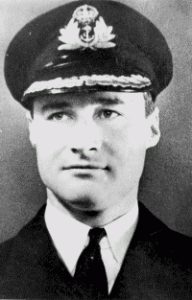
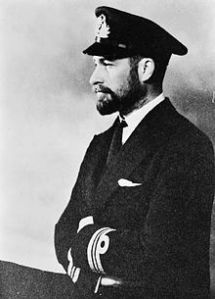
The heavily defended port at St Nazaire features prominently in my Second World War novel, ‘Heronfield’, which also recognizes the courage of those British men and women who served in the SOE behind enemy lines, and the members of the French Resistance who gave up so much to win their freedom from the Nazis. My characters may be fictional, but through them I recognize and pay tribute to the extraordinary courage shown by ordinary men and women in times of war. Ordinary men like these five who received the Victoria Cross for their role in Operation Chariot:
Citations for the five Victoria Crosses awarded to men who took part in the raid
Captain Robert Edward Dudley Ryder, RN. For great gallantry in the attack on St. Nazaire. He commanded a force of small unprotected ships in an attack on a heavily defended port and led HMS Campbeltown in under intense fire from short range weapons at point blank range. Though the main object of the expedition had been accomplished in the beaching of Campbeltown, he remained on the spot conducting operations, evacuating men from Campbeltown and dealing with strong points and close range weapons while exposed to heavy fire for one hour and sixteen minutes, and did not withdraw till it was certain that his ship could be of no use in rescuing any of the Commando Troops who were still ashore. That his motor boat, now full of dead and wounded, should have survived and should have been able to withdraw through an intense barrage of close range fire was almost a miracle.
Lieutenant-Commander Stephen Halden Beattie, RN, HMS Campbeltown. For great gallantry and determination in the attack on St. Nazaire in command of HMS Campbeltown. Under intense fire directed at the bridge from point blank range of about 100 yards, and in the face of the blinding glare of many searchlights, he steamed her into the lock gates and beached and scuttled her in the correct position. This Victoria Cross is awarded to Lieutenant-Commander Beattie in recognition not only of his own valour but also of that of the unnamed officers and men of a very gallant ship’s company, many of whom have not returned.
Able Seaman William Alfred Savage, RN. For great gallantry, skill and devotion to duty as gun-layer of the pom-pom in a motor gun-boat in the St. Nazaire raid. Completely exposed, and under heavy fire he engaged positions ashore with cool and steady accuracy. On the way out of the harbour he kept up the same vigorous and accurate fire against the attacking ships, until he was killed at his gun. This Victoria Cross is awarded in recognition not only of the gallantry and devotion to duty of Able Seaman Savage, but also of the valour shown by many others, unnamed, in Motor Launches, Motor Gun Boats and Motor Torpedo Boats, who gallantly carried out their duty in entirely exposed positions against enemy fire at very close range.
Sergeant Thomas Frank Durrant, RE Sergeant Durrant, attached to No.1 Commando, was in the Royal Engineers. On 27th March 1942 at St Nazaire he was in charge of a Lewis gun on HM Motor Launch 306 which came under heavy fire during the raid, and although he had no protection and was wounded in several places he continued to fire until the launch was boarded and the survivors were taken prisoner. He died of his wounds the next day. (It is believed that Durrant was wounded at least 25 times. He was captured and taken to a German military hospital where he died of his wounds. A week later, the commander of the German destroyer which had captured Durrant met Newman in a prisoner of war camp and suggested that the Colonel might wish to recommend Durrant for a high award. Durrant’s Victoria Cross is unique as it is the only award given to a soldier taking part in a naval action, and it was awarded on the recommendation of the enemy commander).
Lieutenant Colonel Augustus Charles Newman The Essex Regiment was attached to No.2 Commando. During the St Nazaire raid on 27th March 1942, Lieutenant-Colonel Newman was in charge of the military forces and was one of the first ashore, leading his men and directing operations without regard for his own safety. The troops fought well under his command and held superior numbers of the enemy at bay until the demolition parties had done their jobs. Newman then attempted to fight through into open country and did not surrender until all the ammunition was exhausted when he was then taken prisoner.
Other awards were granted for the St. Nazaire Raid: 4 DSO; 17 DSC; 11 MC; 4 CGM; 5 DCM; 24 DSM and 15 MM. Another 51 men were mentioned in dispatches, 22 of them posthumously.
 Before reading this novel I had a sketchy knowledge of the Irish War of Independence. ‘The Soldier’s Farewell’ has brought it to life for me. Set in England and Ireland in 1921 this novel follows the Ryan brothers through these momentous historical times. Stephen is an Irishman who fought for the British during the First World War, he is subsequently sent to London as part of the Irish Delegation to help with negotiations for the independence of Ireland. Joe, his brother, is jailed for his actions as a member of the IRA. Through the two brothers we follow the political and military upheavals of the early 1920’s, the ending of one war and the beginning of a new, more sinister conflict.




 Henry VIII’s divorce from Catherine of Aragon, and subsequent marriage to Anne Boleyn, are well known facts of history. Most people even know the names of some of the other people who played key roles in this matter. What Hilary Mantel has done in ‘Wolf Hall’ is to breathe life into these people. To flesh out the brief, dusty biographies of history into living, breathing people. People we can love or hate, laugh with or laugh at, care for or hope for their downfall.


 ‘The Royalist’ is the first book about William Falkland by S. J. Deas, set during the English Civil War. The main character, William Falkland, fought for the king but was captured and, as the novel opens, he is in prison awaiting execution. Falkland is led out, presumably to his death, but instead he has a surprising meeting with Oliver Cromwell who wants him to investigate some suspicious deaths in an army camp. To do what Cromwell wants is the only way that Falkland can save his own life, and return to his family.
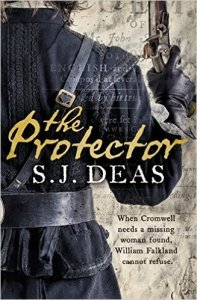 ‘The Protector’ continues the story of William Falkland which began in ‘The Royalist’. Still searching for his family, Falkland is once more called upon by Cromwell, this time to investigate the disappearance of a woman – the sister of the renowned John Milton. Once again the author creates a compelling mystery. Why would someone kidnap Milton’s sister? Is it to silence the writer, or for some other reason? What happened to Ann’s husband? What secrets are hidden in a ruined manor house in Lincolnshire? Deas masterfully weaves a detective story with a picture of life during the English Civil War. Rather than a straight history, details of the war are revealed through conversations amongst the characters, as part of the plot rather than a telling of facts. Deas also conjures the feelings of insecurity, threat, suspense and suspicion which were rife in England at the time as friends, neighbours and families chose sides and fought for what they believed was right.
 ‘The Taming Of The Queen’ by Philippa Gregory opened my eyes to the importance of a little known character in English history, Kateryn Parr. Many will know that she was one of the six wives of Henry VIII, but that is all. I had previously imagined her to be a quiet, submissive woman of the time, who would have kept her thoughts and beliefs to herself in order to keep safe from a mercurial king. But I was wrong. In reading this book I discovered a woman who was deeply religious, intelligent and scholarly.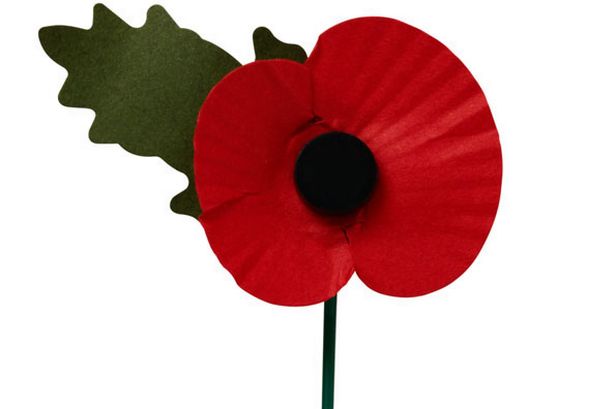





 Dorinda Balchin - Author