Tag Archives: history

For King and Country – VAD nursing auxiliaries

Have you heard of the VAD’s? You may have read about them or seen them in a movie. But who exactly were they, and what did they do?

The Voluntary Aid Detachment (VAD) was a voluntary organisation which provided field nursing services which were of vital importance during the two World Wars as well as during other conflicts. The VAD was founded in 1909 when the War Office put forward a scheme which allowed the British Red Cross to provide supplementary aid to the Territorial Forces Medical Service in the event of war. In 1914 The Red Cross was joined with the Order of Saint John (the St John’s Ambulance) to form the Joint War Committee (JWC). The idea was to make sure that they worked together efficiently in helping the military hospitals; it was thought safer for the St John’s volunteers to work under the protection of the internationally recognised Red Cross symbol. There were over 2,500 Volunteers in Britain at the outbreak of WW1, by the end of 1914 there were 74,000, two thirds of whom were women and girls who also wanted to do their bit during the conflict.

WW1 recruiting poster for the VAD's
WW1 recruiting poster for the VAD’s

The British Red Cross were reluctant to send civilian women to work overseas as most of the Volunteers were from the middle and upper classes and would have found it difficult to cope with the unaccustomed discipline and hardships. The Military authorities also refused to accept the VAD’s at the front line. It was not until three VAD’s, led by Katherine Furse, went to France in October 1914 as canteen workers that things began to change. The women were unexpectedly caught in a battle where they helped out in the emergency hospital. Those in authority on the front line saw how well the women acquitted themselves and, as there was a growing shortage of trained nurses, this opened the door for the VAD’s to serve overseas – as long as they were over 23 and had more than 3 months hospital experience.

Coming from privileged backgrounds and with no real medical training the VAD’s were often critical of the nursing profession on the one hand and criticised for their own lack of experience and discipline on the other. It made for an uneasy relationship with the military and the doctors to begin with, but relations improved as the Volunteers gained more experience.

Between 1914 1nd 1918 over 38,000 VAD’s served as cooks and ambulance drivers and worked in hospitals in all theatres of war from the Eastern Front and Middle East through Gallipoli and on the Western Front. They also served in convalescent hospitals back in the UK. From being resented at the outbreak of war the VAD’s came to be highly respected and many were decorated for distinguished service.

Between the two World Wars the VAD were reorganised and Volunteers were trained to work as nurses, radiographers, pharmacists, clerks and laboratory assistants. When the Second World War broke out the British Red Cross and Order of St. John joined together again to form the Joint War Organisation (JWO). There were also women who had been living abroad with their husbands, notably in the Far East, when war was declared, and they formed local VAD groups. A number of these became prisoners of the Japanese after the fall of Singapore. During WW2 the VAD’s consisted of some 14,155 Red Cross members, 1,695 from the Order of St John’s cross and 21 from the St Andrew’s Ambulance Association.
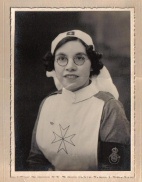
Kath Lewis who served as a VAD in WW2

The VAD’s were opposed to the Governments proposal in 1942 that they should join with the Auxiliary Territorial Service (ATS) and they were supported in their campaign to remain a separate organisation by The Times newspaper. There was a commission of enquiry and The War Office eventually ruled that they should retain their identity and be given new responsibilities.

Being a member of the VAD was just one of many roles that women took on during the two great wars of last century, proving that they had just as much to offer as their male counterparts and spearheading the way for future equality for women.

Please click here to see an example of what life was like for one VAD during World War 2. Kath Lewis served as a VAD at RAF Halton. You can also find out about VAD’s by reading about my fictional heroine, Sarah, in Heronfield.

Were you or one of your relatives a VAD? Do you have a story to tell? If so please leave a comment and tell us all about it. Thank you!
Please see here for further information on the VAD’s
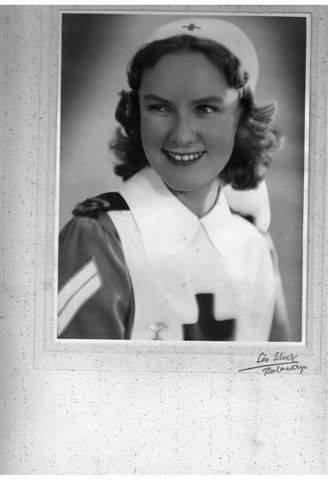
Jennie Upton has commented on this post and sent a picture of her mother who served as a VAD in Kenya.
Isobel Mary Cumming 1941
Thank you to Alison Bilynskyj for this photograph of her mother, Isobel Mary Cumming, who was a VAD. The photo was taken in 1941. I’m afraid I don’t know where she served.

Remembering ‘The Few’

Battle of Britain

I often wonder how it would have felt, as a civilian in southern England, to live through the summer of 1940. After the defeat of the British Expeditionary Force in France and the heroic evacuation from Dunkirk everyone was waiting for the Germans to cross the English Channel. Waiting for Hitler to add Great Britain to his list of conquests. We are lucky to be able to look back at history and see the events of that summer from both sides of the conflict. How much easier it would have been for people then if they had known what we know now.

Hitler’s plan to invade the United Kingdom, code-named Operation Sealion, depended on getting his forces safely across the English Channel. The key would be to make sure that the Royal Navy could not interfere with the invading army; and that would mean having complete control of the skies. To achieve this, the Luftwaffe needed to defeat the Royal Air Force.

As Commander-in Chief of Fighter Command, Air Chief Marshal Sir Hugh Dowding’s main worry in the summer of 1940 was lack of pilots. At the beginning August 1940, when the battle was entering its fiercest phase, there were 1,434 allied pilots available. By the end of the month 840 of these pilots had been lost, an average of 120 a week. The RAF’s training units could not keep up, and only managed to provide 260 new pilots during that month. As the battle progressed new pilots were sent up too soon, and their inexperience often cost them their lives. In opposition, the Germans were turning out more pilots than could be absorbed by the front-line forces during the same period. It was lucky for Britain that, during the early days of the battle, Goring considered the fighter arm as defensive and of secondary importance to the bomber squadrons, giving Dowding time to build up his forces. It also worked to Britain’s advantage that Goring was known for dismissing as unimportant anything he did not understand. This led to him calling off the attacks on radar stations, which he said were not necessary for success. A decision he was later to regret.

In July 1940, Goring planned to tempt the RAF out for a full-scale battle and destroy it in just a few days, leaving the way open for the invading troops. To do this he sent up the Luftwaffe to seize control of the Straits of Dover on 10th July. However, the RAF pilots proved far more tenacious than Goring had anticipated, and the battle raged on. By the end of July the RAF had lost 150 planes. The Luftwaffe losses ran at 268. Goring knew that he could not keep up these losses for ever so, in August, the Luftwaffe began to attack Fighter Command’s airfields, operations rooms and radar stations. If the RAF could be destroyed on the ground the battle would be won.

Battle of Britain working on plane

Dark days for the people of Britain, who felt that they were standing on the brink. Yet victory was theirs, and when the battle was over a new chapter in the war began. For many those facts are enough. But for me the Battle of Britain is not just about numbers. It is about the men who climbed into their planes, time after time, day after day. Battling exhaustion, injury and fear just as much as they battled the enemy planes. How can we imagine what it was like for them? The answer is – we can’t. But we can get some idea of what these men lived through from their memoires.

Battle of Britain pilots

In my novel, ‘Heronfield’,  David Kemshall is a fighter pilot. For me it was incredibly important to make the scenes of battle, his emotions, and his relationships as real as possible. For this I drew on the book ‘Smoke Trails in the Sky’ in which Anthony Bartley recounts his remarkable experiences as a fighter pilot in World War 2.  Anthony Bartley was one of ‘the few’ who Winston Churchill referred to in his famous speech. A select band of whom the majority (82%) were British; but what is often forgotten is that pilots from thirteen other nations fought by their side. In the summer of 2015 let us remember those who, 75 years ago, fought for the freedom of Great Britain.

Nationality Pilots Men killed % of pilots killed
Great Britain 2543 418  16%
Poland 147 30   20%
New Zealand 101 14   14%
Canadian 94 20   21%
Czechoslovakia 87 8   9%
Belgium 29 6   20%
South Africa 22 9   40%
Australia 22 9   40%
Free French 14 0 0%
Irish 10 0 0%
United States 7 1   14%
Southern Rhodesia 2 0 0%
Jamaica 1 0 0%
Palestine 1 0 0%
Total 3080 515 17%


Remembance Sunday Parade and Ceremony held at Number one hangar (Museum) Royal Air Force Cosford with Group Captain James the Senior Officer Present.
Remembrance Sunday Parade and Ceremony held at Number one hangar (Museum) Royal Air Force Cosford


Never in the field of human conflict was so much owed by so many to so few

Sir Winston Churchill


With thanks to the RAF museum for the use of the photographs

http://www.rafmuseum.org.uk

Twitter @RAFMUSEUM