All posts by Dorinda Balchin

Recommended Read – The Garden of Evening Mists by Tan Twan Eng

The Garden Of Evening Mists“On a mountain above the clouds, in the central highlands of Malaya lived the man who had been the gardener of the Emperor of Japan.”

Teoh Yun Ling was seventeen years old when she first heard about him, but a war would come, and a decade would pass before she travels up to the Garden of Evening Mists to see him, in 1951. A survivor of a brutal Japanese camp, she has spent the last few years helping to prosecute Japanese war criminals. Despite her hatred of the Japanese, she asks the gardener, Nakamura Aritomo, to create a memorial garden for her sister who died in the camp. He refuses, but agrees to accept Yun Ling as his apprentice ‘until the monsoon’ so she can design a garden herself.

Staying at the home of Magnus Pretorius, the owner of Majuba Tea Estate and a veteran of the Boer War, Yun Ling begins working in the Garden of Evening Mists. But outside in the surrounding jungles another war is raging. The Malayan Emergency is entering its darkest days, the communist-terrorists murdering planters and miners and their families, seeking to take over the country by any means, while the Malayan nationalists are fighting for independence from centuries of British colonial rule.

But who is Nakamura Aritomo, and how did he come to be exiled from his homeland? And is the true reason how Yun Ling survived the Japanese camp connected to Aritomo and the Garden of Evening Mists?

This is a novel which appears, on the surface, to have a rather simple storyline, but as the reader journeys through it page by page a subtle complexity is revealed. Through a strong description of time and place the author uncovers the history of Malaya in three distinct time periods – during the Second world War, ten years after the war, and thirty years later. The novel switches between time periods without any indication in chapter headings etc. and, at first, this is a little disconcerting; but as you move further through the book it is easy to slip from one time to another which subtly mirrors the way Yun Ling’ thoughts and memories move as she attempts to come to terms with an illness which leads to loss of memory, although sometimes there are things she deliberately chooses to try to forget and these are, paradoxically, the ones which seem to remain.

As Yun Ling thinks back over her experiences, both as a prisoner of the Japanese during the war and during the Emergency which followed, the relationships between the characters and the consequences of their actions are revealed. These individual relationships mirror those of the nations involved in the conflict – no one person or nationality is wholly good or wholly bad and Yun Ling has to struggle to accept the complex characters of the people around her, particularly the Japanese.

Tan Twan Eng has drawn on his own experiences to describe Malaya in a way which is totally believable, one can almost feel the heat, smell the vegetation, luxuriate in the cooling rain. This is seen most clearly in the Japanese garden which is slowly created and is a central feature to the story, its development mirrored in the unfolding of Yun Ling’s story, her understanding and final acceptance of all that she has experienced. The subtlety of a traditional Japanese garden presenting constantly changing vistas as you move through it is used as a perfect metaphor for the journey of Yun Ling, and our own journey, through life. The layered depths of the story are beautifully described in elegant prose which leads to an absorbing novel of personal and social transformation. Important issues are hidden beneath surface detail and it is a delight to uncover these in both the people and the land as one reads further, and deeper, into this novel.

The Garden Of Evening Mists is a beautifully written novel in which the loss of honour, dreams, and loved ones in carefully balanced by the beauty of a Japanese tea ceremony, lanterns of hope released into a dark night sky, and a beautiful garden which finally brings peace and closure. This novel will not appeal to all readers. If you like an action-packed book with a clearly defined story arc you may find this a little too much work, but if you enjoy exploring ideas of identity, love and loss, and of the interplay of pleasure and pain in the recalling of your past, then I think you will enjoy this novel. It is an intelligent read in which mysteries are slowly and carefully revealed, yet certain aspects are left deliberately obscure to allow the reader to follow their own inner journey to its conclusion. When the character Yun Ling begins her apprenticeship with Aritomo she observes him carefully and notes ‘He was similar to the boulders…only a small portion was revealed to the world, the rest buried deep within, hidden from view.’ A perfect description of this wonderful novel which masterfully allows the reader to uncover those hidden depths for themselves.

The Garden Of Evening Mists can be found on Amazon

You can find out more about Tan Twan Eng here

You can find more of my Recommended Reads here


‘Peace for our time’ – the Munich Agreement and the road to war.

80 years ago today Britain, France, Germany, and Italy signed the Munich Agreement allowing Germany to annex the Sudetenland. History records this as a great act of appeasement by British Prime Minister Neville Chamberlain, and many people feel that if Chamberlain had stood up to Hitler he could possible have prevented the Second World War. But is this true?

The Sudetenland was part of the country of Czechoslovakia which had only been created 20 years earlier with the collapse of the Austro-Hungarian Empire at the end of the First World War. The new independent Czechoslovakia was recognised in the Treaty of Versailles, but the world powers who dictated the treaty failed to realise that there would be problems arising out of three million German speaking people – 24% of the population – being included within the new country. Most Czech Germans lived in an area called the Sudetenland which bordered Austria and Germany, and they resented the fact that they had not been consulted about whether or not they wanted to be a part of Czechoslovakia. The constitution of the new country guaranteed equality for all citizens but, in reality, the Germans did not have fair representation in either the government or the army, and felt that their needs were being ignored. In an attempt to address the concerns of Sudeten Germans Konrad Henlein founded the Sudeten German Party (SdP) in 1933. While Czech and Slovak citizens voted for a variety of parties Sudeten Germans put all of their focus on the one party which enabled the SdP to become the second largest party in the country by 1935. Even so, life for the Sudeten Germans was becoming increasingly  difficult as the Sudetenland was more industrialised than the rest of Czechoslovakia and relied heavily on exports which resulted in a higher impact on the region from the Great Depression. Although only 24% of people in Czechoslovakia were German they made up 60% of the unemployed in 1936.

sudetenland

Henlein met with Hitler in Berlin on 28th March 1938 to discuss how to improve the situation for the Sudetenland. The Chancellor ordered that Henlein should make impossible demands on Edvard Benes, the President of Czechoslovakia, in order to provoke a ‘crisis’. Hitler had begun the re-armament of Germany in breach of the terms of the Treaty of Versailles, reoccupied the Rhineland in 1936, and annexed Austria in 1938; the taking of Czechoslovakia was to be the next step in his plan to create a ‘Greater German.’ On Hitler’s orders, one of Henlein’s demands was that autonomy should be granted to Sudeten Germans; the Czech government tried to be placatory and said that they would provide more rights for minorities but they would not grant autonomy, which is just what Hitler had hoped for. He used this as an opportunity to support the demands of Germans living in the Sudeten region.

The Czechoslovak government felt under pressure from their belligerent neighbour and hoped that Britain and France would assist them if Germany were to invade, they were therefore disappointed to find that Prime Minister Chamberlain was willing to compromise with Hitler. Chamberlain took this position in part because he felt that many of the Sudeten German grievances were justified, but he also wanted to avoid another war at all costs and so advised the Czech government to give in to Hitler’s demands. Benes, the Czech President, could not agree to this and so on 19th May 1938 he ordered a partial mobilisation to oppose any possible threat of a German invasion.

Bundesarchiv Bild 121-0008, Sudetenland, Besuch Wilhelm Frick
Henlein

Hitler had already drafted a plan for the invasion of Czechoslovakia, codenamed Operation Green, as well as ordering that U-boat construction should be speeded up, and the completion dates for the battleships Bismarck and Tirpitz brought forward in the hope that these preparations for war would deter Britain and France from intervening on behalf of Czechoslovakia. He wanted to move against Czechoslovakia as quickly as possible because the country’s defences were still being improved and so left the Czechs vulnerable; he also felt that British rearmament was behind that of Germany and so Chamberlain would be less likely to intervene on behalf of the Czechs than if Hitler waited until Germany was fully prepared for an extended European war.

To ensure support at home and put pressure on western powers to intercede on his behalf Hitler turned to his propaganda machine. August 1938 saw the German press full of stories of Czech atrocities against Sudeten Germans, whilst at the same time 750,000 German troops were sent on ‘manoeuvres’ to the Czechoslovakian border. Early in September President Benes offered to grant almost all that Henlein had asked for; but Hitler instructed the SdP not to compromise, instead they held demonstrations and provoked the police into arresting two of their members of parliament. This was the perfect excuse for the SdP to make other false allegations of atrocities and call off negotiations. Hitler continued to demand that Sudeten Germans should be re-united with their homeland, and made inflammatory speeches against the Czechoslovakian government, accusing them of violating international law, branding Germans as traitors and forcing them from their homes, and conspiring with France against Germany. War seemed almost inevitable.

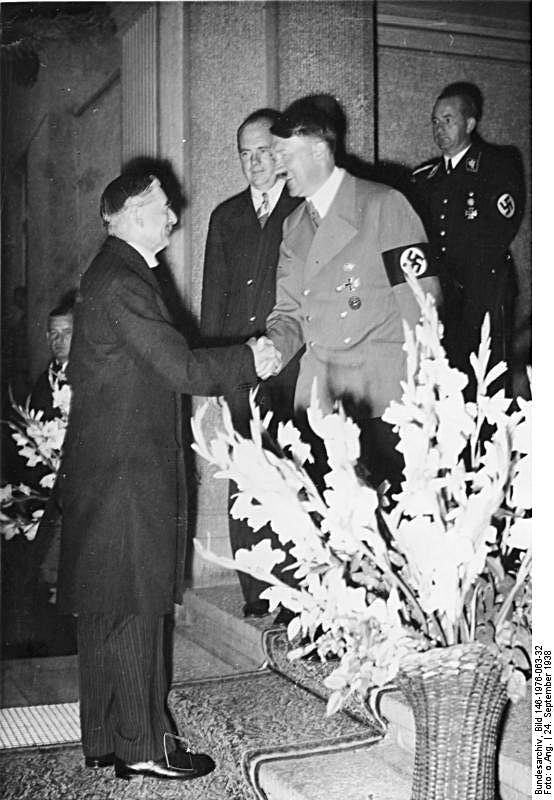
Things came to a head on the 12th – 13th September when Hitler encouraged Henlein to rebel against the Czech government and demand that the Sudetenland be reunified with Germany. When Benes refused and declared martial law Hitler threatened to go to war. Chamberlain asked for a personal meeting with Hitler to try to defuse the situation and flew into Germany on 15th September for a meeting at Berchtesgaden. The German leader insisted that Sudeten Germans must be allowed to exercise their right of self-determination and join with Germany. To avoid a possible European war Chamberlain agreed, in principle, that Hitler could claim all parts of Czechoslovakia where Germans made up more than 50% of the population and Britain would not interfere. On his return home Chamberlain persuaded the French (who were allies of Czechoslovakia) to agree to this on condition that Britain and France would guarantee the independence of Czechoslovakia. No one consulted the Czechoslovakians who rejected the proposal.

On 16th September the Czechoslovak government dissolved the Ordnersgruppe (which was an organization of ethnic Germans living in the country) because of its link with a number of terrorist attacks. The next day Hitler set up a paramilitary group called the Sudetendeutsches Freikorps to take over from the Ordnersgruppe. The new organization was equipped and trained by German authorities and conducted cross-border raids into Czechoslovak territory provoking yet more unrest.

Bad Godesberg, Münchener Abkommen, Vorbereitung
Bad Godesberg

On 22nd September Chamberlain flew to Germany to present the joint British-French proposal to Hitler at Bad Godesberg. He received a great welcome from the German people who felt that the agreement to allow Germany to annex the Sudetenland would ensure peace. Hitler himself, though, was irritated that Chamberlain should think that Germany needed the approval of Britain to further his plans. Hitler put his foot down and told Chamberlain that he wanted Czechoslovakia to be completely broken up with her lands divided between Germany, Poland, and Hungary. Chamberlain was stunned, but Hitler said that it was all because of the atrocities committed by the Czechs since his last meeting with the British Prime Minister. To support this one of Hitler’s aides came into the room (a pre-arranged event) to say that more Germans were being killed in Czechoslovakia. Hitler flew into a rage and vowed to avenge the deaths by destroying Czechoslovakia. For a time it looked like the meeting would fail, but later that day Hitler told Chamberlain that he would accept annexing only the Sudetenland as long as Czechoslovakia began the evacuation of ethnic Czechs from German majority territories by 8am on 1st October; if this happened Germany would have no more claims on Czechoslovak territory and would enter into an agreement to guarantee the border between Germany and Czechoslovakia.

The Czechoslovaks saw this as a provocation and excuse to provoke war, and so ordered a general mobilisation on the 23rd with one million men joining up to defend their country in the first 24 hours. The French also ordered a partial mobilisation on the 24th, whilst on the same day Hitler issued the Godesberg Memorandum saying that Czechoslovakia must give up the Sudetenland by the 28th or Germany would take it by force. Many people in Britain felt that Hitler’s demands had gone too far and they wanted to stand up to him, even if that meant going to war. On the other side of Europe the Soviet Union said that they would come to the assistance of Czechoslovakia if they could cross Polish and Romanian territory to do so, but both countries refused to allow it.

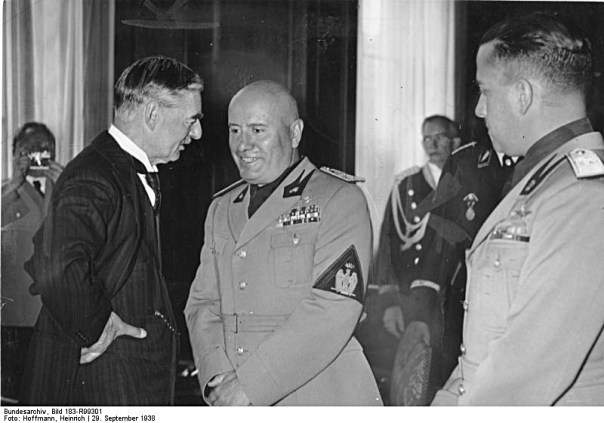
Czechoslovakia could see that things were looking hopeless and so, on the 25th September, they agreed to Hitler’s demands for the Sudetenland. Instead of accepting this victory however, Hitler now insisted that the demands of ethnic Germans in Hungary and Poland should also be met at the same time. On the 28th, with Germany’s deadline running out, Chamberlain invited Mussolini to join the negotiations in an attempt to get Hitler to delay the implementation of his ultimatum. Mussolini agreed and persuaded Hitler to accept a 24 hour delay (he also promised, in private, that whatever happened he would support Hitler!)

Münchener Abkommen, Chamberlain, Mussolini, Ciano
Chamberlain and Mussolini

To try to prevent war breaking out Chamberlain, Daladier (the French Prime Minister), and Mussolini flew to Munich to meet Hitler on the 29th September. No Czech or Russian representative was invited to the conference, and although Chamberlain asked the Czech ambassador to Berlin to come to Munich as an adviser he was not allowed in the same room as Hitler. The Czechs were presented with a stark choice – to accept the loss of the Sudetenland or face Germany alone. They chose to accept.

Signing the Agreement - Chamberlain, Daladier, Hitler, Mussolini
Signing the Agreement – Chamberlain, Daladier, Hitler, Mussolini

On the 30th September Hitler, Chamberlain, Daladier and Mussolini signed the Munich Agreement stating that Germany would complete the occupation of the Sudetenland by the 10th October whilst an international commission would be set up to decide what would happen to other disputed areas. Chamberlain had a separate pact drawn up, based on the Munich Agreement, which would guarantee peace between Germany and Britain, it was signed by the two leaders on the 30th. When Chamberlain arrived back in Britain later that day he waved the paper in his hand, declaring that it guaranteed ‘peace for our time’. At the same time, German troops were marching into the Sudetenland where they were welcomed as heroes.

Chamberlain returns to Britain with 'The Pact'
Chamberlain returns to Britain with ‘The Pact’

Chamberlain was greeted by ecstatic crowds whom he told that he had achieved “…peace with honour. I believe it is peace for our time.”  Winston Churchill immediately criticised Chamberlain by declaring that “You were given the choice between war and dishonour. You chose dishonour and you will have war.”

The following months seemed to prove Churchill right. Elections in Reichsgau Sudetenland in December 1938 resulted in over 97% of the population voting for the NSDAP. Around 500,000 Sudeten Germans joined the Nazi Party making it the most pro-Nazi region in the Third Reich (17.34% of Sudeten Germans joined the party whilst the average in Germany was 7.85%). Then, in March 1939, Slovakia seceded from Czechoslovakia to become a separate state which was highly supportive of the Nazi Party; Hitler sent his troops into the remainder of Czechoslovakia and occupied it as a protectorate of the Third Reich. Poland was now surrounded by German possessions and people in Britain began to fear that this country would be the next target for Hitler, to prevent this an Anglo-Polish military alliance was signed. Chamberlain felt betrayed by Hitler’s occupation of Czechoslovakia. His policy of appeasement had obviously not worked so he now began to mobilise British forces. France did the same. Italy felt threatened by the mobilisations and invaded Albania in April 1939. The final nail in the coffin of ‘peace for our time’ came with Hitler’s invasion of Poland on the 1st September 1939. Chamberlain declared war on Germany two days later.

Since 1939 the Munich Agreement has been seen as a classic example of the futility of trying to appease totalitarian states who are set on expansion. Yet was it as simple as all that? Did Chamberlain sacrifice Czechoslovakia on the altar of appeasement, or did he see it as a necessary evil? It is true that after the horrific losses of the First world War he would have done almost anything to avoid the same thing happening again. But is it also possible that he knew that war was inevitable but that Britain was not yet ready to face the rapidly growing German military machine? Could it be that the Munich Agreement and Pact were his attempt to buy time to rearm and prepare for the conflict ahead? Perhaps we will never know.

Recommended Read – The Soldiers Story by Bryan Forbes

In the uneasy post-war peace of occupied Germany, a British soldier is billeted to a bombed Hamburg hotel. Alex’s days are spent investigating Nazi war criminals, but it is a chance meeting with a German university professor in a shabby back-street bookshop that changes his life. Having befriended the professor and his wife, Alex falls in love with their only daughter, Lisa, only to discover that the professor may not be as innocent as he first appeared. The stale aftermath of a long and hideous war has left the old society in ruins. There are still many secrets to uncover and Alex has to ask himself what is more important – love or truth? As he digs deeper into the professor’s past Alex is forced to recognise that he cannot have both.

This is an absorbing novel in more ways than one. We follow Alex as his life moves from war to peace, from seeing the Germans as enemies to trying to help them on the road to recovery. When he finally leaves the armed forces Alex, like so many men who served in the Second World War, has to re-adjust to civilian life. The Lincolnshire farm where he grew up seems confining, he feels rootless and unable to find his way. In this sense ‘The Soldier’s Story’ is a tale of lost youth. Interwoven with this is a love story, an English soldier falling in love with a young German woman at a time when ‘fraternisation’ was still frowned on; how would her family, and his colleagues, react? If this were not enough, a photograph from Auschwitz places Alex in an impossible situation. What should he do? Should he put his love for Lisa before justice for those who suffered and died in the war? Should he follow his heart or do his duty?

‘The Soldier’s Story’ is a well written novel, peopled with many facetted characters who struggle to do right in a world which is never simply black and white. The dialogue is engaging and believable, helping to bring the characters to life. The descriptions of bomb-damaged Berlin, the Russian sector, the drab people struggling to come to terms with defeat, all combine to give an insight into a fascinating period of history. ‘The Soldier’s Story’ is not a dry history book, although through its pages we achieve a greater understanding of the years immediately following the Second World War, the true destructiveness of conflict, and the loss of innocence which it brings. This is a great piece of historical fiction which I heartily recommend to anyone who has an interest in history, the Second World War, morality, human nature and love.

The Soldiders Story can be found on Amazon 

You can find out more about Bryan Forbes here

You can find more of my Recommended Reads here
Greater Love Has No Man Than This – Noel Chavasse

Following on from my previous article about the Royal Army Medical Corps I wanted to pay tribute to one of the heroes from the Corps who dedicated his life to helping those who had been wounded in battle, Captain Noel Godfrey Chavasse.

Noel Chavasse VC

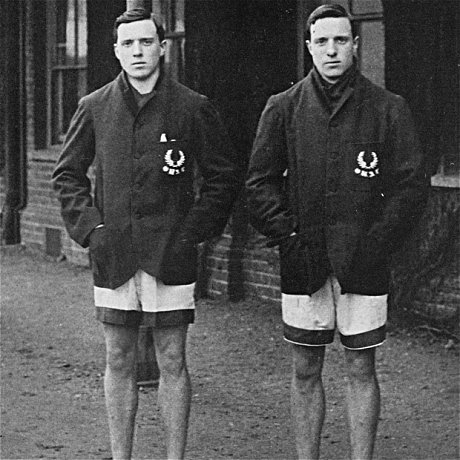
Chavasse was born in Oxford on 9th November 1884, 20 minutes after his twin brother Christopher. The family moved to Liverpool when their father, Rev. Francis Chavasse, was made Bishop of Liverpool. Both boys did well at school where they excelled at sports, before going to Trinity College, Oxford. After graduating with a First-class honours degree Noel continued to study medicine at Oxford, and during that time both he and Christopher represented Great Britain in the 400 metres at the 1908 Olympic Games. In 1909 Noel joined the Officers Training Corps Medical Unit at Oxford University, later being promoted to Lance-Sergeant. He passed his exams to become a Fellow of the Royal College of Surgeons and was awarded the Oxford University’s premier medical prize, the Derby Exhibition. In 1913 Chavasse joined the Royal Army Medical  Corps as a Surgeon-Lieutenant in the Territorial 10th Battalion of the King’s Liverpool Regiment.

Christopher (left) and Noel

When war broke out in 1914 Chavasse, like many other young men, was eager to serve and was happy to be in France by the end of the year. He initially wrote home to say that as he was not particularly heroic he was pleased that doctors were not allowed in the trenches so he would run little risk. Yet the young doctor soon saw the horrors of trench warfare as men were rotated back from the frontline in terrible condition, and he wrote home to say that they all came to hate the war worse than they had thought they could. Yet, despite everything, Chavasse continued to work hard, being amongst the first doctors to use the new anti-tetanus serum to help the wounded, and when the troops in nearby trenches were terrified by the first use of chlorine gas by the Germans he arranged for his father to send a gramophone to help raise their spirits.

For a man who did not feel heroic Noel Chavasse was to become the most highly decorated officer of the First World War. He was awarded the Military Cross for his actions at Bellewaarde near Ypers on 16th June 1915 where he spent 12 hours helping to treat and rescue casualties in no man’s land (more than 1,000 men died during that offensive). Chavasse was promoted to Captain in 1915, and was also mentioned in despatches later that year.

In 1916 Chavasse was awarded the first of two Victoria Crosses. His unit suffered heavy casualties at Guillemont on 9th August with 230 out of 600 men killed, wounded or missing. Chavasse worked for more than 24 hours, disregarding sniper, machine gun and mortar fire to tend the wounded, bury fellow officers and collect ID from the dead. Although wounded in the back by two shell splinters, he refused to retire behind the lines and worked on, rescuing men from as close as 25 yards to the German line. His VC citation read:

Captain Noel Godfrey Chavasse, M.C., M.B., Royal Army Medical Corps.

For most conspicuous bravery and devotion to duty.

During an attack he tended the wounded in the open all day, under heavy fire, frequently in view of the enemy. During the ensuing night he searched for wounded on the ground in front of the enemy’s lines for four hours.

Next day he took one stretcher-bearer to the advanced trenches, and under heavy shell fire carried an urgent case for 500 yards into safety, being wounded in the side by a shell splinter during the journey. The same night he took up a party of twenty volunteers, rescued three wounded men from a shell hole twenty-five yards from the enemy’s trench, buried the bodies of two officers, and collected many identity discs, although fired on by bombs and machine guns.

Altogether he saved the lives of some twenty badly wounded men, besides the ordinary cases which passed through his hands. His courage and self-sacrifice, were beyond praise.

In a letter to his parents Chavasse described his work at the front line: “We found a man bleeding badly from one arm and held the main artery, and then we put a tourniquet on with a respirator string. Then I found that the arm was all but off and was only a source of danger. So I cut it off with a pair of scissors and did the stump up. We had to do everything by the light of an electric torch and when we got a stretcher it took us two hours to get him out of the wood… The mud was fearful. While I and my Corporal were dressing a case we both sank up to our knees in the mud of the trench. Men had to be dug out and some poor wounded of another battalion perished in the mud…We had one sad casualty. A poor fellow was crouching at the bottom of the trench when there was a slip which buried him, and he was dead when he was dug out. Both his brothers have been in the Scottish and have been killed. His mother committed suicide after the death of the 2nd. There is only a sister left.”

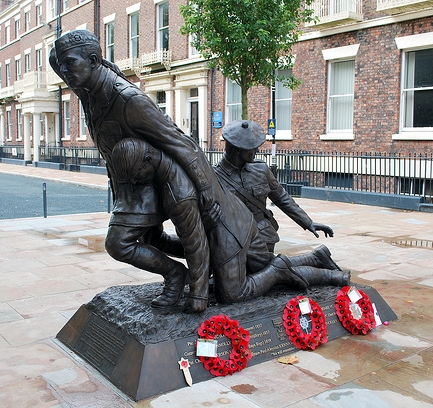
Memorial to Noel Chavasse

Chavasse’s second Victoria Cross was awarded for his actions during the period of the 31st July to 2nd August 1917, at Wieltje in Belgium. On 31st July Chavasse’s unit were trying to recapture Passchendaele Ridge at Ypres, and whilst tending the wounded he was hit in the head but refused to be sent from the line. The weather was terrible and he was under constant heavy fire, but time and again Chavasse went into no man’s land to help the wounded. Early on 2nd August he was resting in his first-aid post when it was hit by a shell. Everyone in the post was killed or wounded; Chavasse himself had at least six injuries but crawled for half a mile to get help for his colleagues. He was taken to a casualty station suffering from a serious stomach wound and died there at 1pm on 4th August 1917, aged 32. The citation for his medal read:

War Office, September, 1917.

His Majesty the KING has been graciously pleased to approve of the award of a Bar to the Victoria Cross to Capt. Noel Godfrey Chavasse, V.C., M.C., late R.A.M.C., attd. L’pool R.

For most conspicuous bravery and devotion to duty when in action.

Though severely wounded early in the action whilst carrying a wounded soldier to the Dressing Station, Capt. Chavasse refused to leave his post, and for two days not only continued to perform his duties, but in addition went out repeatedly under heavy fire to search for and attend to the wounded who were lying out.

During these searches, although practically without food during this period, worn with fatigue and faint with his wound, he assisted to carry in a number of badly wounded men, over heavy and difficult ground.

By his extraordinary energy and inspiring example, he was instrumental in rescuing many wounded who would have otherwise undoubtedly succumbed under the bad weather conditions.

This devoted and gallant officer subsequently died of his wounds.

One soldier who witnessed Chavasse’s actions said “Gee! He did work! I was beginning to think he was not human, because nothing made him flinch or duck…The first wound that he received was in the head, and all he did was to take his tin hat off, put a bandage around his head, and carry on…This he did all day and all night until the next wound he got, in the side, did for him…a VC is too small a reward for such a man”.

The grave of Noel Chavasse

Chavasse is buried at Brandhoek New Military Cemetery, Vlamertinge. His military headstone is unique as it depicts two Victoria Crosses, underneath is an inscription chosen by his father: “Greater love hath no man than this, that a man lay down his life for his friends”. Chavasse’s heroism is still remembered by the people of Liverpool where he came third in a BBC poll in 2003 to find the 100 Greatest Merseysiders, above Bill Shankly, George Harrison and William Gladstone, and behind only Ken Dodd and Lennon and McCartney.

Chavasse has had at least 16 memorials dedicated to him, more than any other VC holder, including one at Liverpool Cathedral. He is the only VC and Bar of World War I and one of only three since the honour was introduced by Queen Victoria in 1857.

In this video athlete Sally Gunnell talks about Noel Chavasse.

The Summer Before The War by Helen Simonson

It is late summer in East Sussex, 1914. Amidst the season’s splendour, fiercely independent Beatrice Nash arrives in the coastal town of Rye to fill a teaching position at the local grammar school. There she is taken under the wing of formidable matriarch Agatha Kent, who, along with her charming nephews, tries her best to welcome Beatrice to a place that remains stubbornly resistant to the idea of female teachers. But just as Beatrice comes alive to the beauty of the Sussex landscape, and the colourful characters that populate Rye, the perfect summer is about to end. For the unimaginable is coming – and soon the limits of progress, and the old ways, will be tested as this small town goes to war.

What a gem of a book! This is the first time I have read anything by Helen Simonson and it reminds me very much of the novels of Jane Austen. Like the best books by Austen The Summer Before The War is filled with a range of characters who are portrayed with a subtle blend of warmth and wit. From the strongly independent heroine to the young men looking for a wife, and from a formidable aunt to the ‘society ladies’ with their fears of scandal it is easy to both laugh and cry with the inhabitants of Rye during that last halcyon summer before the outbreak of war and the loss of innocence, the innocence both of individuals and of a society which was already on the cusp of change.

This novel has a strong plotline which brings to life the evolving world of the early twentieth century, its tight dialogue a good vehicle for the portrayal of social norms, women’s suffrage, divorce, upward mobility, pregnancy outside of marriage, and a hint of forbidden homosexuality. Through her carefully crafted prose Ms Simonson brings to life the small provincial town of Rye in the months before the war, which makes the changes forced upon it and the losses it endures during the conflict all the more poignant. This depiction of Rye is mirrored in the pace of the book which may seem slow and genteel at first, but there is soon an increase of pace as war looms and personal conflicts grow, a pattern which is engrossing and draws the reader in.

The Summer Before The War is a gently satirical novel, full of wry social commentary yet with a depth and sensitivity to the writing which reflects the authors shrewd observation of people and their interactions. The slower pace and genteel setting of the first part cleverly serves to emphasise the darker times brought about by war both on the home front and in the trenches. Ms Simonson has obviously conducted a great deal of research and shows a keen understanding of this period and the impact that war had on individuals, families and communities at that time, communicating this effectively through her delightful cast of characters. She is skilled in creating an absorbing, emotional, and engaging prose that leaves us in no doubt of the heartache caused by the war across the whole social spectrum in Rye from the wealthy to the poorest boy, Snout, who embodies so many young people who lied about their age to seek adventure but found hell instead.

This novel has all the ingredients which make for a good saga – love and loss, prejudice, family conflict, hidden secrets from the past, and a lovely twist in the tail. It may not be a novel for everyone but I found the similarities to Jane Austen’s style strangly compelling, certainly anyone who enjoys Pride and Prejudice or other novels of that style will enjoy reading The Summer Before The War.

You can find out more about Helen Simonson here

The Summer Before The War can be found on Amazon

You can find more of my Recommended Reads here
To war in an ambulance

As part of my background work for the novel I am currently writing I have been researching the Royal Army Medical Corps (RAMC) which has proved to be a fascinating subject. Their Corps Day is 23rd June so it seemed appropriate that my article this month should be about these brave men and women who serve our soldiers in so many different ways.

The Royal Army Medical Corps (affectionately known as the ‘Linseed Lancers’) serve both at home and wherever in the world the British Army is on deployment as they are responsible for ensuring that servicemen and women, and their families, are fit and healthy. Members of the Corps not only provide emergency care on the front line or during humanitarian operations (such as after earthquakes or hurricanes) but are also responsible for providing routine treatment or long term care for soldiers as well as instituting health programmes and preventing disease.

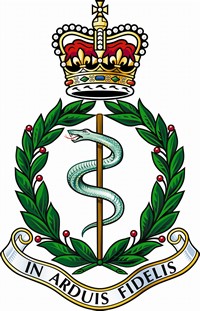
The RAMC is non-combatant and subject to the Geneva Conventions. As such Corps members do not take part in attacks and are only allowed to use their weapons for self-defence. This has led to two traditions which make the RAMC stand out when on parade; firstly, officers do not draw their swords but salute with the right hand whilst holding their scabbard in their left; secondly, other ranks do not carry weapons when on parade. The Corps is also identifiable by its insignia which shows the Rod of Asclepius (a rod with a serpent entwined round it which was carried by Asclepius, the Greek god of healing and medicine), above the rod is a crown, and below it the Regimental motto In Arduis Fidelis (Faithful in Adversity).

The Royal Army Medical Corps was formed by Royal Warrant on 23rd June 1898 (120 years ago today) but the history of army medical services goes back much further than that.

A Standing Regular Army was only formed in Britain after the Restoration of Charles II in 1660, and it was at that time that each infantry and cavalry regiment was assigned a Regimental Surgeon with a Warrant Officer as his Assistant. Although this was a step forward in the treatment of soldiers the Duke of Marlborough wanted to give even better care to his wounded men and so set up ‘Marching Hospitals’ to accompany his armies during the reign of Queen Anne (1702-1714), but it was not until the Peninsular Wars against Napoleon (1808-1814) that the army medical services were organised on a more formal basis.

James McGrigor

During the Napoleonic Wars Sir James McGrigor made changes to the army medical services in an attempt to make them more efficient, he continued that work following the Battle of Waterloo in 1815. Thanks to Sir James a system of casualty evacuation was set up which included the setting up of pre-fabricated huts to treat the wounded, and McGrigor’s system of registering casualties is still the basis of the recording of medical statistics today. McGrigor also set up the Benevolent Fund and the Widows and Orphans Fund to care for soldiers and their families.

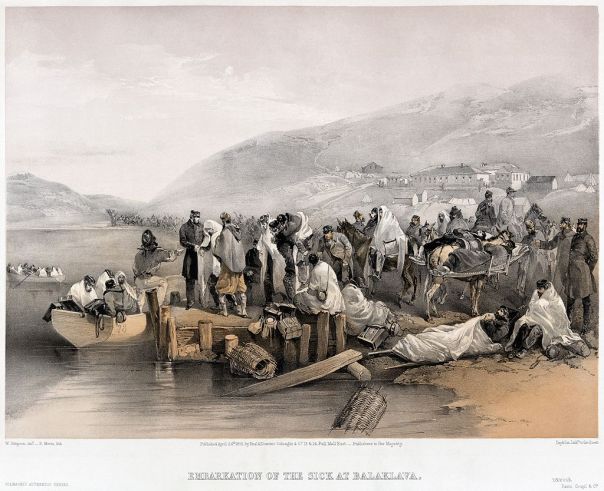
Britain was at peace for almost forty years after the Battle of Waterloo and, unfortunately, during that time many of the lessons of the Napoleonic Wars were forgotten. When the Crimean War began in 1854 civilian departments were given responsibility for medical support and often met to make plans without consulting with anyone from the army. Needless to say, the results were disastrous. At this time a medical officer would be commissioned and wear the uniform of the Regiment he was assigned to but held no rank and so was under the command of his Colonel. The medical officer had no trained staff to help him treat the wounded, just a few men from the Regiment who he would try to give basic first aid training to. The lack of care meant that many soldiers died from wounds and disease who could have recovered under a better system. The telegraph (developed in the 1830’s and 40’s) meant that people back in Britain soon learned of the inadequate care being given to our troops abroad and the scandal caused a national outcry which led to Sir Andrew Smith, (the Director General of the Medical Services) urging the War Office to set up a proper medical corps. The response of the politicians? To create and send to the Crimea an ambulance force made up of 300 old army pensioners. Smith said that they could hardly carry themselves and would not be able to care for the sick and wounded. Smith’s prediction was proved true as the new corps was depleted by deaths from cholera with many of those surviving turning to alcohol. Smith finally saw progress when the Medical Staff Corps was formed in 1855, the instruction was that it should be made up of ‘Men able to read and write, of regular steady habits and good temper and of a kindly disposition’.

A tinted lithograph by William Simpson illustrating conditions of the sick and injured in Balaklava

The Medical Service continued to evolve, and by 1873 doctors who wanted to sign up needed to be qualified, single, and at least 21 years old; they also had to pass exams in physiology, surgery, medicine, zoology, botany, and physical geography including meteorology, as well as reaching a number of other standards including having been present at 12 births and having dissected the whole body at least once. Despite the changes, well qualified army doctors still did not hold military rank which often left them feeling excluded from decision making, they also had to serve longer in India than other members of the British Army (6 years at a time) and received less pay when serving there. Many members of the service felt that their treatment was discriminatory and they needed to have an identity of their own which would give them some kind of parity in service and in the awarding of honours. Finally, the two distinct parts of the Army Medical Services – the Medical Staff Corps (ordinary ranks) and the Medical Staff (officers) – were reorganised into the Roya Army Medical Corps by Royal Warrant on 23rd June 1898; officers were now given executive and administrative powers and the Corps was soon serving in the Sudan, and in South Africa during the Boer War when the Corps lost 743 officers and 6,130 soldiers in other ranks.

Stretcher-bearers of the Indian Ambulance Corps during the Boer War, including the future leader Mohandas Karamchand Gandhi (Middle row, 5th from left).
Alfred Fripp

Many of the soldiers in South Africa were treated by civilian doctors who volunteered their support; their hospitals were much more efficient than those of the RAMC and, at the end of the war, some of those volunteers campaigned for the radical reform of the Corps. Alfred Fripp was key to this as he was friends with the new king, Edward VII, who made sure that the army paid proper attention to Fripp’s ideas. Fripp, and his colleague Cooper Perry, were instrumental in setting up the Hospital and Medical School at Millbank, London; in 1903 both were knighted for their services to the RAMC Committee of Reform. During the Boer War the medical services had treated 22,000 wounded soldiers yet spent far more time and resources on the 74,000 who suffered dysentery or typhoid fever. It became clear that the Corps needed to focus on preventing disease as well as treating the wounded, and by the outbreak of the First World War an anti-typhoid vaccine had been developed which had such an impact that a disease which had killed 8,000 in South Africa had a negligible effect in the trenches of Northern Europe.

Alfred Keogh

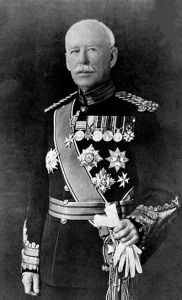
Sir Alfred Keogh (who had worked with Fripp and Perry on the RAMC Committee of Reform) was made Director General of the RAMC from 1904 -1910 and worked hard to ensure that the medical services were seen not as something separate from but as an essential part of the British Army. Keogh was again made Director General of the Corps (1914 -18) and presided over its rapid expansion. At the outbreak of war there were approximately 9,000 members of the ranks, at the end of the war there were around 154,000 as well as 13,000 RAMC Officers in service in all theatres of the war. Thanks to Keogh’s planning a chain of evacuation was set up to move the wounded back down the line through a series of posts, which streamlined and speeded up the care which could be given to wounded soldiers. A patient would typically go through the following posts:


Regimental Aid Post
Collecting Post
Advanced Dressing Station
Main Dressing Station
Casualty Clearing Station (some could take up to 1,000 patients at a time)
Hospital (either in France or England)

Please click here to see a remarkable video showing the work of the RAMC during the First World War. The film is held by the Imperial War Museum.

By the Second World War the RAMC was much more mobile and able to work more effectively on the front line, there were also developments such as the use of penicillin and blood transfusions which helped to improve the survival rate of the wounded. Since the end of the Second World War the RAMC has served with the British Army wherever they have been posted, from Northern Ireland to Cyprus, Korea to Afghanistan, and many more. There are a variety of careers open to anyone wanting to join the RAMC. Officers can serve as doctor, pharmacist, physiotherapist, environmental health officer, medical support officer, or a technical officer (e.g. biomedical scientist, radiographer, clinical physiologist etc.) whist ordinary ranks can serve as combat medical technicians, emergency medical technicians, pharmacy technicians and many more.

RAMC World War I memorial, St Giles Cathedral, Edinburgh

It takes a special kind of courage to be in the middle of a battle and not to focus on the enemy but on the wounded instead; this has been recognised by the awarding of 29 Victoria Crosses to medical personal as well as 2 bars (a bar means that the recipient has been given a second Victoria Cross, and only 3 have ever been awarded). The corps also has one recipient of both the Victoria Cross and the Iron Cross, one officer was awarded the George Cross in the Second World War, and Private Michelle Norris became the first woman to be awarded the Military Cross following her actions in Iraq on 11 June 2006 when she was aged just 19.

Michelle Norris MC

In1856 Queen Victoria laid a Victoria Cross beneath the foundation stone of the Royal Victoria Military Hospital in recognition of the courage of those who have fought and died for their country. When the hospital was demolished in 1966 the VC, which is known as ‘The Netley VC’, was taken to the Army Medical Services Museum in Aldershot where it is now on display.
Those members of the Royal Army Medical Corps who have been awarded the Victoria Cross have truly lived up to the motto of the Corps – ‘Faithful in Adversity’.

Name Award Awarded while serving with Medal held by
Harold Ackroyd VC Royal Army Medical Corps att’d The Royal Berkshire Regiment Lord Ashcroft Collection
William Allen VC Royal Army Medical Corps att’d Royal Field Artillery Army Medical Services Museum
William Babtie VC Royal Army Medical Corps AMS Museum
William Bradshaw VC 90th Regiment (The Cameronians) AMS Museum
Noel Chavasse VC
and Bar
Royal Army Medical Corps att’d The King’s (Liverpool Regiment)
Bar: same
Imperial War Museum
Thomas Crean VC 1st Imperial Light Horse (Natal) AMS Museum
Henry Douglas VC Royal Army Medical Corps AMS Museum
Joseph Farmer VC Army Hospital Corps AMS Museum
John Fox-Russell VC Royal Army Medical Corps att’d The Royal Welch Fusiliers AMS Museum
John Green VC Royal Army Medical Corps att’d The Sherwood Foresters AMS Museum
Thomas Hale VC 7th Regiment (The Royal Fusiliers) AMS Museum
Henry Harden VC Royal Army Medical Corps att’d 45 Royal Marine Commando AMS Museum
Edmund Hartley VC Cape Mounted Riflemen, SA Forces AMS Museum
Anthony Home VC 90th Perthshire Light Infantry AMS Museum
Edgar Inkson VC Royal Army Medical Corps att’d Royal Inniskilling Fusiliers AMS Museum
Joseph Jee VC 78th Regiment (The Seaforth Highlanders) AMS Museum
Ferdinand Le Quesne VC Medical staff Corps Jersey Museum
Owen Lloyd VC Army Medical Department AMS Museum
George Maling VC Royal Army Medical Corps att’d The Rifle Brigade AMS Museum
William Manley VC
Iron Cross
Royal Regiment of Artillery
Awarded Iron Cross 1870
Private Collection
Arthur Martin-Leake VC
and Bar
VC: South African Constabulary
Bar: Royal Army Medical Corps
AMS Museum
Valentine Munbee McMaster VC Royal Army Medical Corps
Winning his VC during the relief of Lucknow, while serving with the 78th Highlanders
James Mouat VC 6th Dragoons (Inniskilling) AMS Museum
William Nickerson VC Royal Army Medical Corps Privately held
Harry Ranken VC Royal Army Medical Corps att’d King’s Royal Rifle Corps AMS Museum
James Reynolds VC Army Medical Department AMS Museum
John Sinton VC Indian Medical Service AMS Museum
William Sylvester VC 23rd Regiment (The Royal Welch Fusiliers) AMS Museum

A Suitable Boy by Vikram Seth

Vikram Seth’s novel is, at its core, a love story: the tale of Lata – and her mother’s – attempts to find her a suitable husband, through love or through exacting maternal appraisal. At the same time, it is the story of India, newly independent and struggling through a time of crisis as a sixth of the world’s population faces its first great general election and the chance to map its own destiny.

The search for ‘A Suitable Boy’ for Lata to marry is the over-arching theme which runs through this novel, yet the book is really so much more than that. Set in an India learning to stand alone after independence this novel is a true saga, bringing together diverse characters from all levels of society whose lives and interactions leave us with a surprising depth of understanding of the historical and political situation at that time. To give insights into the religious conflicts Mr Seth also introduces the reader to two families – one Muslim and one Hindu – who have been friends for many years. Their friendship continues despite the religious rioting and death which accompanied Partition and it is, in fact, an affair of the heart which threatens to shatter the relationship. We are also introduced to a range of characters from different levels of society – politicians, businessmen, landowners, poor workmen, and the untouchables. Anyone who has ever lived in India will recognise the truth of these characterisations and realise that in many ways the years since Partition have been slow to bring change to this ancient structure of Indian society.

In his novel Mr Seth has created a world of closely connected people with believable characters, and many readers will recognise aspects of themselves in the well scripted dialogue and familial descriptions. From the over-anxious mother to the over-bearing politician, the bullying brother to the pushy friend, the man obsessed by love to the woman who prefers her independence, it is easy to become attached to many of these characters as they go about their everyday lives. Alongside this A Suitable Boy weaves a rich tapestry of the complexities of Indian society – the religious festivals which underpin all aspects of life, the family structures, the duties of sons and daughters to their parents, the complex and sometimes corrupt political system, arranged marriages, caste, education – the list is endless and endlessly fascinating.

At it’s heart this is a novel about relationships and the conflicts that arise when we place personal freedom and self-fulfilment against our duty and responsibilities to others. The characters created by Mr Seth are multi-faceted and none of them are completely good or completely bad; they are real people and as such the author does not offer any easy answers to the conflicts which they face, just as there are no easy answers in real life. What comes across clearly is that the decisions which we make, whether at a personal or political level, have consequences for ourselves and others, and sometimes the only thing we can do is to choose the path of least harm as we make our way through life.

As well as the clever characterisation and plotting in A Suitable Boy Mr Seth also uses his considerable skill with words to paint a picture of life in India – the heat and dust, flora and fauna, fashion and food, all are cleverly integrated into the novel in such a way that anyone who knows India will easily recognise the land and its people, and those who are new to that country will come away from the book with clear mental images of what makes India such a fascinating place.

Although I have enjoyed reading it I would give two caveats to my recommendation of A Suitable Boy. Firstly, it is a wonderfully complex novel full of rich and nuanced language, but it is a saga in the true sense of the word (the edition which I read is 1,350 pages long). If you like a story which can be read in a day or two then this book is not for you. Secondly, there are passages of prose telling something of the history of the times immediately after Independence, and also a number of political speeches which do tend to slow the pace at times; it is, however, possible to skim over some of these without any loss to the story. There is also a fair amount of Indian vocabulary for the reader to contend with and a wordlist at the end of the book would probably be useful. Having said that, if you enjoy well written books which cover all aspects of life from birth to death, love, friendship, jealousy, loss, grief etc., and are willing to put in the time, then you will enjoy reading A Suitable Boy.

Please note that there are no spoilers here; if you want to know if Lata and her mother found A Suitable Boy you will have to read the book!

A Suitable Boy can be found on Amazon

You can find out more about Vikram Seth here

You can find more of my Recommended Reads here
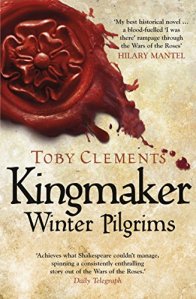
Recommended Read – Kingmaker: Winter Pilgrims: (Book 1) by Toby Clements

An enthralling adventure story, honest and powerful. The Wars of the Roses are imagined here with energy, with ferocity, with hunger to engage the reader.’ Hilary Mantel

February 1460 In the bitter dawn of a winter’s morning, a young man and a woman escape from a priory. In fear of their lives, they are forced to flee across a land ravaged by conflict.

For this is the Wars of the Roses, one of the most savage and bloody civil wars in history, where brother confronts brother, king faces king,

and Thomas and Katherine must fight – just to stay alive …

I was influenced in choosing to read this novel after seeing a glowing review of it by the historical novelist Hilary Mantel and am pleased that I followed my instincts to pick up the book. Many people only know the bare bones of the events surrounding the civil war in England known as the War of the Roses, often finding the interconnections between the royal houses confusing to follow and so giving up on the study. In his Kingmaker series Toby Clements sets out to rectify this lack of knowledge and understanding even though this first novel is not about the members of the powerful and wealthy families and factions at the pinnacle of society but the brutally hard lives of ordinary people. The main characters in Winter Pilgrims are not the key players as one might expect, but a monk and nun who have to flee for their lives; they are quite naïve in their understanding of who the people of power and ambition are, and the reader is able to gradually build up a solid understanding of the politics of the time alongside Thomas and Kit without any need for long passages of historical explanation. Yet Mr Clements has conducted an incredible amount of research into the topic which has enabled him to re-create a time full of historical detail which draws the reader in – the descriptions of a countryside ravaged by war; deserted villages; the cold, hunger and tiredness of an army on the move; the lack of medical knowledge and the primitive treatments given, all work together to give a depth of understanding of life for the ordinary man and woman which is at times harrowing and bloody yet also full of friendship, loyalty and compassion.

Alongside the realistic telling of the lives of ordinary people the author also immerses the reader in the blood and gore of 15th century warfare. The descriptions of training for the archers is very detailed whilst the skirmishes and battles themselves are harrowing. The elements of the cut and thrust of the fighting are incredibly accurate, both in the description of the physical fighting and in the actual historical confrontations – the author holds nothing back in writing about the battle of Towton which brings this novel to a close (and which  is closely based on historical records of the biggest and bloodiest battle to have ever been fought on English soil); it is one of the best descriptions of the chaos, butchery, exhaustion and horror of battle interspersed with moments of calm detachment and observation that I have ever read in a work of historical fiction.

As well as accurate portrayals of what was happening during the War of the Roses Mr Clements also brings to life some of the key historical characters of the time including Edward Earl of March (18 -19 years old in this novel and destined to be the future king Edward VI) and the Earl of Warwick (known to history as ‘the Kingmaker’), as well as many more of the Yorkist leaders (we find out little about the Lancastrian leadership as this novel is told from a Yorkist perspective). These important men appear infrequently in the plotline of this novel which cleverly brings together what life was like for men in all strata of society. The stories of Thomas and Kit are interwoven with the struggles of nobles to hang on to their lands during times of lawlessness and confusion, with some holding fast to their allegiances and responsibilities whilst others frequently change sides whenever it suits them in order to increase their own lands and power.

I must admit that I found some of the plot for Thomas and Kit a little far-fetched at times but no more so than in books by Conn Iggulden or Bernard Cornwell, and it is possible to stretch imagination on occasions to fulfil the key purpose of an historical novelist – the creation of a good story. The fact that the couple have been confined in religious institutions means that they are inexperienced in the wider world and so we are able to discover more about religion at the time as well as the spiritual and philosophical conflicts which are a part of the journey of these characters.

Some readers may find the fact that this novel is written in the present tense difficult at times, but I find that, as the story progresses, it helps to add a sense of immediacy to the actions and emotions of the carefully created cast of characters and as such becomes an integral part of the storytelling. Mr Clements uses all his skills of writing to create a world full of excitement and contradiction, gory battle scenes and strong supportive relationships, and an honest telling of the vagaries of human character. As a novel Winter Pilgrims is well-researched and intelligent entertainment and will be enjoyed by anyone who is a fan of such writers as Conn Iggulden and Bernard Cornwell.

Winter Pilgrims can be found on Amazon

You can find out more about Toby Clements here

You can find more of my Recommended Reads here

Blitzkrieg – the ‘lightning war’

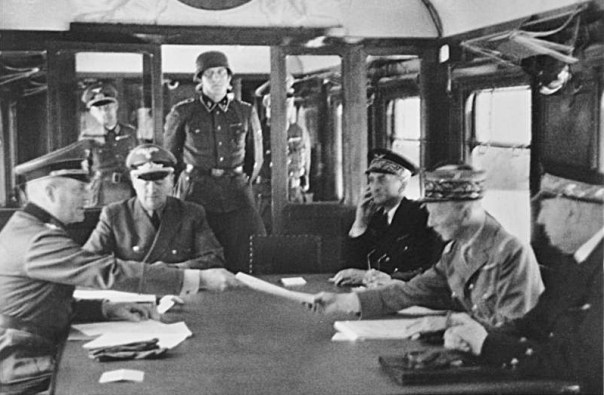
On 10th May 1940 Hitler launched an attack into Belgium and France. What no one could have imagined on that day was that just six weeks later Marshall Pétain would sue for peace, signing an armistice which ceded three-fifths of French territory to the Germans. To add insult to injury, Hitler insisted that the armistice was signed in the same railway carriage in which Germany had been forced to admit defeat at the end of the First World War. So what had gone wrong for the Allies?

Signing the Armistice 1940

World War 1 had been a long-protracted conflict in which the opposing armies were static for the majority of the time, dug-in in extensive trench systems across northern Europe. Between the wars the Allies had assumed that if there were to be another war it would also be trench based and so they had planned accordingly. The French had used their huge defence budget to build a line of super-trenches with fortifications, tunnels, and underground bunkers on the German border (the Maginot Line), whilst the BEF supported French troops on the Belgian border. Therefore, when the British Expeditionary Force arrived in France at the outbreak of the Second World War they were ready for the prospect of a static defensive war. What the Allies were not prepared for, however, was Hitler’s intention to fight a swift, offensive war.

The Maginot Line

At dawn on 10th May 1940 29 German divisions began an invasion of the Netherlands and Belgium; in response the Allied commanders positioned the bulk of their forces defensively inside Belgium, playing into the hands of the enemy. What they were initially unaware of was that this attack was a feint and a further 45 divisions were thrusting forwards through the Ardennes. The French had believed this forested area to be impassable by enemy troops and so had left it woefully undefended. This second German force swiftly breached the Allied right flank, pushing them back towards the English Channel. With the fall of France and the disastrous retreat of the BEF from Dunkirk blame was placed on an innovative German tactic of blitzkrieg in which the enemy used the new technology of tanks and dive-bombers to force a swift victory. In German blitzkrieg means lightning war, a term which seemed apt for surprise attacks which made lightning fast advances into enemy territory, and in which air power supported ground troops to overwhelm the defenders. But blitzkrieg was not, in fact, a completely new idea.

Blitzkrieg – German attack through the Ardennes forest

The key elements of blitzkrieg are speed, surprise and superior firepower, and as such the concept can be traced back to Prussian military tactics in the early 19th century where limited resources meant that the only route to victory for the Prussians was through swift, powerful attack. Carl von Clausewitz, who made a detailed study of generals from Alexander the Great to Frederick II of Prussia, argued in his 1832 book ‘On War’ that all military force should be focussed in a single action against the enemy’s ‘centre of gravity’, its Schwerpunkt. Once this vulnerable point has been identified a frontal attack combined with a double flanking movement should crush the enemy, even if attacking troops had to be withdrawn from other areas and risks taken to achieve this objective.

Carl von Clausewitz

The German Alfred von Schlieffen developed a plan for a swift attack against his country’s old enemy, France, and this plan was put into action at the beginning of the First World War. Developing the ideas of von Clausewitz, Schlieffen’s aim was to achieve a swift victory by using 90% of the German army to move through Belgium and northern France to take Paris in a quick and decisive campaign. The plan was good in principle, but the attacking forces were slowed when they met with unexpected Belgian resistance, and this in turn gave the British time to prepare a defence at Mons. Although the Schlieffen Plan had failed it was believed to have a solid basis and so the idea of a lightning fast attack was used again in the spring offensive of 1918 when German armies reached within 75 miles of Paris before their advance was halted.

Heinz Guderian

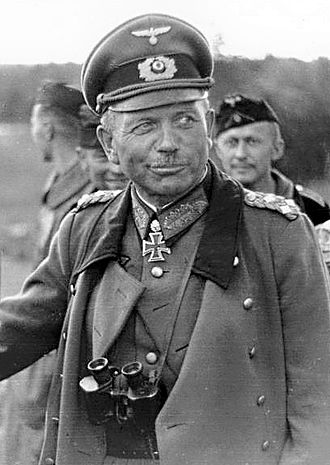
Between the wars the theory of blitzkrieg was further developed by Heinz Guderian who advocated the integration of light tanks and dive-bombers to improve the manoeuvrability of the German army, insisting that every tank should have a radio to give them an added advantage. Hitler had fought in the trenches during World War 1 and wanted to avoid further trench warfare if at all possible, so when he saw Guderian’s plan he was very taken with the idea of victory through speed and movement. The German High Command were derisive of Guderian’s plan, telling Hitler that his claim that he could reach the French coast in a matter of weeks was idle boasting, but Guderian insisted that if they could break through the enemy frontline the panic and confusion caused amongst the civilian population would hamper any defending army’s movements to the front and so make success even more assured. Despite the misgivings of his senior officers Hitler was prepared to take the gamble. Germany tested its modern blitzkrieg tactic with a combination of both air and land action in the Spanish Civil war in 1938 and in Poland in 1939, with promising results.

When Germany pushed into the Ardennes in 1940 stukas were sent in just ahead of the armour to soften up the target and destroy rail links and communication centres. The German tanks, supported by infantry in half-track vehicles, began their advance at the same time with the bombing only stopping at the last minute, leaving the Allies no time to re-group. Once the first objective was taken the attacking army moved on leaving civilian refugees to clog the roads needed by the defending army, and also attacking the fleeing civilians to add to the fear and panic. The use of FM radio communication gave yet another advantage to the attacking army, enabling quick decisions to be made based on reliable evidence rather than waiting for orders from HQ. It was left to units following this initial attack to secure the gains made, thus freeing the panzer units to move on to the next Schwerpunkt.

French refugees, 1940

Blitzkrieg was so successful in the initial phase of the war that Germany went on to use the tactic on the Easter Front against the Russians during Operation Barbarossa, and in the North Africa campaign (Rommel, who commanded the German Afrika Korps, had been involved in the May 1940 attacks which forced the surrender of France). The Allies also adopted the ‘lightning war’ tactic in the Western Desert, on the Eastern Front, and after the D Day landings, relying on firepower to establish breakthroughs by fast-moving armoured units. Germany last used the blitzkrieg tactic during the Battle of the Bulge, yet the Allies continued to push forward and by the end of the war Hitler’s Third Reich was defeated by the very tactic which had brought it such success in 1940.

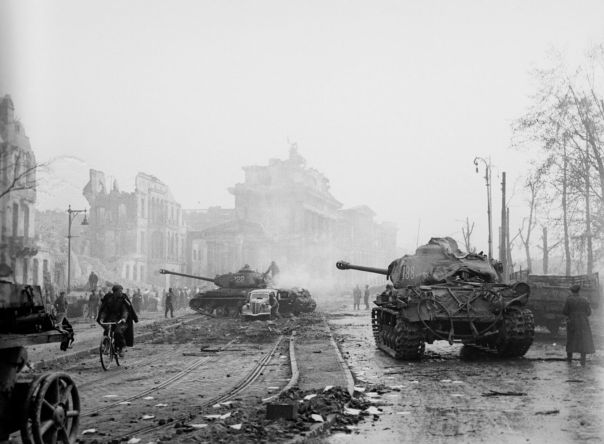
Fall of Berlin

Bibliography:

  • The Roots of Blitzkrieg by James Corum
  • Panzer, a Revolution in Warfare: 1939–1945 by Roger Edwards
  • The Blitzkrieg Legend: The 1940 Campaign in the West by Karl Heinz Frieser
  • To Lose a Battle: France 1940 by Alistair Horne.
  • History of the Second World War by B H Liddell Hart
  • A History of Blitzkrieg by Bryan Perrett

The Windsors at War – Part 3 Edward VIII, the Duke of Windsor

This is my third and final article about the British royal family during the Second World War. My pieces about King George VI and Princess Elizabeth (now Queen Elizabeth II) showed two individuals with a keen sense of duty who, despite their privileged position, tried to understand what it was like for the ordinary British citizen – staying in London during the Blitz, living on the same rations as everyone else, serving in the ATS etc. – but for the Duke of Windsor, formerly King Edward VIII, the role he played before and during the conflict is a more controversial issue altogether.

Edward VIII as a boy cadet

Prince Edward had trained in the Royal Navy from the age of 13, but at the outbreak of the First World War he was commissioned and served as a staff officer in the Grenadier Guards. After the war he toured many parts of the British Empire and took an interest in national affairs; his support for the unemployed made him incredibly popular with the working classes. But as the years progressed Edward appeared to develop a dislike for the official world he was forced to live in and began to cultivate friends from ‘high society’ rather than the aristocracy. 1930 proved to be a pivotal year for the future king as that is when he met and fell in love with Wallis Simpson, a married American. When George V died in 1936 and Edward became king his affair with Simpson was the subject of much speculation in the foreign press, but pressure was put on British newspapers to keep it quiet as Edward VIII was Head of the Church of England and, as such, would not be able to marry a divorcee. Under pressure to choose between the throne or the woman he loved Edward chose Wallis and abdicated saying ‘I have found it impossible to carry the heavy burden of responsibility and to discharge my duties as King as I would wish to do without the help and support of the woman I love.’ After his abdication Edward moved to France and the couple were married when Wallis was finally divorced in 1937. The new king, George VI, created his brother Duke of Windsor but refused to allow the new Duchess the rank of ‘Royal Highness’, something which the Duke and his new wife both resented. There were also conflicts within the royal family as to the financial worth of Edward who had hidden some of his wealth from his brother when the abdication settlement was worked out, relations were therefore frosty between the former king and his family. And so the scene was set for the role that Edward and Wallis would play during the war.

(You can listen to the Abdication Speech here)

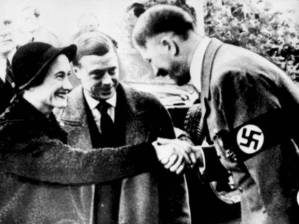
During 1937 and 1938 the Duke and Duchess lived in France although they spent a lot of time traveling around Europe, including a visit to Germany where they met with Hitler, a visit which was well publicised in the German media. The Duchess, who always felt slighted by the British royal family and government, was treated like royalty during the visit with German aristocrats bowing and curtsying to her; Edward was inordinately pleased that the Germans treated her with the status and dignity which he felt she was due as his wife and yet was withheld from her by his own people.

According to Albert Speer Hitler believed that Edward was friendly towards Germany so the fact that he was no longer king had a negative effect on the Fuhrer’s plans for Europe, as Hitler is reported to have said – ‘I am certain through him permanent friendly relations could have been achieved. If he had stayed, everything would have been different. His abdication was a severe loss for us.’ The Windsor’s visit to Germany went against the advice of the British government who felt that their opposition was vindicated when the Duke was seen to give a full Nazi salute on a number of occasions whilst in Germany.

The Duke and Duchess of Windsor visit Hitler

Some historians have defended Edward’s links with Hitler by saying that he saw fascist Germany as a barrier between western democracy and communism and that having seen the horrors of the battlefields of the Great War he was willing to appease Hitler to prevent such wholesale slaughter happening again. In May 1939 Edward gave a radio broadcast for NBC in which he appealed for peace. The recording took place on the First World War battlefields of Verdun where he said ‘I am deeply conscious of the presence of the great company of the dead, and I am convinced that could they make their voices heard they would be with me in what I am about to say. I speak simply as a soldier of the Last War whose most earnest prayer it is that such cruel and destructive madness shall never again overtake mankind. There is no land whose people want war.’ The speech was broadcast around the world but although many British newspapers published the transcript in full the BBC refused to air it as it seemed to be supporting appeasement.

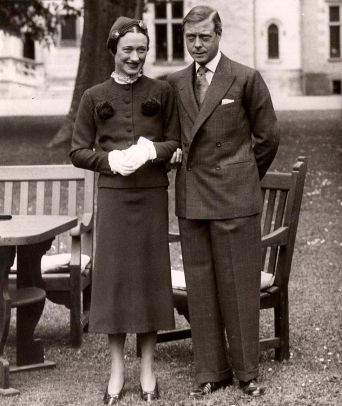
The Duke and Duchess of Windsor

It is difficult to assess just how much the Duke supported fascism and Nazi Germany although many believe that his words in 1940 were quite revealing when he said that ‘In the past 10 years Germany has totally reorganized the order of its society… Countries which were unwilling to accept such a reorganization of society and its concomitant sacrifices should direct their policies accordingly.’

When war broke out Edward hoped to be reconciled with his brother but George VI was still angry that his brother had abdicated. Rather than being given a royal role to play Edward was given a position as liaison with the French. Years later, in February 1949 Count von Zech-Burkersoda, who was the German Minister in the Hague at the outbreak of the war, said that the Duke had passed the Allied plans for the defence of Belgium to Germany which had helped the swift invasion of France and, consequently, led to the disaster at Dunkirk. After the fall of France the Windsors travelled to Madrid where the Duke appears to have been introduced to a plan for the Nazis to put him back on the throne with Wallis at his side, a not very subtle plan to use the former king against the established government in Britain. Edward travelled from Madrid to Lisbon where he is said to have received a number of telegrams with details of the plan to reinstate him on the throne in return for his support for Hitler. Copies of the telegrams (which were found in Germany at the end of the war) say that Edward had initially believed that he could never be king again after abdicating but that when he was told that it was possible that the British constitution could change after a Nazi victory ‘the Duchess in particular became very thoughtful.’ One telegram even suggested that the ‘Germans expect assistance from the Duke and Duchess of Windsor, the latter desiring at any price to become queen.’

The British were not aware of the telegrams at the time, but Edward’s reluctance to return to England forced Winston Churchill to threaten to court martial him if he did not immediately travel to London; then the Prime Minister offered him the position of Governor of the Bahamas as there were ‘fears for his safety’. The Windsors travelled to the Caribbean in 1940 and remained in post until the end of the war. In December 1940 the Duke gave an interview to Liberty magazine in which he was reported to have said that ‘Hitler was the right and logical leader of the German people,’ he went on to say that the time was coming for the American President to mediate a peace agreement between Germany and Britain. The former king said that he had been misquoted and misrepresented in the article, but the Allies were sufficiently worried that President Roosevelt ordered the Duke and Duchess to be placed under surveillance when they visited Florida in 1941. The Allies concerns were further enhanced when they received information (which may or may not have been true) that Wallis had slept with Ribbentrop (the German Ambassador) in 1936, was still in contact with him and passed secrets to him.

Governor of the Bahamas

After the war ended the Windsors returned to France to live, and the Duke never held another professional position after his Governorship of the Bahamas.

Just after the war ended the Americans found 400 tons of German diplomatic papers near Marburg Castle; included in the haul were around 60 letters, telegrams and other papers about the Duke of Windsor and his links to the Nazis. Amongst the documents were details of ‘Operation Willi’ which was the codename for the plan to conquer Britain, overthrow George VI and put Edward back on the throne. It appears that there was a concerted effort to manipulate Edward into helping the Nazi plan, including telling him that his brother, the king, planned to have him assassinated. Copies of the documents were sent to America, and Churchill appealed to the Americans and French to refrain from publication for at least 10 to 20 years, saying that the documents were ‘tendentious and unreliable’ and likely to leave the misleading impression that the Duke ‘was in close touch with German agents and was listening to suggestions that were disloyal.’ Eisenhower replied, saying that the telegrams were “obviously concocted with some idea of promoting German propaganda and weakening western resistance” and were “totally unfair” to the Duke. The telegrams were suppressed but not for as long as Churchill had hoped. They were eventually published in 1957. Included in the documents were statements attributed to the Duke saying that he was convinced that war could have been avoided if he had not abdicated as he was a firm supporter of compromise with Germany. Another telegram said that the ‘Duke believes with certainty that continued heavy bombing will make England ready for peace’ (some historians believe that his comment could have been the reason that Hitler shifted the focus of Luftwaffe actions in 1940 from the Battle of Britain to bombing cities). American naval intelligence also published a report from a German conference held in 1941 that said that the Duke was ‘no enemy to Germany’ and the only English representative with whom Hitler was willing to negotiate peace terms, saying that Edward was ‘the logical director of England’s destiny after the war.’ When he found out about them the Duke of Windsor said that the telegrams and documents were ‘complete fabrications…and gross distortions of truth’. Edward admitted in his memoirs that he admired the Germans but had never been pro-Nazi and that Hitler struck him as a ‘somewhat ridiculous figure, with his theatrical posturing and his bombastic pretensions.’

Marburg Castle

Some historians don’t believe that the Duke of Windsor knew about the plan to put him on the throne and that his contacts with Germany were more about working for peace and finding a place for himself and Wallis in government circles after his abdication, as well as making the Duchess feel important and a part of state affairs (something which the royal family never did). On the other hand Andrew Morton, the royal biographer, suggests that Edward was a Nazi sympathiser saying that he ‘was certainly sympathetic…even after the war he thought Hitler was a good fellow and that he’d done a good job in Germany, and he was also anti-Semitic, before, during and after the war’.

The Duke of Windsor’s attitude to Germany and conduct during the war is in stark contrast to that of his brother, King George VI, and his niece, Princess Elizabeth. There will always be controversy about just how much of a Nazi sympathiser he was and how deep his admiration and support for Hitler went but, if the historical documents are to be believed, then many people feel that he should never have been allowed to return to live in France after the war ended and that he certainly should not have received any further funds from Britain. True, he was socially ostracized and had very little contact with his family for the rest of his life, but many people felt that was far too lenient and he should have been tried for treason.

Whatever your view of the monarchy one could argue that the Windsors were a fair reflection of British society during the Second World War, from an appeaser and probable Nazi sympathiser to a prince who died for the Allied cause (Prince George), a princess who enrolled in the armed forces, and a king and queen who worked tirelessly to build morale and support the British people in their hour of need.

(The Marburg files appeared in a recent episode of The Crown, you can find out more about how the files were discovered here )

Bibliography:

Block, Michael. The Secret File of the Duke of Windsor. L

Donaldson, Frances Lonsdale. Edward VIII.

Roberts, Andrew, and Antonia Fraser. The House of Windsor. A Royal history of England.

Windsor, Edward, (Duke of). A King’s Story The Memoirs of H.R.H. the Duke of Windsor K.G.

Ziegler, Philip. King Edward VIII The Official Biography.