Tag Archives: World War 2

How a symbol of good fortune came to symbolize hate…

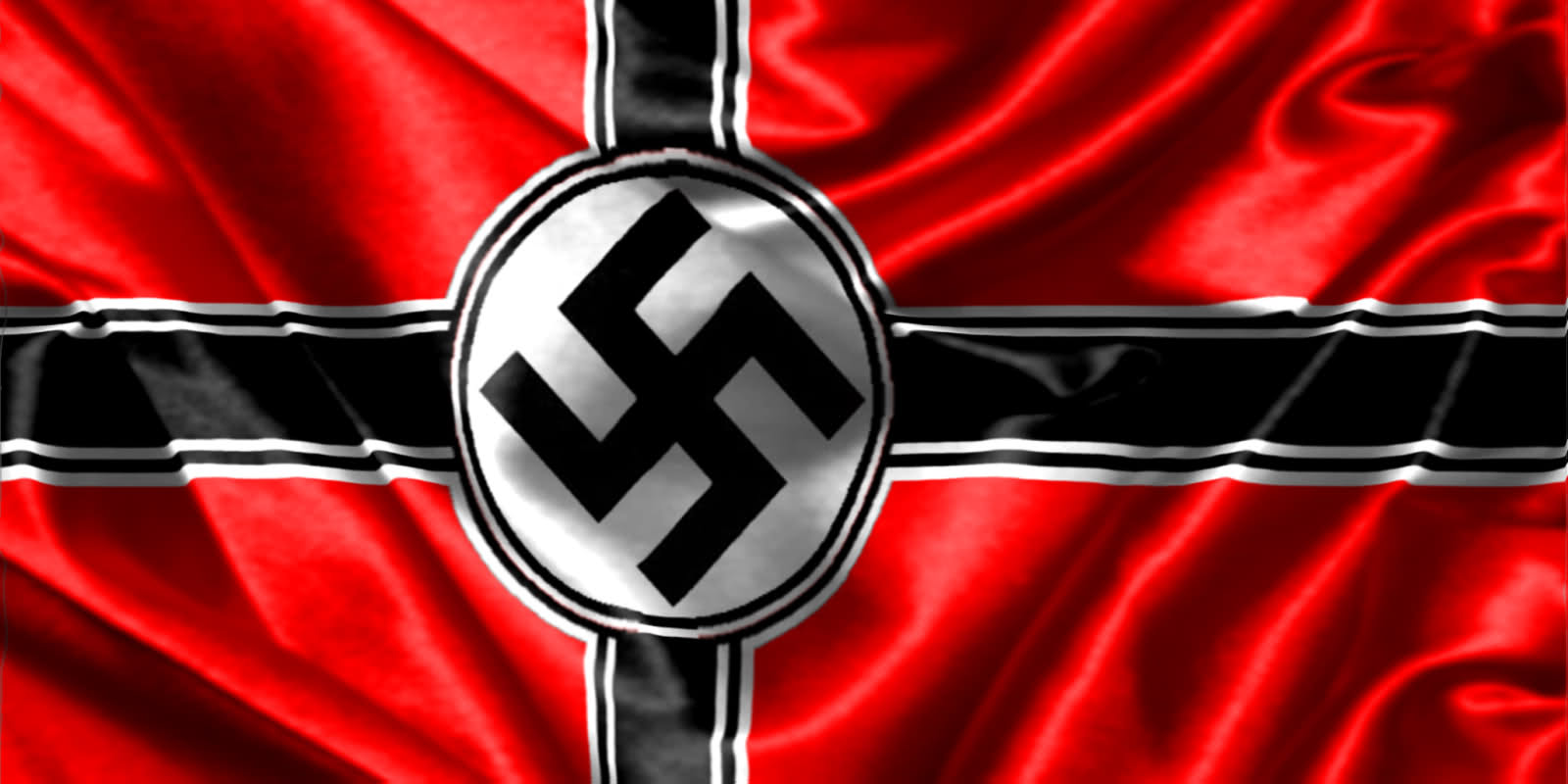
There is no symbol in history which has such diametrically opposed meanings as the swastika. Many people know it only as a symbol of Nazi Germany, but its origins lie much further back in history – it has been used for millennia, and is older even than the well known ancient Egyptian symbol of the ankh. The symbol’s history can be traced back to the early Indus Valley Civilization some 5,000 years ago, the word swastika itself comes from the Sanskrit ‘svastika’ meaning ‘good fortune’.
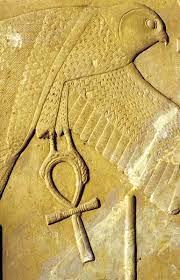
Ankh

No one knows the true origins of this cross with its arms at right angles (sometimes with a dot in each of the four quadrants), but many historians believe it represents the movement of the sun across the sky.
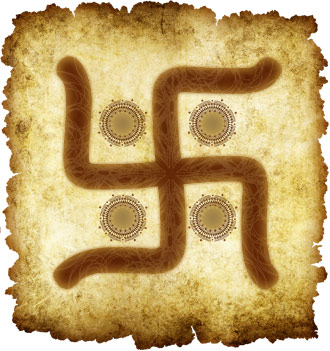
The swastika was also used in many other cultures beside that which emerged in the Indus Valley. It appears frequently on coins from ancient Mesopotamia, and was known in pre-Christian European cultures where archaeologists have found the symbol on a number of artifacts.
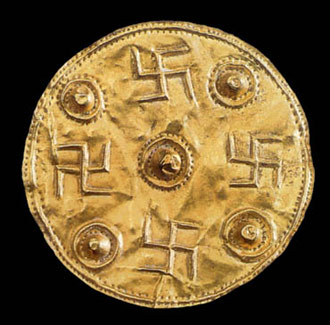
Later in history, the swastika was called the ‘gammadion’ in Byzantine and early Christian art; in Scandinavia it was the symbol of Thor’s hammer.

Thor’s hammer

By the Middle Ages, although it was not frequently used, the swastika was well known throughout the world. In England it was called the ‘fylfot’, in Germany the ‘hakenkreuz’, the Greeks called it ‘tetraskelion’, the Chinese named it ‘wan’; it also appears in artifacts from the Mayan peoples in Central and South America, and was used by native American peoples, particularly the Navajo.

Navajo use of the swastika

For 5,000 years the swastika symbolized power, the sun, life, good luck and strength; even as late as the early 20th century it was used throughout the world as a decoration on buildings, coins, and even cigarette cases; during its early days the Finnish Air Force used the symbol, and the US 45th Infantry Division wore a swastika on their shoulder patches during the First World War.
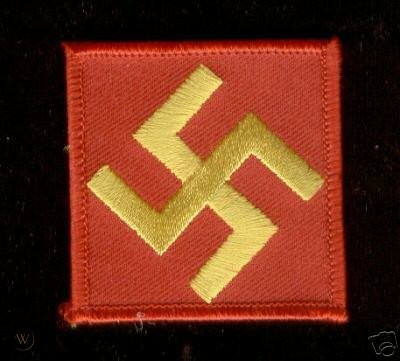
US 45th Infantry Division shoulder patch

So, what happened to change of meaning of such an ancient and benign symbol?

Europeans in the 19th century were fascinated by the ancient civilizations of India and the Near East. One of the great archaeologists of the time was Heinrich Schliemann, who spent years searching for the historical site of the city of Troy; when he found it he also found ancient carvings of the swastika. Historians were surprised to find the symbol was very similar to others which had been found on German pottery and began to speculate that there was once a vast Aryan culture which spanned Europe and Asia. It was not long, however, before nationalists began to claim that Aryanism was not about a common culture but that the Aryans were a superior race, and that Germans were their descendants. After German unification in 1841 German nationalists began to see themselves as the descendants of this ancient master race – the Aryans – and adopted the swastika as their symbol. By the early 20th century the majority of nationalistic societies in Germany were using it, so when Hitler decided that his fledgling Nazi Party needed a symbol of its own he adopted the swastika, and it became the official emblem of the party in the form we now know in 1920 – a red flag with a white circle, and the black swastika in its centre. Hitler described his new flag in his book ‘Mein Kampf’ as “In red we see the social idea of the movement, in white the nationalistic idea, in the swastika the mission of the struggle for the victory of the Aryan man, and, by the same token, the victory of the idea of creative work, which as such always has been and always will be anti-Semitic.” Hitler’s words were the first time that this ancient symbol of good luck was linked with anti-Semitism and death. In September 1935 Hitler went one step further and made the swastika the national flag of Germany. It was a powerful symbol utilizing the colours of Imperial Germany with an identification as ‘the master race’ intended to instill pride in the German people, and fear into Jews and other enemies of Nazi Germany.

At a rally, members of the Hitler Youth parade in the formation of a swastika to honor the Unknown Soldier. Germany, August 27, 1933.

At the same time that the swastika became Germany’s national flag the German government passed the Nuremberg Race Laws, including the Law for the Protection of German Blood and German Honour, which further discriminated against Jews. Part of the reason for the enacting of these laws was the way in which the Nazi party, and the swastika, were being seen abroad. On 26th July 1935 the SS Bremen, a German passenger liner which was docked in New York, was the focus of a protest against increasing anti-Semitic incidents in Berlin, and the swastika was taken from the ship and thrown into the river. Although the police arrested a number of the demonstrators Germany issued a formal protest to the Americans, and when the courts freed the majority of the defendants Hitler passed the Reich Flag Law. In these laws, sexual relations and marriage were forbidden between Germans ‘or those of kindred blood’ and Jews, and Jews were banned from using the new national flag or even displaying the nation colours.

The use of the swastika as the national flag of Germany ended in May 1945 with the nation’s surrender at the end of the war. The Allied governments, who controlled the defeated nation, banned all Nazi organisations and their symbols – to use the swastika became a criminal act. Today the public display of Nazi symbols, including the swastika, is banned in Germany and many other European countries. It is not, however, against the law to display Nazi symbols and propaganda in the United States which has a strong tradition protecting the freedom of speech. In neo-Nazi groups throughout the world the swastika is still the most popular symbol.

National Socialist Movement USA (from Southern Poverty Law Centre website)

So, what does the swastika mean to people today? If you are Buddhist or Hindu you will still use it as a religious symbol of good luck, but the majority of the world is unaware of this and only see it as a symbol of hate. How can one differentiate between the two? Well, if you look closely you will see that the arms of the cross in the Nazi symbol radiate clockwise, whilst the symbol of eastern religions usually radiates anti-clockwise, although both are known in Hinduism – the left-hand/anti-clockwise is more technically known as the sauvastika and has always meant the opposite to the swastika – the right-handed standing for the good whilst the left-handed symbolises night, magical practices and Kali, the terrifying Hindu goddess; it is probably not surprising that Hitler chose the sauvastika version to represent the Nazi party.

Buddha with swastika

The right-hand/clock-wise symbol is the one you will see whilst travelling in the Far East. It must be a great sadness to Hindus to hear people calling the swastika a symbol of hate when, for them, it is the most widely used auspicious symbol in their religion, as it also is for Jains and Buddhists. For Jains it is the emblem of their Seventh Saint, as well as the four arms of the swastika symbolizing the four possibilities for re-birth, depending on how you live this life – birth in the animal or plant world, on Earth, in hell, or in the world of spirits. For Buddhists, the swastika symbolizes the footprints or feet of the Buddha; it is often found at the beginning and end of religious inscriptions, and it was via Buddhism that the swastika found its way to Japan and China where it symbolizes long life and prosperity.

Ganesh with swastika on palm

If you travel in India you will see the swastika, which is one of the 108 symbols of Vishnu, wherever you look – they are used on the opening pages of account books, during marriage services, on cars and lorries, on the walls of temples houses and other buildings, and even on clothing. In many pictures and statues gods and goddesses are shown with a swastika on the palm of the hand, and it is considered to be a very auspicious sign if a person has the shape of a swastika in the lines of their palm, the swastika might be worn as jewellery. It is even used as a girl’s name.

So, whenever you see a swastika take a moment to look closely at it and its context. Is it being used as a sign of hate? Or as an ancient symbol of good fortune?

Recommended Read – The Slaves Of Solitude by Patrick Hamilton

Measuring out the wartime days in a small town on the Thames, Miss Roach is not unattractive but no longer quite young. The Rosamund Tea Rooms boarding house, where she lives with half a dozen others, is as grey and lonely as its residents. For Miss Roach, ‘slave of her task-master, solitude’, a shaft of not altogether welcome light is suddenly beamed upon her, with the appearance of a charismatic and emotional American Lieutenant. With him comes change – tipping the precariously balanced society of the house and presenting Miss Roach herself with a dilemma.

Published just after the war (1947) The Slaves Of Solitude is set in 1943 and is a book about war from which war is remarkably absent. Set in the fictional town of Thames Lockdon (based on Henley-on-Thames) the novel reflects a provincial tranquillity where everything is touched by the conflict – from blackouts to food shortages, lack of small comforts to the arrival of the ubiquitous GI’s. Patrick Hamilton beautifully captures the narrow world and pettiness of middle England during the Second World War, portraying ordinary lives lived in extraordinary circumstance.

The central character of this novel, Miss Roach, left London after being bombed-out, and now resides at the Rosamund Tea Rooms with an eclectic mix of characters. In her mid-thirties, her prim timidity makes her the butt of the bullying Mr Thwaites, and she spends much of her time re-playing her conversations with him (and others) in her head. That is something which we all do, and Miss Roach finds herself with the same dilemma – does this re-playing of conversation clear up what was said or cloud matters even further! As the novel progresses, life brightens for Miss Roach (who hates to be referred to by her Christian name) when she meets a charming though somewhat enigmatic American soldier, and also befriends a German émigré – a woman not too far from her own age.

Building on the relationship between these three people and Mr Thwaites the story unfolds with gentle humour, quiet action and circuitous conversations. On the periphery of these interactions, we find Mr Prest who is seen as an oddity and ignored be his fellow residents at the Rosamund Tea Rooms, yet he pursues a secret life in London. As the book reaches its conclusion it is Mr Prest who is the instigator of Miss Roach’s ‘purification’.

The Slaves Of Solitude is a brilliantly written tragicomedy carefully detailed to evoke a specific time and place in which Miss Roach’s silent observations of her fellow guests tellingly reveal that this could be any time and any place. The characters are superbly drawn and the author has used his masterful knowledge of language to bring them to life with all their foibles; he handles the full range of human emotions with a light and deft touch which cannot but resonate with the reader.

For a gentle and humorous read you would find it hard to better The Slaves Of Solitude.

The Slaves Of Solitude can be found on Amazon

You can find out more about Patrick Hamilton here

Fish Oil and Dynamite – the story of Operation Claymore

Lofoten. Photo by Pascal Debrunner

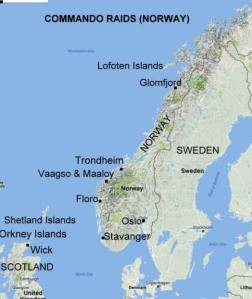
Norway’s spectacular Lofoten Islands, which lie 100 miles within the Arctic Circle, resemble the Scottish Outer Hebrides in their rugged beauty. Yet, despite their peaceful appearance, these islands with their small ports and fish oil processing facilities were the scene of a dramatic Allied commando raid during the Second World War.

Norway had declared herself neutral at the outbreak of war in 1939, but the country’s strategic position meant that both Britain and Germany had an interest in what was happening there. In particular, the port of Narvik was important to the Germans as it allowed passage through the North Sea for the iron ore which the Nazis obtained from Sweden thus avoiding the Baltic Sea, parts of which regularly froze during the winter months. Almost as important for the Germans as this sea route, if not more so, was the fish oil which was produced in huge quantities in Norway. Why fish oil, you ask? Well, surprisingly, it was used to produce glycerin, which was then used to make nitroglycerin – a major component of dynamite.
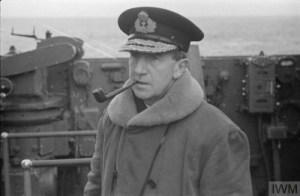
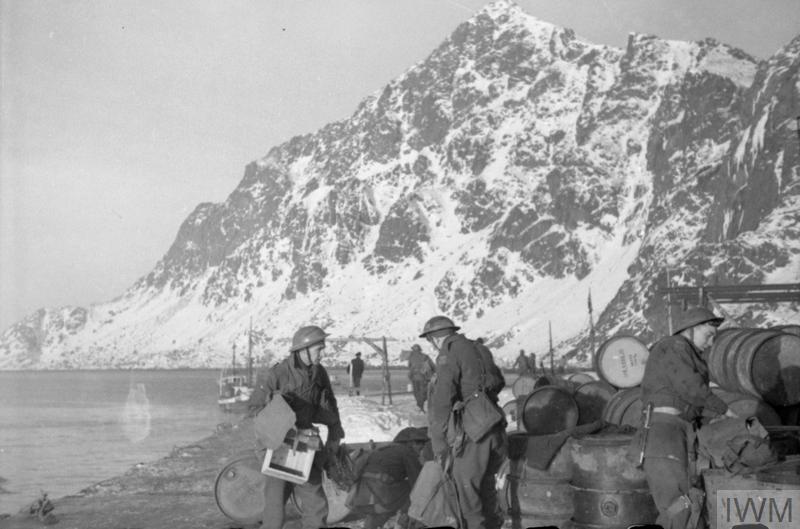
Rear Admiral L H K Hamilton, DSO in command of the naval operations. © IWM (A 6822)

At the outbreak of war in 1939 Britain planned to mine Norwegian waters in an attempt to force retaliation from Germany, which would subsequently allow Britain to move in to protect Norway’s neutrality. Hitler initially wanted to focus his advances westwards and did not want to be seen as the aggressor in the Nordic sphere and so he also wanted to appear to be protecting Norway’s neutrality rather than invading the country. Britain’s actions by mining Norwegian waters gave him the perfect excuse to move northwards. Although Britain had planned for and expected Germany’s advance into Norway, the action came sooner than expected, leaving the Allies wrong-footed. They were able to hold the Germans out of Narvik for a few weeks but eventually had to send troops back to mainland Europe as the situation there became desperate with the British forces pinned down at Dunkirk. And so the German take-over of Norway began. In just two months the country capitulated, and King Haakon VII went to Britain with a large number of Norwegian troops to form the Free Norwegian Overseas Forces. Churchill was unhappy with the situation in Norway and planned that his first major offensive there should take place as soon as practically possible. And so began the planning for Operation Claymore.

The pom-poms of one of HM Ships silhouetted against the snow covered mountains as she lies in Kirke Fjord. © IWM (A 6799)

Operation Claymore was to take place at the beginning of 1941 with a force of 500 commandos and 52 Norwegian troops sailing to Norway with three main aims:

  • To attack the Lofoten Islands and destroy any shipping there which was engaged in the German war effort, regardless of whether the ships were German or Norwegian.
  • To attack the ports of Stamsund, Svolvar, Henningsvaer and Brettesnes to destroy as much of the fish oil industry as possible.
  • To take German prisoners, capture members of the Quisling regime, and take back to Britain any Norwegians who wished to join the Free Norwegian Force.

© IWM N 418

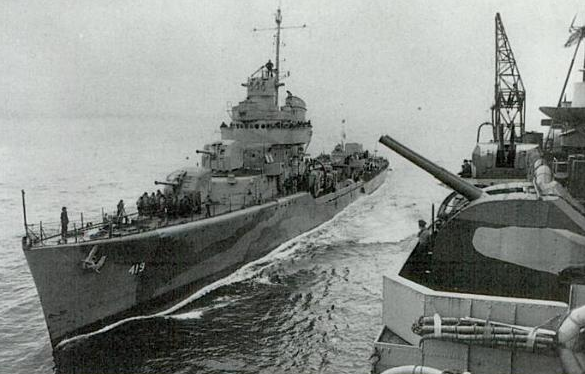
The attacking force, consisting of 2 landing ships and 5 destroyers, sailed from Scapa Flow in 1st March 1941. The North Sea crossing was rough, with heavy seas and high winds for the entirety of the three day crossing; then, to make matters worse, the flotilla was spotted by a German reconnaissance plane. For some reason the Germans did not pursue this sighting leaving the commando force to arrive at their destination on 4th March unmolested. Not only that but, to the surprise of the attacking force, the harbour lights were lit and the German occupiers seemed to have no idea that an Allied attack could take place.

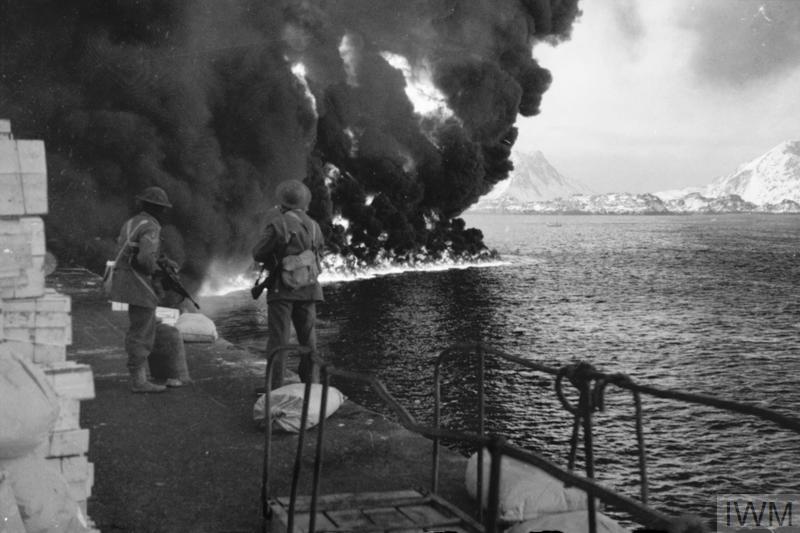
RAID ON THE LOFOTEN ISLANDS, 4 MARCH 1941 (N 397) Fires burning in Stamsund as British commandos leave. © IWM.

The landings began at 06:45 and, having met no opposition, were over by 06:50! The cold was so intense that the sea-spray froze on the uniforms of the attackers as their landing craft grounded on thick ice. The surprise was total, with the only German shots being fired from the Krebs, an armed trawler, which was subsequently sunk. The attacking commandos ran towards their objectives through the early risers of the local population who said and did nothing, the surprise being so total that they thought they were witnessing a German training drill! When the Allies came into contact with their first Germans the enemy immediately laid down their weapons and surrendered.

© IWM N 419

Prisoners were taken and explosives set. Soon the air was thick with the smoke from burning fish oil and there was the sound of explosions as the ships in all four harbours were sunk. In the meantime, the local population served ersatz coffee to members of the attacking force. 60 collaborators were identified and held with the 225 German prisoners. The success of the mission was so overwhelming that the commandos even had time to send a telegraph from the office in Stamsund to Hitler reading ‘You said in your last speech German troops would meet the British wherever they landed. Where are your troops?’

Allied troops were on the Lofotens islands for less than six hours, but in that time they destroyed the Lofotens Cod Boiling Plant and ten other factories; in all around 800,000 gallons of fish oil paraffin were destroyed along with 9 ships. By 13:00 hours the raid was over, all of the landing force along with the German prisoners and Norwegian collaborators had embarked; and with them were 314 volunteers, includindg 8 women, who would travel to Britaina to join the Free Norwegian  Forces. The British also repatriated the English manager of Allen & Hanbury chemists who had been trapped on the islands at the outbreak of the war. And the cost to the commandos? One officer accidentally shot himself in the leg!

© IWM N 399

Not only was the destruction of ships and fish oil a great success, but there was an even more important outcome to the raid when it was discovered that the armed trawler, Krebs, had an Enigma cypher machine! Although the machine itself was lost to the Allies when it was thrown overboard they did manage to recover a set of rotor wheels for it, along with a number of code books.

Back in England Churchill saw the raid as a complete success, not only because of the destruction of the shipping and oil, the capture of Enigma parts (which were used at Bletchley Park for months and led to Allied shipping being able to avoid Hitler’s Atlantic Wolf Packs), and the number of prisoners for no Allied losses, but also because Hitler was now aware that the Allies would always be a threat to Norway and so many German troops were tied down there rather than being used in other theaters of the war.

Yet, perhaps above all, Operation Claymore gave a much-needed boost to the morale of Britain at a time when victories were few. It gave renewed hope, to both British and Norwegian, that the Germans were not invincible and that future victory against the Nazi regime was possible.

© IWM N 396

‘Operation Fish’ – the gold that crossed the Atlantic to keep it safe from Hitler

“Hope you won’t mind our dropping in unexpectedly like this, but we’ve brought along quite a large shipment of fish.” This was the strange comment from British banker, Alexander Craig, when he arrived at Bonaventure Station in Montreal on 2nd July 1940, yet the ‘cargo of fish’ he had brought for his Canadian counterparts contained no fish at all. The train standing at the platform was actually carrying 2,229 bullion boxes, each containing 4 bars of gold with a total value of £30 million. As well as the gold there were 500 boxes of marketable securities worth in excess of £200 million. This was a massive amount of money, yet it was only the start of Operation Fish, a wartime mission so secret that few people know of it even today.

Canada set up a Central Banking System in 1935, and within a year Britain was purchasing and holding ‘earmarked gold’ there (that is gold bought in Canada and kept there for safety or trading). By the end of 1936 the British government, with one eye on early signs of aggression from Germany, was holding 3,304 gold bars in Canada, each with a value of $US 14,000. With the prospect of war continuing to grow, Britain approached the Bank of Canada in early 1939 with a request that it would receive and hold gold reserves sent from Britain to keep them safe and to make it easier for Britain to pay America for arms and munitions if war broke out. At this point there was talk of a Lend-Lease agreement but it was still in the early stages and the Americans were demanding cash payment from Britain for all deliveries of ships, planes, tanks and munitions.

King George VI and Queen Elizabeth arrive in Vancouver, 1939

The first shipment of £30 million of gold bullion from Britain was sent ‘under cover’ with King George VI and Queen Elizabeth when they made an official visit to Canada in the spring of 1939. The project was so secret that no records of the arrival of the gold in Halifax were kept, instead the cargo was unloaded at a quiet out of the way pier where 100 armed mounted police waited to transfer the gold to trains for shipping to Ottawa. Once war broke out in September of that year shipments began in earnest.

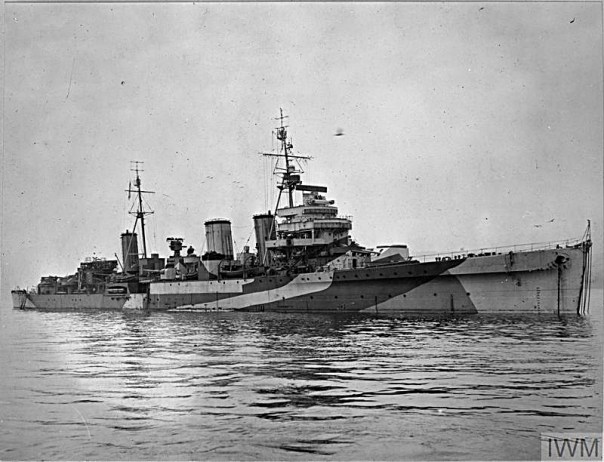
HMS Enterprise, one o f the ships used to transport Britain’s gold © IWM FL 5389

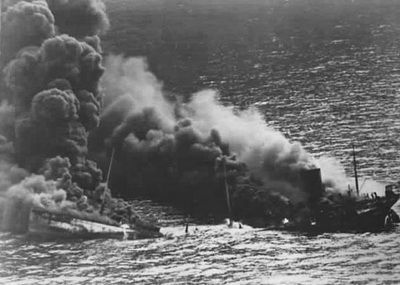
In early 1940 the British Government used its Emergency Powers Act to force civilians to register their paper securities; these were later confiscated by the Government and sent to Canada to be used in the war effort. The decision to send Britain’s wealth to the New World was not an easy one to make as the ships carrying it would be at the mercy of Hitler’s U-Boats which were then wreaking havoc in the Atlantic. Yet with the prospect of an imminant invasion of the British Isles Churchill believed he had no choice, if Britain was overrun the Government would need a base oversees from where it could direct the Empire in it’s continuing fight against Nazism. Transferring the gold was such a great risk, however, that the British War Cabinet did not inform the War Risk Insurance Office of the shipments knowing that if even just one of the ships was lost the value could never be compensated. In the month of May 1940 alone, over 100 ships were sunk whilst making the Atlantic crossing – that was more than 40% of all transatlantic travel – yet, miraculously, not a single gold transport was lost during the entire war.

Guarding the gold

When the shipments arrived in Halifax the boxes were put on sealed trains guarded by the RCMP. They travelled first to Montreal where the paper securities were unloaded and sent to the Sun Life Building to be stored in an underground vault three stories below ground level, Royal Canadian Mounted Police officers kept a 24 hour guard. The vault beneath the Sun Life Building had to be constructed in a hurry, so a rumour that the British Crown Jewels were being held there was deliberately spread as a cover for the increased activity and security.

Sun LIfe Building c.1935

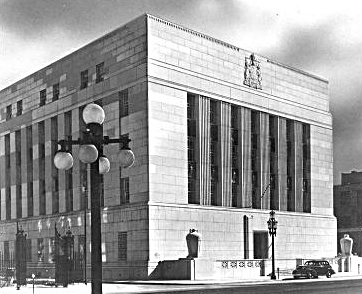
After the securities had been unloaded the trains would continue their journey from Montreal and deliver the gold to the Bank Of Canada’s vaults in Ottawa. Each rail car could only hold 150 – 200 boxes as they were so heavy, and so as many as five trains were sometimes needed to ship the gold from just one transatlantic convoy. There was so much gold (in excess of 1,500 tons) that it filled the 6,000 square foot vault, and the Bank needed to hire more than 120 retired Canadian bankers, brokers and investment firm secretaries to keep records. By the end of Operation Fish, the Bank of Canada was home to more gold than anywhere in the world outside of Fort Knox in the United States. The movement of such vast amounts was a highly labour-intensive task and the cost of transport was over $CAN 1 million.

Bank of Canada building c.1942

By the end of Operation Fish Britain’s assets in Canada exceeded over 1,500 tons of gold and over $300 billion in Securities (2020 value).

Britain was not the only country to send its gold to Canada for safe keeping. In June 1940 a single carrier from France shipped a staggering 254 tons of bullion across the Atlantic with an estimated value $US 305 million. Whilst the shipment was at sea the German Blitzkrieg rolled across northern Europe and France was defeated. The French government authorised Britain to take over France’s debts and assets to continue fighting the war, leading Churchill to request that the French gold be put with the British reserves. Unfortunately, the captain of the ship decided that he would take his orders from the hastily set up Vichy Government and so he slipped out of Halifax and sailed with his cargo to Martinique whilst France’s remaining assets in Ottawa were frozen until the end of the war.

It is testament to the high levels of security surrounding the shipment and storage of Britain’s wealth that no one found out about ‘Operation Fish’. The 5,000 employees of Sun Life never suspected what was being stored beneath their feet, and even though hundreds of people were involved in transporting, counting, recording, and storing the huge amounts of gold and securities the Axis intelligence agencies never found out about the ‘golden fish’ whch travelled from Great Britain to Canada.


The teacher who hid children in baskets – the story of Johan van Hulst

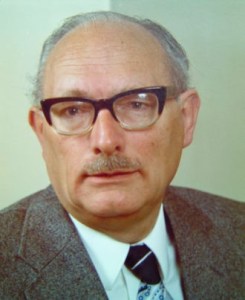
Johan Willem van Hulst

On Holocaust Remembrance Day this year I would like to commemorate the life and work of Johan Willem van Hulst who was just an ordinary school Director in the Netherlands before the outbreak of the Second World War, but what he saw happening there led him to help in the saving of over 600 Jewish children destined for Nazi concentration camps.

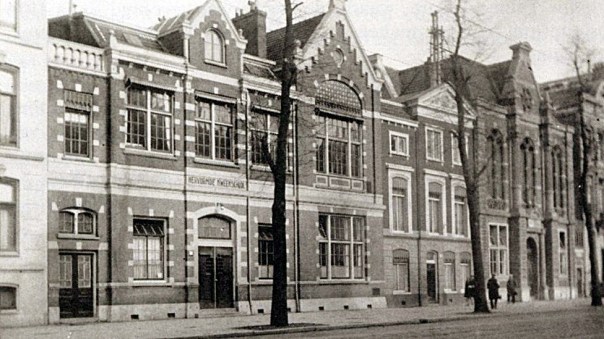
In 1943 Johan was working as Director of a Calvinist teacher training college opposite the Hollandse Schouwberg theatre in Amsterdam. The theatre was the main clearing site for Jews who had received deportation notices from the Nazi government, whilst just two doors down from the college was a crèche for Jewish children.

Walter Süskind

Many of the records of those who were detained in Hollandse Schouwberg have been lost, but it is estimated that about 46,000 were deported from there to the death camps in the 18 months from mid-1942 to the end of 1943 (the majority going to Westerbork, Auschwitz and Sobibor). The deportation centre was run by a German Jew, Walter Süskind, who had links with the SS and so his Jewish heritage was overlooked; but Süskind had an ulterior motive to working at the centre. Soon after taking over as Administrator he began to falsify the number of arrivals, perhaps saying that 65 had arrived rather than 80 and so allowing 15 people to escape

In early 1943 the Nazis appropriated the crèche across the road and Süskind began to place children there to await deportation. Within days of taking over he was working with the head of the crèche, Henriëtte Pimentel, to sneak children to safety when a tram passed in front of the building, shielding their activities from the Germans in the theatre. Staff at the crèche began to smuggle out as many of the children as they could and placed them with families in Amsterdam and the nearby countryside who were willing to hide them, but it was a slow and dangerous way to save the children so Süskind approached Johan van Hulst to ask for his help.

Henriëtte Pimentel

Johan offered the use of his college as a transit point for the children who were passed over the fence which bordered the gardens of both properties and then hidden in one of the classrooms until picked up by members of the rescue organization; he also helped to find families who were willing to risk their lives to shelter these children. Süskind ensured that none of the Jewish children whose parents agreed to the subterfuge were registered at the deportation centre and so their disappearances were never noticed. It was heartbreaking for the parents who gave up their children, yet they believed it was the best chance they had to survive the war.

The college and creche

The children who were rescued varied in age from babes-in-arms to 12-year-olds. Süskind canvassed families who were willing to take them in, asking them for physical descriptions of themselves and their own children so that he could place the rescued children where they would best fit in. Once a safe house had been arranged the children were smuggled out in bags or laundry baskets, often with the help of the students from the training college, or perhaps openly on a bicycle by a member of the Resistance pretending that the child was their own.

In order to prevent suspicion only a handful of children were rescued at a time, and van Hulst later said that this was one of the most difficult parts of the work he did during the Occupation, knowing that for every child he saved many more could not be helped. “Everyone understood that if 30 children were brought, we could not save 30 children. We had to make a choice, and one of the most horrible things was to make a choice.”

As well as making difficult choices the group of rescuers also had to keep on good terms with the Nazis; Süskind and the staff at the crèche had to continue their jobs as though supporting the deportations whilst Hulst would often behave as if he was on the side of the German occupiers. He would frequently tell his students off for watching the SS guards and tell the to ‘Let these people do their jobs, it is none of your business’ whilst winking at the guards to try to gain their trust and confidence, an act of theatre which seemed to work.

van Hulst 1969

Things did not always run smoothly and there was one occasion in 1943 when a Dutch education Ministry official discovered several Jewish children hiding in the college and asked van Hulst to explain what they were doing there. After a long silence he replied ‘you don’t really expect me to answer that, do you?’ The official wrote up his report with no mention of the children. On another occasion a government inspector visited the college unexpectedly and heard babies crying; by an incredible stroke of luck the inspector was a member of the Resistance and joined in Johan’s work of saving the children. These incidents convinced van Hulst, who was married with two children of his own, that he must say nothing to his wife so that she would not have any compromising information if he was caught and arrested.

Henriëtte Pimentel

The rescue of Jewish children had been running for many months, but it all came to an abrupt end in July 1943 when Henriëtte Pimentel was arrested and sent to Auschwitz where she died that September.* 100 children from the crèche were sent with her and suffered the same fate. On the day of Henriëtte’s arrest van Hulst was able to save one last group of children which turned out to be one of the most harrowing experiences of the war for him as he tried to decide just how many he could save without the Nazis noticing. As he said many years later, ‘Now try to imagine 80, 90, perhaps 70 or 100 children standing there, and you have to decide which children to take with you… That was the most difficult day of my life… You know for a fact that the children you leave behind are going to die. I took 12 with me. Later on I asked myself: “Why not 13?”’

Walter Süskind and his daughter

In 1944 Walter Süskind was sent to Westerbork concentration camp with his wife and daughter. None of them survived the war. **

It was at this point that the creche and the deportation centre at the theatre were closed, but that did not stop Johan van Hulst who continued to help people in hiding as well as defying attempts to conscript his students into the German army. Three weeks before liberation Johan received a tip-off that the Germans were coming for him; he managed to escape just minutes before they arrived and was forced to spend the next weeks in hiding until the Allies arrived.

In his later life, Johan van Hulst spent 25 years as a Dutch senator and was a Member of the European Parliament from 1961 to 1968. His old school now houses the National Holocaust Museum of the Netherlands, and the joint wall which played such a crucial part in the saving of so many lives carries a permanent exhibition in van Hulst’s honour.

In 1973, Johan van Hulst was awarded the Righteous Among the Nations, a title given by the state of Israel to Gentiles who helped Jews during the Second World War. Later on, in 2015, he met Israeli Prime Minister Benjamin Netanyahu who told van Hulst that ‘We say: those who save one life saves a universe. You saved hundreds of universes.’

van Hulst and Netanyahu

Johan van Hulst died on 22 March 2018 at the age of 107. A bridge in Amsterdam close to the college where he carried out his rescue of Jewish children has been renamed The Johan van Hulstbrug. But this brave man was only one of many who risked their lives to help the Jewish population of the Netherlands at a truly horrific time – the Netherlands has 5,851 Righteous Gentiles, the world’s highest number after Poland.

“I only think about what I have not been able to do, about those few thousand children that I could not save.” Johan van Hulst.

* Henriëtte Pimentel has not been formally recognised for her role and her sacrifice by Yad Vashem

** As a Jew Süskind was not recognised as Righteous Among the Nations as this honour is reserved for Gentiles.

Lyudmila Pavlichenko – The most successful female sniper in history

“The only feeling I have is the great satisfaction a hunter feels who has killed a beast of prey,” Lyudmila Pavlichenko

Lyudmila Belova was born 12th July 1916 in Bila Tserkva in the Ukraine (near Kiev). Her mother was a school teacher and her father a factory worker who worked his way up to a position of responsibility. Unfortunately, that meant that he had to move to a new town every year which in turn meant that Lyudmila had to start again each year at a new school with new friends.

Lyudmila was a tomboy – preferring to play rough and tumble games with the boys rather than with girls. When she was 14 the family moved to Kiev where one boy kept bragging that he could shoot better than anyone else, this annoyed Lyudmila who thought she could do anything that a boy could do so she joined a local shooting club. She had a natural talent and was soon winning medals at competitions.

As a teenager Lyudmila worked at the Kiev arms factory as well as working so hard at her studies that she graduated from college a year earlier than other students of her age. Lyudmila married a doctor, Alexei Pavlichenko, when she was 16 and they had a son called Rostislav. Russian women were expected to marry young and start a family so this was not unusual; it was also a matter of pride for women to work full-time and also look after their young family, not like the ‘stay-at-home-mums’ of other European countries. The Russian idea was that ‘it takes a village to raise a child’ so everyone helped to look after the children of the community which enabled the women to work.

Lyudmila was not satisfied with working in the armament’s factory – she wanted an education and a career, unfortunately her insistence on this led to her and Alexei getting a divorce. Lyudmila studied for a Bachelor’s degree in history at Kiev University with the aim of becoming a teacher. The young Russian was planning to do a Master’s, but then the Nazi’s invaded the Soviet Union in 1941 and her plans were put on hold after the death and destruction she witnessed during the battle of Kiev made her put aside her dreams of becoming a teacher in favour of killing Nazis.

Lyudmila was 24 when she enlisted in the Russian Army, this was a year before women were conscripted but she didn’t want to wait. The authorities felt that as a woman she should become a nurse but Lyudmila had other ideas and when she showed them her shooting medals she was allowed to join an all-male sniper school (a women’s sniper school was not set up until 1942). When she was sent to the front after her training Lyudmila was initially set to digging trenches, it wasn’t until a colleague was too wounded to continue and he handed her his gun that she had a weapon at last. The young woman had been bullied at sniper school and the other snipers still did not accept her fully so they set her a test – to shoot two of the enemy standing in a field, if she couldnd’t do it she would be sent home. Lyudmila surprised everyone by killing both Germans with two very quick headshots and she was accepted in the ranks of the snipers.

On her first day on the battlefield Lyudmila was frozen with fear and couldn’t bring herself to lift her gun and fire on the enemy. Then a young Russian soldier moved beside her but before he could settle in a shot rang out and he was killed. The shock spurred Lyudmila to action as she had liked the ‘nice, happy boy’, and from that moment on there was no stopping her.
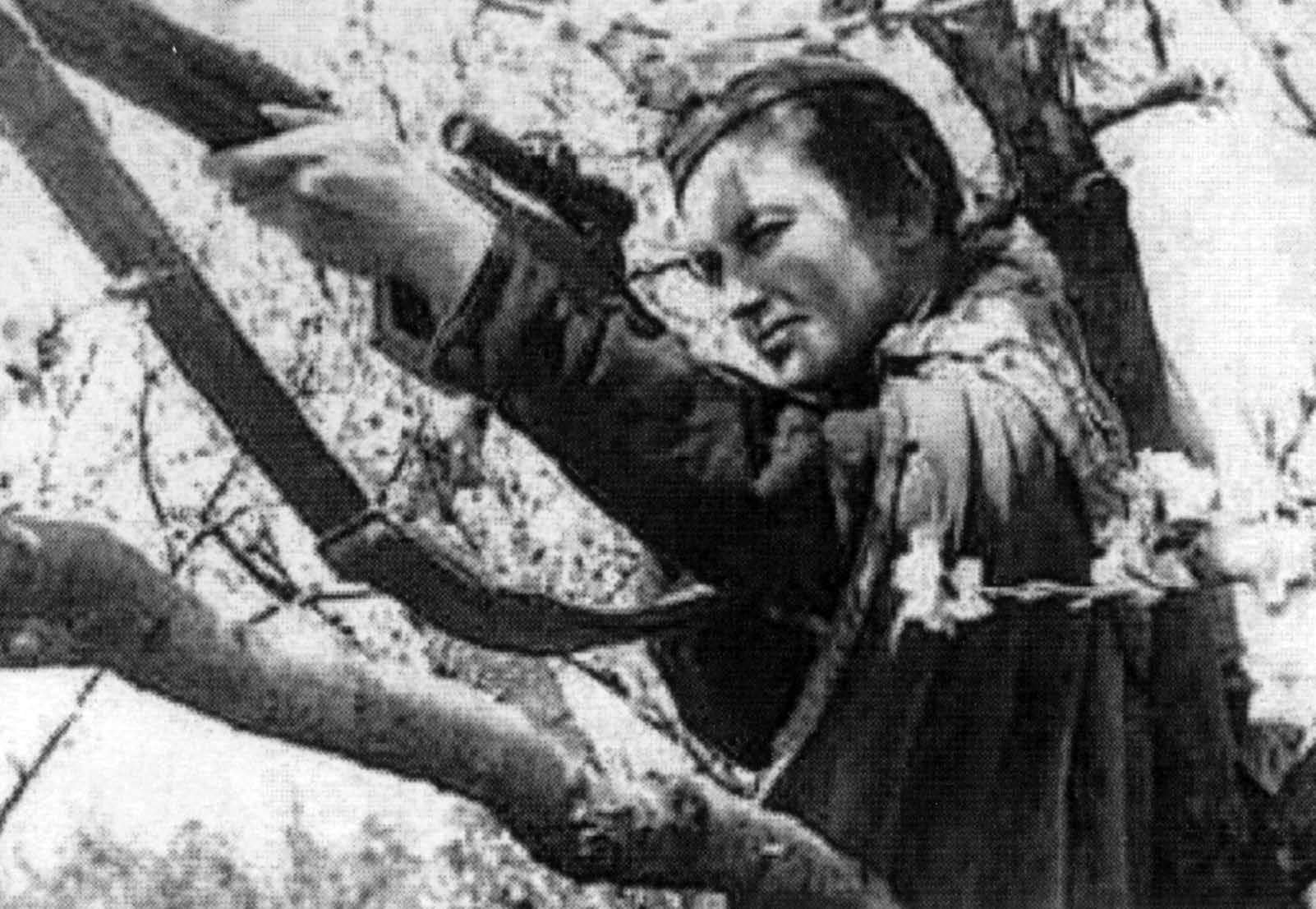
During the Siege of Odessa which lasted from 8th August until 16th October 1941, Lyudmila killed 187 of the enemy saying that she was so successful because she hated the enemy too much to fear him. On one occasion Germans had marked her position in a tree and were firing at it. Knowing that it was only a matter of time before they killed her Lyudmila deliberately fell out of the tree and played dead until nightfall when she slipped quietly away. It was at that point that her comrades began to call her ‘Lady Death’.

Lyudmila later took part in the battle of Sevastopol where she killed 70 more Germans (taking her total to 257) and she was assigned to become a counter-sniper – in other words to target and kill enemy snipers. This took great skill and perseverance as she had to sit still and wait until the enemy sniper revealed himself before taking her shot; on average this took 15 – 20 hours. On one occasion Lyudmila had to lay still in her hiding place for 3 days without food or water waiting for the enemy sniper to reveal himself. In all she was sent against 36 enemy snipers and killed them all.

By the time she had killed 309 Germans Lyudmila had become a Lieutenant and fallen in love with Sergeant Major Leonid Kitsenko who was also a sniper; the couple were married but Leonid was killed soon after.

The Germans knew who Lyudmila was and were so afraid of her skill that they tried to persuade her to defect by offering her chocolate and the promise of an officer rank in the German army. Lyudmila was never going to agree so the Germans said that when they caught her they would tear her into 309 pieces. This pleased Lyudmila because it meant that everyone knew her tally!

Lyudmila was shot four times whilst on active service and also suffered numerous shrapnel wounds although these did not stop her and she continued to fight. After being hit in the face by shrapnel from a mortar shell the ace sniper was withdrawn from the battlefield (by submarine from Sevastopol) to spend a month in hospital. Rather than sending her back to the front the Soviet High Command posted Lyudmila to train snipers, she was also given the role of propagandist.
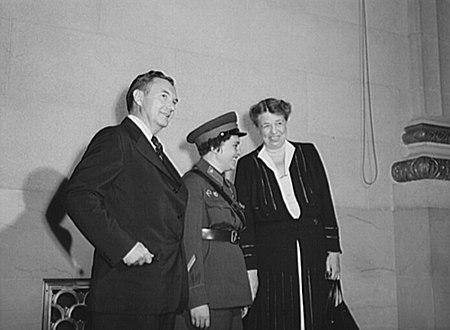
Stalin had been trying to encourage Roosevelt to open a Second Front in Europe without success so in 1942 Stalin sent Lyudmila to America to tell her story. The young Russian woman arrived in Washington where she became the first Soviet citizen to be welcomed at the White House. Afterwards, Eleanor Roosevelt asked Lyudmila to accompany her on a tour of the country so that she could tell Americans about her experiences as a woman in combat. Rather than being impressed with Lyudmila reporters on the tour asked why she didn’t wear make-up or style her hair, and what she thought of the military uniform which made her look fat. She replied that “I wear my uniform with honour. It has the Order of Lenin on it. It has been covered with blood in battle. It is plain to see that with American women what is important is whether they wear silk underwear under their uniforms. What the uniform stands for, they have yet to learn.”

Eleanor Roosevelt was very impressed with the young Russian and gave her advice on public speaking. As they travelled through 43 states Lyudmila’s confidence grew and she and the First Lady became very good friends. This boost in confidence became obvious when they reached Chicago and Lyudmila confronted the men in the audience by saying “Gentlemen, I am 25 years old and I have killed 309 fascist occupants by now. Don’t you think, gentlemen, that you have been hiding behind my back for too long?” She also addressed the subject of equality by saying “Now [in the U.S.] I am looked upon a little as a curiosity, a subject for newspaper headlines, for anecdotes. In the Soviet Union I am looked upon as a citizen, as a fighter, as a soldier for my country.”

Lyudmila also visited Canada before traveling to Coventry in England where she accepted donations of £4,516 from local workers to pay for three X-ray units for the Red Army. She also visited the ruins of Coventry Cathedral before returning to Russia and continuing to train snipers until the end of the war.

Lyudmila was a national symbol of women in the USSR, she was even featured on a ration postage stamp. After the war Lyudmila returned to Kiev University and finished her Master’s Degree in History, but instead of becoming a teacher she was given a position as a research specialist for the Soviet navy.

In 1957 Eleanor Roosevelt visited Russia and the two women were re-united for an afternoon reminiscing about their tour of America.

Lyudmila died in 1974 aged 58. Her life was commemorated with a second postage stamp.

Awards and honours

  • Hero of the Soviet Union (25 October 1943)
  • Two Order of Lenin (16 July 1942 and 25 October 1943)
  • Two Medals “For Military Merit” (26 April 1942 and 13 June 1952)
  • Campaign medals

The day that Churchill sank the French Fleet

On July 3rd 1940 the British Fleet fired on the French Fleet which was at anchor in the North African port of Mers el Kebir, near Oran in Algeria. The attack lasted for only 10 minutes but in that time hundreds of French sailors were killed and their ships crippled. Yet only days before France and Britain had been Allies fighting against Hitler’s Germany, so what went wrong?

The German Blitzkrieg was unexpected and totally devastating in its speed and France fell to the Germans which left the British in a difficult position. Many of the ships in the French Fleet were still at sea or in port and Churchill realised that it was vital to keep these resources out of enemy hands by any means possible.

Many French ships were already in British ports but there was also a large squadron of battleships in the port of Mers el Kebir. The Admiralty were worried that if these ships were to join with the Italian navy in the Mediterranean it would give the Axis powers naval superiority there and possibly make Britain’s position in North Africa untenable. On 23rd June 1940 an armistice was signed between France and Germany, and when the details were announced they confirmed the worst fears of the Admiralty. The agreement said that ‘The French war fleet is to collect in ports…under German and/or Italian control to demobilize.’ The declaration went on to say that ‘The German Government solemnly declares to the French Government that it does not intend to use the French War Fleet which is in harbours under German control for the purposes of the war.’

Germany and France sign an armisgtice © IWM HU 75914

However, the British government did not trust Hitler as he had broken many promises before, which left Churchill afraid that the French Fleet might be used to help an invasion of Britain. He had to make a decision about what to do next and so announced that ‘At all costs, at all risks, in one way or another we must make sure that the navy of France does not fall into the wrong hands.’

Churchill ordered the immediate setting up of Operation Grasp whose aim was to simultaneously seize

  1. all French ships in the UK ports of Plymouth and Portsmouth
  2. all French ships in the port of Alexandria in Egypt

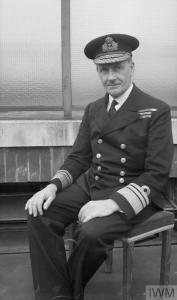
Admiral Somerville. © IWM A 20772

At the same time Operation Catapult under Rear Admiral Somerville was to give an ultimatum to the ships in Mers el Kebir. Somerville had command of a force consisting of Ark Royal, Hood, Valiant, Resolution, 2 cruisers, and 11 destroyers. At Gibraltar Somerville met with Admiral North who was Commander-in-Chief of the Atlantic Fleet, and Captain Holland who spoke fluent French. The three officers had been ordered to present French Admiral Gensoul with 3 options

  1. Join the Royal Navy to fight the Germans
  2. Sail to a British Port where the ships would be taken over and the crews repatriated
  3. Sail to an island in the French Caribbean, disarm, and stay there for the remainder of the war

Churchill had ordered that if Gensoul refused to make a decision he would be told to scuttle his ships. If he refused to do that the last resort would be for the British to fire on the French Fleet and sink it.

Somerville and North both felt that these orders went against what was honourable as the French had so recently been an ally; the Prime Minister understood this but explained his decision by saying that ‘you are charged with one of the most disagreeable and difficult tasks that a British Admiral has ever been faced with.’ But, despite that, he was still convinced that this confrontation with Admiral Gensoul was the only way forward.

On the morning of 3rd July the British Fleet arrived off Mers el Kebir and Holland was ferried in by the destroyer HMS Foxhound to conduct negotiations. Gensoul initially refused to allow Holland on board his flagship because he felt insulted that the British had sent a mere Captain to speak with him, as he was an admiral he insisted that talks had to be conducted by an intermediary. Gensoul eventually rejected the British proposals saying that he would scuttle his ships if the Germans tried to take them but would not do so on the orders of the British.

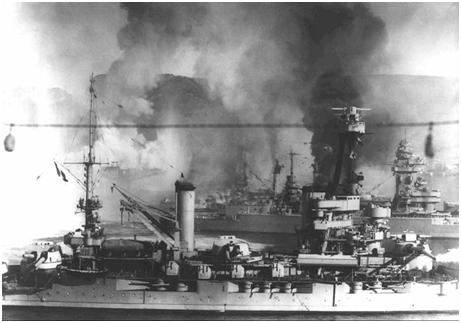
French Fleet at Mersel Kebir

Somerville recalled Holland and gave Gensoul until 3pm to reconsider his decision. Whilst waiting Swordfish aircraft were sent in and dropped magnetic mines across the harbour entrance to prevent the French leaving. At 2.15pm, probably in an attempt to buy more time, Gensoul said that he would finally speak directly to Holland. In acknowledgment of this Somerville extended the deadline to 5.30pm because he did not want to fire and hoped that further talks would lead to a resolution of the situation. However, Gensoul continued to insist that he was not prepared to relocate to the Caribbean or scuttle his ships unless they faced a direct threat from the Germans.

The Admiralty notified Somerville that French re-inforcements were on the way and so his time was up. Holland left the French admiral at 5.25pm whilst Gensoul still thought that the British would not open fire and that they were simply bluffing to put pressure on him to scuttle.

French Cruiser the Strasbourg

At 5.54pm the British battleships Resolution and Valient opened fire on the French Fleet, closely followed by Hood. The French tried to leave anchor to escape but it was too late and the Dunkerque, Gensoul’s flagship, was hit four times killing 181 men and causing a great deal of damage. When the Bretagne was also hit one of her main magazines exploded and the ship capsized, taking 1,079 of her crew with her.

Admiral Gensoul

At this point Somerville ordered a halt to attack to give the French time to abandon their ships so that the British could scuttle them, but the French had no intention of letting the British sink their ships so two destroyers and a battleship broke out of the harbour and returned fire on the British. Gensoul hoped to gain some time to allow these ships to escape so he sent a signal to Somerville to say that he now agreed to the British terms. Somerville, however, knew what was happening and told Gensoul that ‘Unless I see your ships sinking I shall open fire again.’

The French ships which had broken out managed to escape their British pursuers, but there was no hope for those left in Mers el Kebir. A final bombing run was made on the ships a few days later to make sure that none were seaworthy but the battle had, in effect, ended late in the afternoon of the 3rd July.

During the Battle of Mers el Kebir the French lost 1,297 sailors with over 350 wounded. They saw the British attack as an act of treachery, and at the funerals of those who died Gensoul told the remaining French sailors that ‘If there is a stain on a flag today it is certainly not on yours.’

Somerville himself felt that the action he had been ordered to lead was dishonourable and called himself ‘the unskilled butcher of Oran’. He wrote home to his wife and said ‘I just felt so damned angry being called on to do such a lousy job. We all feel dirty and ashamed that the first time we have been in action was an affair like this.’

Churchill however was unrepentant. He had felt that he could not give more time for the negotiators to seek a peaceful solution and believed that ‘Mers el Kebir showed that the British War Cabinet feared nothing and would stop at nothing.’

There are a number of theories as to why Churchill ordered his fleet to fire on the French. Some argue that the British Prime Minister was simply ruthless and took this action to show the world, particularly the Americans, that Britain was not beaten and that under his leadership there would be no surrender to the Germans.

Others argue that keeping the peace between Britain and a France which had already been defeated by the Germans was not as important to Churchill as ensuring that the French ships could not be used against the British.

For Churchill making a public statement of British resolve was a major factor in ordering the operation against the French.

So, was the sinking of the French Fleet at Mers el Kabir an unpleasant necessity (Churchill’s view), a dishonourable act (Somerville’s view) or a murderous atrocity (Gensoul’s view)? Or does the answer, as is so often the case during a time of war, lie somewhere in between?

Accident or murder? The mysterious death of Leslie Howard

Leslie Howard

Leslie Howard was a superstar actor of his day. The son of Jewish immigrants from Hungary he was born in London in 1893 and served during the First World War, he was mustered out of the army a few weeks before the Battle of the Somme began in 1916 as he was suffering from shell shock. It was actually his doctor who suggested acting as a therapy little knowing that Howard would go on to international fame, particularly for his roles in Pygmalion and Gone With The Wind. When the Second World War broke out the English actor gave up his lucrative Hollywood contract (including his share of the box-office takings for Gone With The Wind) and returned home to see what he could do to further the war effort.

Leslie Howard in Gone With The Wind

Howard was not the only Hollywood actor to join up at the first opportunity, Americans Kirk Douglas, Paul Newman and Charles Bronson also served whilst Clark Gable and James Stewart were awarded medals for their bravery; on the other side of the Atlantic British actors Richard Todd, Alec Guinness and Dirk Bogarde all served in the armed forces.

Leslie Howard, however, decided that rather than fighting he would put his acting skills to use and so offered to do whatever he could for the British government. One of the first things he was asked to do was to make broadcasts to the United States which still remained a neutral country with Churchill doing everything he could to get the Americans to join the war as Britain’s allies. Many women in America were isolationists and strongly against the war, it was recognised that their views had a not insubstantial effect on the views of American men so it was thought that a matinee idol such as Howard might go a long way towards making them change their minds. But America was only a part of his focus as Leslie Howard also made programmes for the domestic audience appearing on ‘Britain Speaks’ and making National Savings documentaries for the Ministry of Information. Many of his broadcasts focused on British values which the soldiers at the front were fighting to protect – freedom, tolerance and decency. The propaganda programmes which Howard was involved in were so successful that William Joyce (better known as Lord Haw Haw) singled out Howard as a target in his radio broadcasts from Europe (‘Germany Calling’) saying that he should ‘stick to acting’.

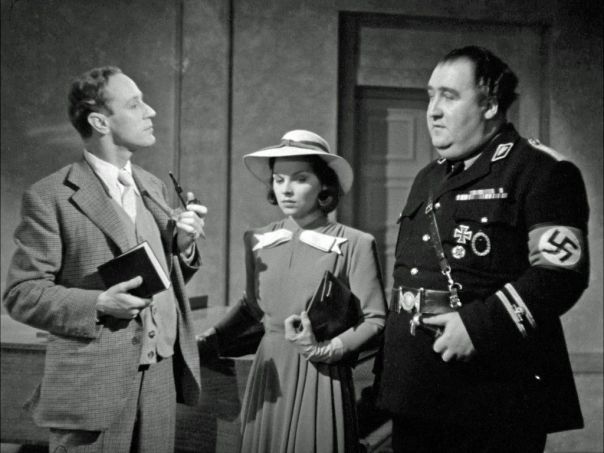
Howard’s work for the government also included directing, co-producing and starring in several war films including 49th Parallel, The First Of The Few (the story of RJ Mitchell, the inventor of the Spitfire) and Pimpernel Smith (based on the story of the Scarlet Pimpernel who rescued aristocrats from Paris during the French Revolution, only this time the plot revolved around an English professor rescuing refugees from the Germans). The work that Howard did was obviously propaganda but he felt that it was justified whilst the country was at war with Hitler, in one broadcast Howard even used what was considered strong language for the 1940’s when he said “To hell with whether what I say is propaganda or not, I’ve never stopped to figure it out and I don’t think it matters anymore.”

On the set of The First of the Few

Howard had met Winston Churchill in 1937 when they had several informal talks where Howard made his anti-Nazi views known. Churchill remembered this and when he became Prime Minister he used Howard and other actors, including Laurence Olivier and Noel Coward, to get access to famous or important people who might be able to help with the war effort. To this end Howard went to Spain and Portugal in May 1943 purportedly to open links between Spanish and British film-makers and present a series of lectures on his films and the role of Hamlet, but it is believed that his real purpose was to try to prevent General Franco from joining the Axis powers. The Iberian peninsula was neutral during the war and so became a magnet for spies from both sides which meant that the actor was closely watched by German agents during his visit.

Pimpernel Smith

Howard left Portugal in June 1943 on a civilian Douglas DC-3 which flew regularly across the Bay of Biscay as there was an informal agreement for both sides to respect the neutrality of civilian planes. On this day, however, the agreement was ignored and six Junkers JU88 fighters shot it down killing all seventeen passengers and crew. The news of the death of incredibly popular Leslie Howard shocked the British people, and the reason for the German action raised many questions which have not been fully answered to this day.

Why was the plane shot down? Was it an accident or deliberate? If deliberate, who was the target?

One thing we do know is that this same plane making its daily Lisbon to London run had been attacked for the first time two weeks earlier, but it was assumed that the aircraft had been hit by mistake and so the flights continued. Now the plane had been fired on again, and this time shot down with a number of people on board who could have been a possible target. There was Arthur Chenhall, Howard’s manager who was travelling with him and who looked a lot like Churchill. There was also Kenneth Stonehouse who was a reporter for Reuters, Wilfred Israel who was a Jew from Berlin whose work with the Kindertransport had been, in part, the inspiration for Pimpernel Smith, Tyrrel Shervington who was the Lisbon manager for the Shell Oil Company, and Ivan Sharp who had been negotiating tungsten and wolfram imports which were important for the British war effort and deals which the Germans would obviously like to prevent. Any one of these men could have been targeted by the Germans although many thought that the clear target was Howard as when Goebbels (the German Propaganda Minister) had seen the film Pimpernel Smith he had taken it as a personal parody of himself and wanted to kill the director and star.

Pimpernel Smith

There is, however, another possibility. On the same day that Howard’s ill-fated plane set off from Portugal Winston Churchill also took off from Gibraltar to return to Britain after a visit to North Africa. The British Prime Minister was to have flown in a similar flying boat and on a similar flight path to the plane which was shot down but, due to bad weather, he decided to take a bomber instead. The German pilots who brought down the plane took photographs of the wreckage before flying back to their base in France. So, was Leslie Howard the target of the German Junkers, or did they mistake the civilian plane for the one carrying the British Prime Minister? What a coup it would have been if they had been able to shoot down and kill the man who was the inspiration for so many of the Allies.

Three days after the plane was shot down the New York Times reported that “It was believed in London that the Nazi raiders had attacked on the outside chance that Prime Minister Winston Churchill might be among the passengers.” When secret files about Ultra (the Allies’ secret Nazi code-breaking capabilities) were finally made public decades after the Second World War it was learned that the British had known in advance that the Germans assumed Churchill was on Flight 777 and so might target the plane. It was obviously vital for the war effort that Ultra could not be compromised and so the intelligence was not passed on to the Portuguese authorities or the airline. When Churchill wrote his history of the war he fed the flames of the mistaken-identity thesis when he referred to Leslie Howard’s death as one of “the inscrutable workings of fate.”
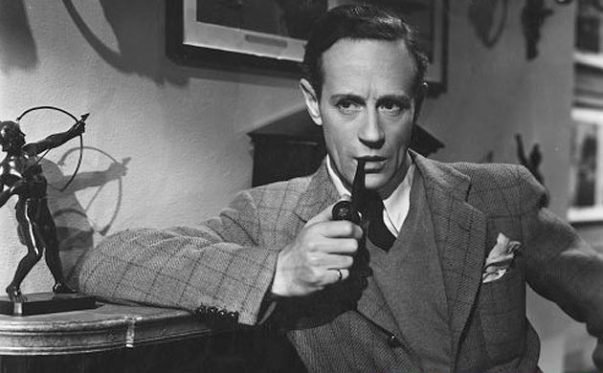
We will never know for certain the true circumstances of the death of Leslie Howard, but JB Priestley spoke for many when he made a broadcast after the actor’s death was announced on the BBC – “The war has claimed another casualty, the stage and screen have lost an unselfish artist, and millions of us have lost a friend.


The war-gaming Raspberries who helped to win the Battle of the Atlantic

After the fall of France in the early days of the Second World War Britain stood alone in her opposition to Germany in Europe. As an island nation she was vulnerable because food and materials for the war had to be brought across the Atlantic from America, running the gauntlet of German U-boats hunting in ‘Wolfpacks’. Britain needed more than 1 million tons of imports a week to survive so it was imperative to find ways to combat the U-boat threat in what was known as the Battle of the Atlantic.

HMS BARHAM explodes as her 15 inch magazine ignites, 25 November 1941. Copyright: © IWM. object/205022049

Britain had prepared her sea defences based on the belief that Germany would fight a similar sea war to the one fought during World War I. No one had anticipated that France would fall so quickly thereby placing its ports on the western coast of Europe in the hands of Germany and enabling the Nazis to have a stranglehold on the Atlantic crossing. A new approach to the war at sea was needed.

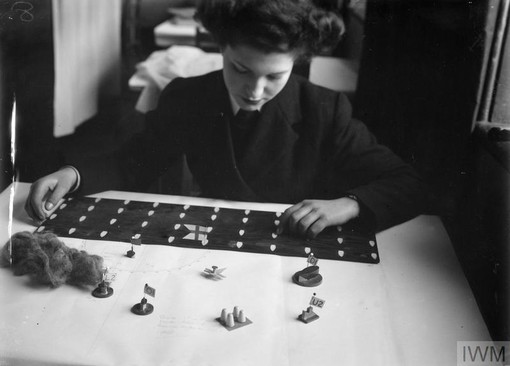
‘War games’ have always been an important feature of military tactical planning and so the Western Approaches Tactical Unit (WATU) was set up in Liverpool led by Captain Gilbert Roberts under Sir Percy Noble who was made responsible for protecting convoys from the threat of German U-boats. Roberts brought together a group of officers and ratings from the Women’s Royal Navy Service (the Wrens) to ‘explore and evaluate new tactics and then to pass these on to escort captains in a dedicated ASW (Anti-Submarine Warfare) course’. Churchill’s instructions to the new unit were clear – “Find out what is happening in the Atlantic, find ways of getting the convoys through and sink the U-Boats!” The small staff under Roberts consisted of Chief Petty Officer Raynor, four Wren officers, and four Wren ratings, two of whom were only seventeen.

Captain Roberts consults with Commander J M Rowlands, DSO, RN, an Escort Group Commander. One of the most important phases of the Tactical Unit is the consultation with Escort Group Commanders and Commanding Officers of Escort Vessels when they come in from sea. © IWM (A 27825)

Roberts first analysed reports of attacks on convoys and came to the conclusion that only one Commander, F Walker, had any sort of tactic against the U-boats – he had set up a system whereby when the signal ‘Buttercup’ was given all escort ships under his command turned outwards and fired starburst shells to illuminate any German submarines on the surface. Robert’s analysis also led him to believe that rather than U-boats moving in to attack the perimeter of a convoy at night they were already amongst the supply ships and using their targets as cover!

The facility which housed WATU was very simple – a pattern of squares painted on the floor, some basic ships models, and a number of tactical tables. The first thing that the new team needed to do was to learn current ASW techniques and get an understanding of their technology before they began to create a set of rules so that they could play ‘real-time’ games where they responded to simulated naval attacks, developed tactics to combat them and analysed communications problems. The first problem they approached was the perceived tactic of U-boats hiding withing the convoys. By playing their war games they came to the conclusion that a U-boat would fire on the stern of a ship, dive and fall back behind the convoy, then surface again. To counter this they moved the escort back after an initial attack to sweep the area where the U-boats were expected to re-surface. This seemed to be a successful defence.

Measuring up and preparing contact chits. © IWM (A 27823)

Sir Percy Noble thought that the plan for wargaming was unlikely to work, but after visiting WATU and watching the team at work he changed his mind. He observed a series of attacks on a convoy where the logic behind the assumptions made about U-boat movements were explained as were the tactics to combat these. Immensely impressed he gave his full support to ‘Operation Raspberry’ and ordered that all escort officers should attend the course.

Sir Max Horton (Western Approaches Command) attended one of the courses where he played the role of a U-boat captain. During the course he initiated five attacks on a convoy and each time his submarine was tracked and destroyed using the tactics derived from the war games. He was astonished that an eighteen year old Wren was able to outperform him so well and made sure that the new tactics were included in the next set of orders sent to the Fleet. King George VI was also impressed by the work coming out of Liverpool and visited WATU in November 1942.

© IWM (A 27821)

After a time the unit adapted the training room so that the players who represented the commanders of the Allied convoy escort ships could only have a limited view of what was happening as would be the case in real life situations; only the umpires of the game were able to see the U-boat’s position. As each German tactic was countered and new ones introduced the war gamers of WATU came up with new counter-measures and Germany’s losses in the Atlantic grew. During the remainder of the war 5,000 officers attended the course, one of the very few military courses at the time which were run by women. By the end of the war WWATU had a complement of eight male officers as well as thirty six Wren officers and ratings.

The models used on the Tactical Table. © IWM (A 27824)

At the end of 1943 Roberts was invested as a ‘Commanded of the British Empire’ for his work at WATU. He took a Wren Officer and a Wren Rating with him to Buckingham Palace for the investiture in recognition of the remarkable team of young women who played the war games which saved British shipping in the Battle of the Atlantic.

The worst journey in the world – the Arctic Convoys of World War 2

On 23rd August 1939, just days before Germany invaded Poland in the opening moves of the Second World War, the world was surprised to see two sworn enemies – Germany and Russia – sign a Non-aggression Pact in which they agreed not to go to war against each other for the next ten years. For Stalin the treaty meant that Russia could stay on peaceful terms with Germany whilst building up her own military strength; for Hitler it meant that he would be able to invade Poland unopposed. In September Hitler attacked Poland and the country was soon under Nazi control, this meant that Hitler had got what he wanted from the Pact so in June 1941, much to the anger of Stalin, Germany invade Russia with more than 3 million troops. This was the largest invasion in history (in comparison the D Day landings in Normandy saw 156,000 Allied soldiers come ashore). Operation Barbarossa (the attack on Russia) was initially a success with the Russians losing 4,500 planes in just nine days, a number which constituted half of their air force, within six months the Russian army had lost 20,000 tanks. By the end of the year the Germans were within 15 miles of Red Square in the centre of Moscow and a desperate Stalin begged Churchill to send Russia tanks, planes and guns to halt the German progress.

Operation Barbarossa © IWM (HU 111387)

Churchill didn’t like either communism or Stalin, but he knew that Britain would not be able to defeat Hitler alone. So far America was only sending supplies to Europe not troops and so Churchill had no real alternative but to help Stalin in an effort to keep a large part of Germany’s troops occupied in the east rather than freeing them up for an invasion of the British Isles. Churchill knew that to defeat Hitler in Russia would be a colossal undertaking and so he promised Stalin that there would be deliveries of supplies every 10 days. But how would they get there? They could be sent across the Pacific from America and then by train across Russia, or they could go around Africa and then overland from India, but both of these routes would take weeks, if not months. The only realistic route to deliver supplies quickly and regularly would be to go the north of Norway to the Russian ports of Murmansk and Archangel; the problem with that route was that Germany already held Norway so the convoys would have to run the gauntlet of German ships, submarines and planes as well as struggling with the treacherous conditions of the Arctic Ocean. As Churchill said, it should take about 10 days but it would be the worst journey in the world.

ARCTIC CONVOY. ON BOARD HMS INGLEFIELD , 14 FEBRUARY TO 13 MARCH 1943, DURING CONVOY DUTY IN ARCTIC WATERS. © IWM (A 15400)

The Merchant Navy was delegated to man the convoys. Before the war merchant vessels had brought trade goods to Britain from all parts of the world, but the experienced sailors who served in the Merchant Navy had never signed up for active service during a war. As a non-military fighting force these men – aged from 14 to 70 – were ill-equipped with little more than a long coat, leather boots and balaclava. One of their main jobs whilst the ships were on the arctic run was to clear the ice from the decks so that it didn’t jam up the winches and guns, or build up until the ship became so top-heavy that it would capsize. Most of the ships in the Merchant Navy were old and slow, many dating from the First World War, and they had certainly not been designed for the harsh Arctic Ocean. The brave merchant seamen who took on this task were paid as little as £10 a month, and it was the rule that a sailor’s pay would be stopped the moment his ship sank!

Ice forms on a 20-inch signal projector on the cruiser HMS Sheffield while she is helping to escort an Arctic convoy to Russia

Only 1 of the 103 ships which sailed in the first 12 convoys to Russia was lost and so huge numbers of supplies reached their destination, so much so that in the Battle of Moscow at the end of 1941 75% of the tanks used by the Russians were British made and had arrived via the convoys. As well as tanks the ships cargos included fighter planes, fuel, ammunition, raw materials, and food. Ships would return to Britain either with ballast or some passengers who were mainly survivors of sunken merchant ships, British servicemen and Russian diplomats.

The convoys were co-ordinated by a control centre in Liverpool. At the heart of the convoy were the merchant ships with the supplies, usually travelling in rows eight abreast. Surrounding these were the warships which offered close protection – destroyers, armed trawlers and anti-aircraft ships. The distant protection was provided by heavy cruisers which would be 30 or 40 miles further out to combat any threat from German surface ships – the German ship Tirptz in particular was in Norwegian waters and considered a constant threat. Sometimes there were also one or two submarines offering protection to the convoy. In the summer months as the ice retreated the convoys would take the route from Iceland (usually off Hvalfjörður) north of Jan Mayen Island to Archangel, but as winter approached and the pack ice increased the convoys would take a more southerly route to Murmansk. From February1942 convoys also assembled and sailed from Loch Ewe* in Scotland.

Loch Ewe during the war

As if the threat of German attacks wasn’t enough the merchant convoys also had to contend with the severe weather conditions of the Arctic Ocean – fog, freezing temperatures which went down to -60, gales with winds of up to 100mph, mountainous waves, strong currents, drift ice, and the difficulties of navigating so close to the North Pole all meant that the loss rate for ships was higher than any other Allied convoy route. The journey meant days of heightened tension for the sailors, a particular fear was that your ship might sink because if it did there was little hope of rescue as you would only be able to survive for minutes in the freezing waters and the other ships in the convoy needed to keep moving as a unit and so often couldn’t stop to help.

The most infamous convoy was PQ17 which had the distinction of being the first significant joint Anglo-American operation of the war, was the largest arctic convoy to sail, and was also one of the biggest naval disasters of the 20th century.

The convoy of 35 ships in PQ17 assembled at Hvalfjord, Iceland, at the end of June 1942.  One ship grounded when leaving harbour and another was damaged by floating ice and had to withdraw, but the remaining 33 merchant ships headed east for Russia on 27th June. The 33 British and American merchant ships were carrying enough tanks and munitions to equip an army of 50,000 men. By this time Germany had realised that the convoys had to be stopped if they were ever to defeat Russia and so Hitler had increased the number of planes, ships and submarines in Norway. British command recognised the danger and gave PQ17 a massive armed escort – a close escort of 19 ships and a cruiser force of 7 further out. The British were also put in charge of this joint Anglo-American force as they were the only ones with the experience of Arctic convoys. The ships set out at their top speed on a voyage that was expected to take about 10 days, and for the first 7 days there were no major incidents as any U-boats that came close were driven away by the destroyers, and the anti-aircraft ships saw off any German planes. (Film star Douglas Fairbanks Jr served onboard one of the escort ships for PQ17).

USS Wainright

But the massive convoy’s luck did not hold out and disaster struck on 4th July at 8.20 pm when the Germans launched a full assault. The first wave of the attack came from a flight of Heinkel 111 torpedo bombers. The USS Wainright broke ranks, turned away from the convoy and headed off alone to try to shoot down the planes; the heavy fire they gave caused most of the German planes to drop their torpedoes too early or turn back. After this initial success another more persistent wave of bombers came and within a short time 3 merchant ships had been hit with a loss of just 3 German planes. At the same time Naval HQ in London received news from Swedish intelligence that German surface ships had left Norway and were heading for PQ17, they reported that the Tirpitz was with them. The Tirpitz was the most advanced warship in the world with massive armour yet it was fast and had a huge number of colossal guns. The ships protecting the convoy could fire their shells a distance of 16 miles, but the Tirpitz’s guns could hit them from 22 miles away. The convoy stood no chance against such a ship.

Tirpitz

First Sea Lord Sir Dudley Pound (who was suffering with a brain tumour) had to make a decision – should he order PQ17 to turn back? If he did so it was possible that without the supplies Russia could lose the war, but if he ordered the convoy to continue it was likely to be destroyed and Russia could still lose the war. Pound decided that the Cruiser escort should turn around and return to Britain because they couldn’t take on the Tirpitz and the British could not afford to lose so many ships. The convoy itself should be ordered to disperse and head for Russian ports on their own. His theory was that if the merchantmen remained together the Tirpitz would be able to sink them all, but if they scattered at least some of them should get through. The messages from London created a sense of panic amongst the convoy who were not sure what to do. When the cruiser escort turned around Captain Broome was left in charge of the close escort and took overall control of the convoy, but with the merchant ships scattering in all directions he believed that it would be impossible to protect them so he turned around too, thinking that he could perhaps help the cruisers fight the Tirpitz. The merchant ships were left alone with no protection and 800 miles still to go.

Sir Dudley Pound

The Germans began their main attack on PQ17 with a force of 133 bombers, 12 torpedo planes and 12 U-boats; the unprotected ships were sitting ducks and it was a disaster for the convoy. The attack continued for 2 days with 12 merchant ships lost in the first 24 hours; and during that time there was still no sign of the Tirpitz. First Sea Lord Pound was eventually informed that the Tirpitz was still at anchor in Norwegian waters, there had been no need to abandon the convoy after all.** This is when the most puzzling decision of all was made, rather than bring the convoy back together Pound, for some unknown reason, said it must remain scattered. That order meant the effective end of PQ17.

It was at this point that the hero of Convoy PQ17 appeared. Captain Gradwell was a volunteer sailor who had been a barrister before the war but was now in command of a trawler which had been converted with a couple of guns and depth charges, and whose crew was mainly fishermen. Gradwell decided that the order to abandon the convoy was so bad that he would disobey it and stay with the scattered merchant ships. He found 3 US merchantmen whose officers agreed to follow his trawler as he led them as far north as possible, intending to hide amongst the ice until the attack was over and then head for Archangel. Gradwell didn’t have the charts he needed for the area and so was using a Times Handy Atlas! And he only had a certificate to captain a leisure cruiser in coastal waters! Gradwell took the ships as far north as he could, only stopping when the ice was too thick to go further, then he ordered the crews to paint the ships white and cover the decks with white sheets and tablecloths. At least one German plane flew over but didn’t see the camouflaged ships against the ice. Gradwell then ordered the tanks on deck to be loaded and pointed south to where any enemy would come from. And there the ships waited whilst chaos reigned in the south. When a fog came down Gradwell decided that it was time to try to escape and led the ships back south. On the morning of 25th July, two weeks overdue, Gradwell and the three ships he was escorting arrived in Archangel. Only 11 out of 33 of the convoy’s ships reached the Soviet Union, and 153 men lost their lives on those that were sunk. Captain Gradwell was awarded the DSC for his actions on Convoy PQ17.

Arctic convoys continued to the end of the war and the mistake of scattering the ships in the face of a German attack was never made again; but PQ17 was not the only one of the 78 arctic convoy missions to suffer losses. A total of 104 Allied merchant ships and 18 warships were sunk with the arctic convoys; over 3,000 personnel were killed. Russia also lost 30 merchant ships and an unknown number of personnel. Germany lost 5 surface warships, 31 submarines, and an unknown number of aircraft in her attacks on the convoys.
Over four million tons of supplies were delivered to the Russians by the Arctic convoys including tanks, aircraft, trucks, tractors, telephone wire, railway engines, sheet metal, food, and boots. The supplies were not as vital towards the end of the war but the convoys continued as a symbolic show of unity amongst the Allies.

The role which the convoys played in keeping Russia in the war cannot be overstated, but because they were Merchant Navy those who crewed the merchant ships did not receive a medal at the end of the war. It wasn’t until March 2013 that the role they played was finally recognised and they were awarded the Arctic Star.

*RUSSIAN ARCTIC CONVOY MUSEUM  near Loch Ewe in Scotland. Please take a look at their website, and call in if you are ever in the area – it is a fascinating museum.   There is some interesting video of Loch Ewe here (filmed in 2012 so some information about the museum and medal is out of date).

**Aside from an abortive attempt to intercept PQ12 in March 1942 and a raid on Spitsbergen in September 1943, the Tirpitz spent most of the war in the Norwegian fjords. She was repeatedly attacked by Allied forces and was finally sunk in Tromsø fjord on 12th November 1944 by the RAF.