Category Archives: Book reviews

Book review – ‘The Fort’ by Bernard Cornwell

the-fort‘Captivate, kill or destroy the whole force of the enemy’ was the order given to the American soldiers in the summer 1779.

Seven hundred and fifty British soldiers and three small ships of the Royal Navy. Their orders: to build a fort above a harbour to create a base from which to control the New England seaboard.

Forty-one American ships and over nine hundred men. Their orders: to expel the British.

The battle that followed was a classic example of how the best-laid plans can be disrupted by personality and politics, and of how warfare can bring out both the best and worst in men. It is a timeless tale of men at war.

The Fort tells the story of the military action which took place at Penobscot Bay where General McLean of the British Army was sent to set up a garrison to control the New England seaboard and offer a place of refuge for loyalists fleeing from the American War of Independence. The American rebels in their turn planned to oust the British in a show of strength. The novel is told from four perspectives – both the British and American, and for each side descriptions of the action on land and at sea. This gives the reader a feel for the complexity of what was going on and also the rivalries which can cause problems for military expeditions. One problem I initially had with this approach though is that some of the sections, particularly at the beginning of the book, were quite short and I had to stop to remind myself which side I was reading about; but as the story progressed this became less of a distraction. I found myself becoming increasingly engrossed in the story and eager to find out what happened next.

The American War of Independence is not something I have studied in any great depth so the story of Fort George was completely new to me. As with all of his novels Mr Cornwell has obviously spent a great deal of time researching this period, and this action in particular, and has conveyed a real feel for warfare at the time. I was particularly impressed with his descriptions of the navel engagements from both a tactical point of few and from the perspective of the sailors. Such battles must have been truly terrifying for the participants.

Fans of Bernard Cornwell’s ‘Sharpe’ novels may be surprised by this book; it has a very accurate historical focus but less attention is given to the personal lives and romantic relationships of the characters. Having said that, most of the people who appear in this novel are real historical figures and much of their conversation and actions is based on authentic documents. This gives the novel a real feeling of authenticity, placing the reader in the midst of the conflict and eliciting feelings of anger and frustration towards some of the people (I have completely changed my view of Paul Revere!) whilst leaving me wanting to know more about others (in particular Lieutenant John Moore who went on help reform and develop the British Army and who appears to have been a fascinating character).

The Fort is not a novel for those who like historical stories where the main protagonist is in a fight of ‘good and evil’ against an opponent who holds some sort of a grudge against them, and where the hero then goes on to win the day pretty much all by himself. But if you like a well-researched, accurate account of a little known event in history then I would recommend that you take the time to read and appreciate The Fort.

‘The Fort’ can be found on Amazon

Bernard Cornwell’s website

More of my book reviews can be found here


Book review – ‘The Lady From Zagreb’ by Philip Kerr

The Lady From ZagrebSummer 1942. When Bernie Gunther is ordered to speak at an international police conference, an old acquaintance has a favour to ask. Little does Bernie suspect what this simple surveillance task will provoke . . .
One year later, resurfacing from the hell of the Eastern Front, a superior gives him another task that seems straightforward: locating the father of Dalia Dresner, the rising star of German cinema. Bernie accepts the job. Not that he has much choice – the superior is Goebbels himself.

But Dresner’s father hails from Yugoslavia, a country so riven by sectarian horrors that even Bernie’s stomach is turned. Yet even with monsters at home and abroad, one thing alone drives him on from Berlin to Zagreb to Zurich: Bernie Gunther has fallen in love.

‘The Lady From Zagreb’ is the tenth in a series of novels by Philip Kerr about German detective Bernie Gunther. These novels have well-constructed plots and are a pleasure to read for anyone who is a fan of detective novels. What makes them unique, however, is the historical setting. Bernie is a detective in Germany during the Second World War and the story gives us a different perspective on the conflict – from the point of view of a German who does not support the Nazis but has to try to survive to the end of the war. Disillusioned and cynical he often hides his feelings with a defensive blanket of sarcasm and dry humour, yet this detective is intelligent and persuasive with a belief in truth, justice and honour which is at odds with Nazi Germany.

Mr Kerr’s knowledge of Germany during the war years is extensive, and he expertly weaves the plot of his novel into the historical timeline – an international criminal conference in 1942 held at the villa where the ‘Final Solution’ to the Jewish question was decided; harrowing descriptions of the brutality of war in Yugoslavia; the Swiss plan to blow up key mountain passes if Germany tried to invade; these are just a few of the historic details which bring this novel to life. The author also expertly weaves real historical characters into ‘The Lady From Zagreb’, from Walter Schellenberg to Goebbels, Kurt Waldheim to Paul Meyer-Schwerendbach. Some of these names are familiar, others less so, but together they give this novel a real feel for time and place both descriptively and historically.

‘The Lady From Zagreb’ is an atmospheric novel which will draw a complex mix of emotions from the reader – anger, horror, sympathy, surprise, empathy to name just a few. It is a novel which will keep you turning the pages as you tread with Bernie Gunther the treacherous path between obedience, honour and survival.

In this novel Mr Kerr has expertly woven together the murder of a man by being struck over the head with a bust of Hitler, a missing priest and a mysterious body in a lake. Add to that a twist in the tale to equal any good detective story and you have a book which will appeal to anyone who loves the intricacies of a good crime story as well as historical fiction. I heartily recommend ‘The Lady From Zagreb’, and all of Mr Kerr’s novels about the cynical idealist Bernie Gunther.

‘The Lady From Zagreb’ can be found on Amazon

Philip Kerr’s website

More of my book reviews can be found here

Book review – ‘Winter Of The World’ by Ken Follett

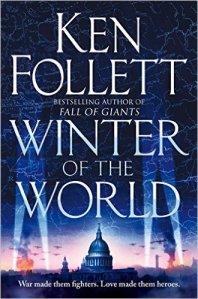
Winter Of The World‘Winter Of The World’ is the second part of Ken Follett’s trilogy about the twentieth century. It is an ambitious novel, taking readers from 1933 through the Second World War to 1949. The plotting is complex with characters in the US, England, Germany and Russia who experience some of the key points of this period of history – the rise of Hitler, the Nazi euthanasia programme, the war in Europe, Pearl Harbour, war in the Pacific, the development of the atom bomb, the aftermath of war in Germany – the list could go on and on. The raft of characters and wide ranging storylines does mean that some important parts of this period of history are missed or skimmed over, but that is perfectly understandable.
The historical information in this book creates a believable backdrop for the lives and loves of the fictional characters, and is testament to the in depth research which Mr Follett must have carried out. The characters are quite well rounded and believable of themselves, although the fact that they are almost all upper class or wealthy does give a certain bias to the book; even the family which comes from a Welsh mining village is involved in politics and has MP’s amongst them. I realise that Mr Follett does this to move the plot on, but I would have preferred to read about a few more ‘ordinary’ people.

Mr Follett has a way with words which brings scenes to life; he also writes in a way which keeps the story moving at a good pace and so draws the reader into his world. The first novel in the series, ‘Fall of Giants’, which deals with the first thirty years of the last century, should be read before this novel to give an understanding of who the main characters are and where they came from, but as that is an equally well researched and well written novel reading it will be no hardship!

‘Winter Of The World’ is a novel which will be enjoyed by people with an interest in twentieth century history, and also fans of Mr Follett’s previous books. I heartily recommend it.

Winter Of The World can be found on Amazon

Ken Follett’s website

More of my book reviews can be found here

An absolutely amazing story that needs to be read

I would like to thank Jodie at Whispering Stories for her lovely review of Heronfield. As an author it means a great deal to me to know that my work has touched someone in this way. Here’s what Jodie said:

Set in Europe during the Second World War, Heronfield takes us on a six year journey of war, friendship, love, sadness, and hope. We meet many different characters, a few of whom are taken right into our heart.

I became strongly attached to one of the main characters, Tony. A young man hardly in his twenties, he is secretly recruited as a British agent in the efforts to foil Hitler’s war. I found myself feeling sorry for him when certain members of his family turned against him for shirking his duties when in fact, unbeknown to them, he was doing the exact opposite, but was duty bound not to tell them.

I felt the turmoil and heartache he was going through. He showed a tremendous amount of strength and courage throughout the story – all borne by his passion to defeat Hitler, to prove to his father that he was indeed fighting in the war, and most of all, the driving force to keep going – his love for a woman.

Another character I enjoyed reading about was Sarah, a volunteer nurse. She gets stationed at Heronfield, a family home turned war hospital. She has plenty of heartache along the way but it makes her stronger over the years. As the story progresses and I found myself rooting for her all the way.

Some characters are constant, and others are fleeting, but memorable all the same. We come across a German soldier who makes us realise that they are not just the enemy. They are human too.

The German soldier does a selfless and heartfelt deed. We meet him again later on in the story and he has the opportunity to end a life. Instead he chooses to back down and explains that he doesn’t agree with Hitler, but if he doesn’t fight under the regime then he’s as good as dead anyway. It’s a touching scene and puts a different spin on the people behind the enemy faces.

The story grabbed me from the opening pages, with the graphic descriptions of the attacks on innocent civilians by the Germans. It’s harrowing but draws you right in, and you get a real sense of what actually went on during the war.

I liked the mini segments that gave real life time lines of what was happening during the war in various locations. It gave a sense of where the story would head next, and the progress of the war. They were superbly detailed without being boring.

The author has expertly carried out her research. The environment descriptions, the horrors of war, the abhorrent conditions of concentration camps, torture methods meted out, and many more besides are so wonderfully detailed that I found myself there. I winced at the persecution of innocents, gasped and grimaced at the torture methods bestowed on one of the characters, and I shed quite a few tears along the way.

My heart was in my mouth many times and the raw emotion grabbed at me and didn’t let go, even after finishing the book. I’ve never read a story that’s taken me by the soul and stayed with me quite the way Heronfield has done, and that’s a really good and beautiful thing – and a sure sign of a brilliantly well-written story.

Sadly I can only give this book five stars. I wish I could give it more but five is the maximum! An absolutely amazing story that needs to be read.

If Jodie’s review has intrigued you why not read Heronfield yourself and see if you agree?

If you have already read Heronfield, then have you thought of leaving a review? I love to hear what my readers think.

Book review – ‘The Nightingale’ by Kristin Hannah

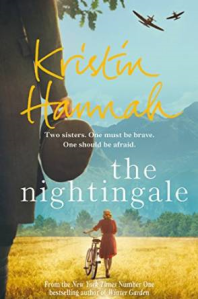
The Nightingale‘The Nightingale’ is a novel which will grip you from start to finish with its portrayal of life for two sisters in France during the Second World War. Vianne’s husband is taken by the Germans to a labour camp. Having a daughter makes Vianne cautious, intent on ensuring that they both survive the war. Her sister, Isabelle, is younger, more daring; a girl who has felt unloved for most of her life and feels she needs to do something, anything, to give meaning to her existence. Yet as the years progress, as hunger and lack of all luxuries set in, so the characters change to meet their changing circumstances. Small changes at first, but for each action there is a consequence leading, almost inevitable, to more dangerous actions. This is real life in the sense that it is moral choices that people make which mould them, choices which they sometimes wish they didn’t have to make but which cannot be avoided.
The Nightingale’ covers many aspects of life in occupied France – living with German officers who are billeted in your home, whether you like it or not; the treatment of Jews; the harsh realities of Occupation; the French Resistance; escape routes for Allied pilots across the mountains into Spain. Unusually, this novel’s two central characters are women, giving us a deeper understanding of what life was like away from the battlefields of the war, and helps us to realise that there are more battles to be fought than those involving guns and bombs.

The relationship between the two sisters changes dramatically during the novel as they finally come to realise the strengths and weaknesses which they each have, both different yet both equally brave and selfless in their attempts to help the lost and vulnerable under Nazi occupation.

This novel is well-paced, the plot developments work well, the characters are believable and many faceted, the dialogue realistic. The novel begins in America in 1995 with a French immigrant receiving an invitation to a ceremony in France to honour a heroine of the Second World War. Part of the suspense of the novel is wondering which of the sisters it is to honour, and which is the one who received the invitation. Did they both survive the war?

The Nightingale’ is fiction but is based on the lives of real people who put their lives on the line to help others during the German occupation of France. Many of these people made the ultimate sacrifice, but those who did survive rarely spoke of their experiences, sometimes because their memories were just too painful, or maybe because they felt that they had done nothing more than others. In ‘The Nightingale’ Kristin Hannah pays tribute to these people in a story full of pain and fear, yet also humanity and courage. It is a novel which I can heartily recommend to you.

The Nightingale can be found on Amazon

Kristin Hannah’s website

You can find more of my book reviews here

Book Review – ‘Jackdaws’ by Ken Follett

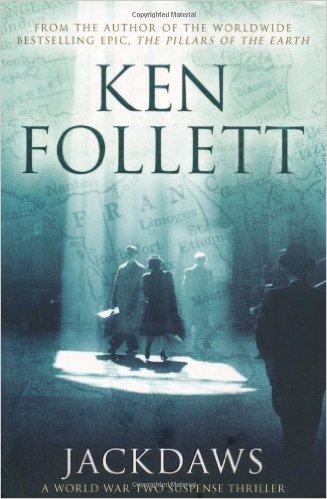
JackdawsTwo weeks before D-Day, the French Resistance attacks a chateau containing a telephone exchange vital to German communications – but the building is heavily guarded and the attack fails disastrously.

Flick Clairet, a young British secret agent, proposes a daring new plan: she will parachute into France with an all-woman team known as the ‘Jackdaws’ and they will penetrate the chateau in disguise. But, unknown to Flick, Rommel has assigned a brilliant, ruthless intelligence colonel, Dieter Franck, to crush the Resistance. And Dieter is on Flick’s trail…

Mr Follett is an historical novelist whose writings have ranged across the centuries; with ‘Jackdaws’ he returns to World War II in the days leading up to D Day. After an unsuccessful attempt to destroy an important communications exchange female SOE operative, Flick Clairet, heads an all-female operation to enter the complex in disguise and cause enough damage to disrupt German communications during the Allied invasion.

The plot of ‘Jackdaws’ is realistic; many women served in the SOE during the war, and some of them paid the ultimate sacrifice. Details of how agents were trained, how they reached their destinations in France, and the types of attacks they carried out alongside the French Resistance are accurate. Through this we are able to see the fear and horror facing those who worked behind enemy lines, yet also their courage and resourcefulness, and in this respect I can highly recommend this novel.

On the other hand, I did find some aspects of ‘Jackdaws’ a little too far-fetched. It would have been possible to put together an all-female group, but no agents would have been sent out with the limited training that the characters in this novel received. Also, some of the characters were incredibly blasé about the dangers facing them, behaving almost as though they were on holiday rather than on a secret mission behind enemy lines. Having said that, this is historical fiction and so one can suspend belief a little in exchange for a good story. And ‘Jackdaws’ is that. The plotting is clear, the action almost constant, the suspense engaging.

Alongside the story of Flick and her group we also have the story of Dieter Franck, a German Intelligence officer whose character is full of contradictions – willing to do whatever is necessary to achieve his aims, yet feeling the guilt at what those actions entail; a loving husband, yet a man who also loves his mistress; a man who upholds the German ideal yet has feelings for a Jew. With Franck, and the other main characters in this novel, Mr Follett explores human psychology showing us the complexity of human relationships and how our feelings for others can colour our actions.

All in all, ‘Jackdaws’ is a good war-time thriller. Anyone who enjoys a fast-paced story set during the Second World War will enjoy this novel.

Mr Folletts website can be found here 

Jackdaws can be found on Amazon

You can find more of my Book Reviews here

Book Review – ‘An Officer And A Spy’ by Robert Harris

an officer and a spyParis in 1895. Alfred Dreyfus, a young Jewish officer, has just been convicted of treason, sentenced to life imprisonment at Devil’s Island, and stripped of his rank in front of a baying crowd of twenty-thousand. Among the witnesses to his humiliation is Georges Picquart, the ambitious, intellectual, recently promoted head of the counterespionage agency that “proved” Dreyfus had passed secrets to the Germans. At first, Picquart firmly believes in Dreyfus’s guilt. But it is not long after Dreyfus is delivered to his desolate prison that Picquart stumbles on information that leads him to suspect that there is still a spy at large in the French military. As evidence of the most malignant deceit mounts and spirals inexorably toward the uppermost levels of government, Picquart is compelled to question not only the case against Dreyfus but also his most deeply held beliefs about his country, and about himself.

I can remember a brief study of the Dreyfus Affair while I was at school. It intrigued me but I never followed up on it, so when I saw ‘An Officer And A Spy’ by Robert Harris I felt I had to read it. I was not disappointed.

This book is an amazing read. Mr Harris has utilised all of the primary sources and leading academic works on the subject to create an incredibly detailed novel, drawing on court records, and also Dreyfus’ own writings. This may give the impression that ‘An Office And A Spy’ is a dry history book, but that couldn’t be further from the truth.

Mr Harris has written a gripping novel which draws you in – I certainly found it difficult to put down. The scenic descriptions are detailed, giving a great feel for time and place, the characters are well drawn, the dialogue totally believable. But what is most compelling about the novel is the complex plotting. Spying, forged documents, trials and hearings, attempted assassinations and attempted government cover-ups all lead to a taut thriller. I had to stop a number of times and remind myself that this story is real, a true accounting of an historical event, yet it reads like a novel by John le Carré, Robert Ludlum or Frederick Forsyth.

Mr Harris has brought to life the divisions of the Third Republic in France, the racism and anti-semitism, the corruption within the army and the government. From the initial miscarriage of justice, through the search for the truth by Georges Picquart and the defence of the free press in Zola’s J’accuse speech, we are led to the final triumph of justice and release of an innocent man.

The Dreyfus Affair, a scandal and one of the most famous miscarriages of justice of all time, has lain in dusty history books for 120 years, but in ‘An Officer And A Spy’ Mr Harris has transformed it into a spellbinding, gripping thriller which I hope that someone will one day make into a movie. If only all history books could be this exciting!

Robert Haris’s web page

‘An Officer And A Spy’ on Amazon

You can see more of my Book Reviews here

Book Review – ‘The Soldier’s Farewell’ by Alan Monaghan

The Soldier's FarewellBefore reading this novel I had a sketchy knowledge of the Irish War of Independence. ‘The Soldier’s Farewell’ has brought it to life for me. Set in England and Ireland in 1921 this novel follows the Ryan brothers through these momentous historical times. Stephen is an Irishman who fought for the British during the First World War, he is subsequently sent to London as part of the Irish Delegation to help with negotiations for the independence of Ireland. Joe, his brother, is jailed for his actions as a member of the IRA. Through the two brothers we follow the political and military upheavals of the early 1920’s, the ending of one war and the beginning of a new, more sinister conflict.

A sub-plot follows Stephen’s girlfriend, Lillian. A gifted mathematician, her work is stolen and her career progress blocked because of her gender. This provides an interesting look at the role and position of women in the early twentieth century, noting some changes (such as women’s suffrage in Ireland) and predicting some of the changes which would ultimately come. This sub-plot is expertly woven into the story of independence and helps to create a full, rounded character in Stephen.

As a historical novel ‘The Soldier’s Farewell’ is well researched, the real-life facts and characters portrayed through the story in an engaging way which never lectures. The fictional characters are believable and the dialogue well written. The descriptive scenes are compelling; from streets scenes to a prolonged journey on foot through snowy mountains, from formal meetings and court scenes to desperate military actions, from scenes of love to scenes of murder, Mr. Monaghan has created a world which brings to life a period of history which all British people should become more familiar with.

I can heartily recommend this book to anyone who wants to know more about the history of Ireland, the dreams and aspirations of the IRA, and how the Anglo-Irish conflict of the twentieth century was born in Dublin in 1921. (The Soldier’s Farewell is part three of Alan Monaghan’s trilogy set during the Irish Civil War).

Mr Monaghan’s website can be found here

‘The Soldier’s Farewell’ can be found on Amazon

Readers’ Favorite reviews Heronfield

I was very pleased to receive a 5 star review fro Readers’ Favorite; after all, it’s my readers who are most important to me!

Reviewed by Trudi LoPreto for Readers’ Favorite

Heronfield by Dorinda Balchin is a six-year saga set in England during World War II. It is a fantastic story that put me on the battlefield and into the lives of brothers Tony and David, their friends, family and loved ones. Heronfield is the home of the two brothers, but is now being used as a convalescent hospital for those injured fighting the Germans. Sarah is a young woman who is volunteering at Heronfield, nursing the soldiers back to health. David joins up and becomes a fighter pilot, making his father, Sir Michael, very proud. Tony becomes a secret agent, parachuting into enemy territory, setting up a resistance group, and working to destroy the strategic spots without getting caught – but he is unable to tell his family what he is really doing. Sir Michael thinks he is a coward and not willing to fight for his country. The story took me into many of the battles and to the horrors in the concentration camp that the prisoners had to endure on a daily basis. Heronfield also shared with me the happy times of falling in love and seeing friends caring for and helping each other through very tough times.

What a wonderful book this is. Dorinda Balchin wrote four hundred and ninety pages of an excellent story. It took me longer than I expected to read it, but each page made me cry, cheer, smile, and anxiously await D-Day and the end of the war. Heronfield is a fictional story with accurate historical events that made for a superb book. I cannot recommend it highly enough, especially if you enjoy family sagas and World War II history because it combines these elements in an incredibly good read.

You can take a look at the Readers’ Favorite website here

Book Review – ‘Wolf Hall’ by Hilary Mantel

wolf HallHenry VIII’s divorce from Catherine of Aragon, and subsequent marriage to Anne Boleyn, are well known facts of history. Most people even know the names of some of the other people who played key roles in this matter. What Hilary Mantel has done in ‘Wolf Hall’ is to breathe life into these people. To flesh out the brief, dusty biographies of history into living, breathing people. People we can love or hate, laugh with or laugh at, care for or hope for their downfall.

At the centre of it all is Thomas Cromwell. A man of humble origins, a traveller in his youth, a lawyer, friend of archbishops and, ultimately, confidant of the king. Ms Mantel has managed to get into the character of Cromwell, teasing out possible motives for his actions, deftly drawing the psychology of a man and of an age. History depicts Cromwell as a ruthless self-seeker, and there are aspects of that in this book, yet Ms Mantel digs deeper – a loyal friend, a family man, a loving husband and father, a cultured man who knew many languages, loved art and poetry, loved to hunt with his falcons, was keen to find and train young minds. This bringing to life of Cromwell, and many other characters, makes ‘Wolf Hall’ compelling reading, even though we already know the outcome of the story. Added to this is the in-depth depiction of life at court – the ladies in waiting, the kings gentlemen, intrigue and indulgence, banquets and religious disagreement, hunting and jousting – the list is endless. Along with the background of Cromwell this gives a fascinating insight into life in Tudor times for both rich and poor.

‘Wolf Hall’ is an historical novel with an emphasis on history, both in the plot and the descriptions. Ms Mantel has taken a story we all know and masterfully made it into something new, which any lover of history will enjoy. With one caveat. I enjoyed reading this book, but for some the style may be a little strange. Cromwell is always referred to as ‘he’, which can be confusing at times; so much so that, on occasion, the author resorts to writing ‘he, Cromwell, said…’. For myself, this is not a problem as the style is quite unique and gives a feeling of being in another time with another turn of phrase, another way of saying and doing things. For those who initially find this style difficult to follow I would ask you to persevere, a few pages in and you will cease to notice this most of the time as you become gripped by the story.

‘Wolf Hall’ is a fascinating read, and a great introduction to Thomas Cromwell. I am very much looking forward to following his story through Anne Boleyn’s time as Henry’s wife, and on to yet another queen in Ms Mantel’s sequel, ‘Bring Up The Bodies’.

Hilary Mantel’s website can be found here

Wolf Hall can be found on Amazon

You can find more of my Book Reviews here