Category Archives: world war 2

A wartime Christmas

Children who grew up during the long years of the Second World War had a difficult life, they certainly had little idea of the type of Christmas festivities which had been enjoyed by their parents or older siblings in earlier years. With food shortages, rationing, and manufacturing focused on the war effort, these children had far less too enjoy than those who had gone before. But what was worse for most families was the fact that they had to spend the festive season without their loved ones – many husbands, fathers, brothers, and sons were fighting overseas, or were prisoners of war; many women were in the services or carrying on vital war work, many children had been evacuated and would be spending Christmas far from home with strangers. And many families had empty chairs at their tables which would never be filled again – family members killed in action or bombing raids.

As well as the sadness of separation Christmas luxuries were also hard to come by, even basic foods were scarce and people had to improvise by finding creative substitutes for festive ingredients. The black market did a roaring trade  in December but, even so, few people were able to buy gifts which  meant that many of the presents unwrapped on Christmas morning were homemade and practical. The government even encouraged people to ‘Make it a War Savings Christmas’, buying bonds and supporting the war effort rather than giving presents.

Poster issued by the National Savings Committee. © IWM (Art.IWM PST 16433)

Making Christmas look as festive as possible was more difficult from 1941 onwards because it was impossible to buy Christmas wrapping paper thanks to the Ministry of Supply ruling that ‘no retailer shall provide any paper for the packaging or wrapping of goods excepting foodstuffs or articles which the shopkeeper has agreed to deliver’. This effort to save paper  impacted on many aspects of life, including making it difficult to wrap Christmas presents and keep them a surprise. The shortage of paper also meant that it was almost impossible to find decorations so these, too, were homemade, often using old newspapers which had been painted in festive colours.

Children at Fen Ditton Junior School (Cambridgeshire) making paper chains for Christmas..© IWM (D 23619)

Britain’s allies understood the hardships of people back in the United Kingdom and set up charities to help. In America many of these charities came together under the umbrella of the British War Relief Society whose aim was to send food and clothes to those in need. In this photograph a young boy called Derek Cunningham received a Christmas card and gifts from the BWRS in Canning Town (London).
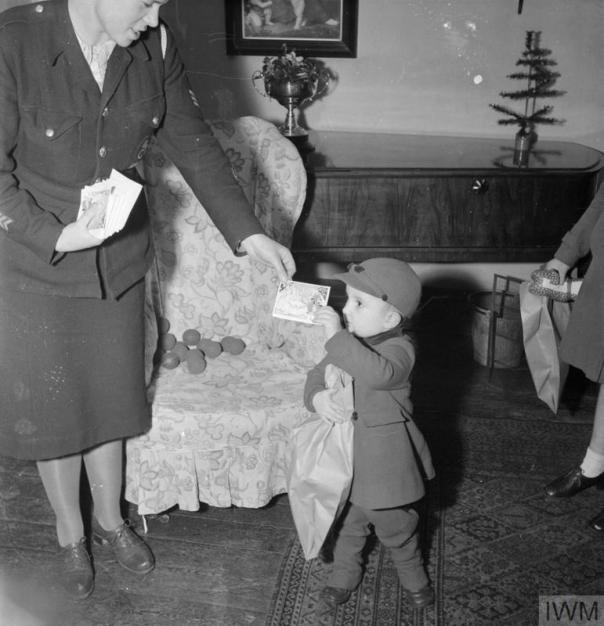
© IWM (D 23296)

American soldiers were also encouraged to spend Christmas with their English allies in an effort to integrate more closely as they were often resented by the locals for being ‘overpaid, oversexed, and over here!’ Most GI’s had never been abroad before so to be spending Christmas away from their families was difficult for them. The idea was that civilians would invite an American to spend Christmas Day with them and, in return, the soldiers would bring gifts (nylon stockings, chocolate, cigarettes, chewing gum etc.). Rationing meant that the British had limited food supplies so each soldier who accepted an invitation was given special rations from the PX for every day that they spent with a host family (the PX was the Post Exchange which was the American equivalent of the British NAAFI). Despite initial misgivings the programme proved a huge success.

© IWM (EA 10182)

Added to the sadness of Christmas without family members and the hardship of trying to find food and presents during a time of rationing, was the fear of the enemy. In 1940 London had been bombed for 57 consecutive nights leading up to Christmas, and no one believed that Christmas Eve would be any different. Fearing for their safetly many people spent the night before Christmas in air-raid shelters rather than waiting at home for Father Christmas to call. It could be a very dark and dreary begining to what should be a festive season.

A Shelter in Camden Town under a Brewery: Christmas Eve, 1940, by Olga Lehmann. © IWM (Art.IWM ART LD 1899

Some places which offered shelter did thier best to raise people’s spirits with decorations and maybe even a little tree. This picture, by Edmund Knapp, depicts the crypt of St Martin-in-the-Fields church (close to Trafalgar Square) which was used as a canteen by firewatchers, ARP wardens, and people whose homes had been bombed. The church itself was damaged by the massive bombing raid on 29th December 1940 but the crypt remained intact and in use for the remainder of the war.

Ready for Christmas: the Canteen under St. Martin’s-in-the-Fields, 1941, by Edmund Knapp © IWM (Art.IWM ART LD 800)

Despite the hardship of a war-time Christmas some pre-war rituals remained, such as carol singing and pantomimes, and the BBC tried to help with the festive cheer by broadcasting a special radio programme for Christmas Day. In 1939 this programme included a Christmas speech from King George VI. Although there had been previous broadcasts by monarchs this message had particular meaning as it was the first year of the war. As well as praising the  armed forces the king ended with a message of hope from the poem ‘God Knows’ by Minnie Louise Haskins:

I said to the man who stood at the Gate of the Year, “Give me a light that I may tread safely into the unknown.” And he replied, “Go out into the darkness, and put your hand into the Hand of God. That shall be to you better than light, and safer than a known way.”
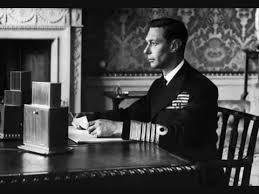
George VI’s speech was listened to by everyone who could get close to a radio, instilling a sense of common purpose as the country faced an uncertain future. It was to be six long years before the king gave his next Christmas message in a time of peace.

May I take this opportunity to send you all best wishes for  a happy and peaceful  Christmas, and hope that 2018 is all that you dream it will be.

The Orphan’s Tale by Pam Jenoff

(New York Times Bestseller)

In Nazi-occupied Holland, seventeen-year-old Noa snatches a baby from a train bound for the concentration camps, fleeing with him into the snowy wilderness surrounding the train tracks.

Passing through the woods is a German circus, led by the heroic Herr Neuhoff. They agree to take in Noa and the baby, on one condition: to earn her keep, Noa must master the flying trapeze – under the tutorage of mysterious aerialist, Astrid.

Soaring high above the crowds, Noa and Astrid must learn to trust one another…or plummet. But with the threat of war closing in, loyalty can become the most dangerous trait of all.

In this novel Noa, a Dutch teenager who falls pregnant after a one-night stand with a German soldier, is disowned by her family and forced to give up her baby. She later comes across a train pulling a cattle truck full of Jewish babies en-route to a concentration camp, and impulsively takes a child – partly because of her horror at the situation and partly because of the loss of her own child which has left her feeling guilty and bereft. Noa gets lost in a snow storm and expects to die, but is rescued by a travelling circus where she makes a strange alliance with Astrid who has her own complicated history as a Jew who had once been married to a German officer. The premise of this story may seem far-fetched but, surprisingly, it is based on a number of true stories from the Second World War. In her notes at the end of the novel Ms Jenoff explains how she came across two stories in the Yad Vashem archives whilst doing research for her job as a diplomat for the U.S. State Department handling Holocaust issues in Poland. The first story was an account of a boxcar full of babies being sent to a concentration camp, the second was the story of a German circus which had sheltered Jews during the war (the owner, Adolf Althoff, was named Righteous Among The Nations by Yad Vashem). The author has taken these stories and woven them together to create a fictional circus with characters and incidents which give us a glimpse of the fear and hardship of those who put humanity above nationality during one of the darkest periods of the 20th century.

Using parallel narratives Ms Jenoff tells an inspiring story of two very different women brought together by war; characters who are believable because they are so flawed – capable of generosity and selflessness at times, and at other times quite reckless and selfish; women who are changed for the better by the tragedies they have to endure. I must admit that I found Noa’s almost instant love for Luc, and his for her, rather improbable; for me this is the weakest part of the novel but, setting that aside, it does help the author to explore one or two other themes connected to war and conflict, particularly how a family (in this case Luc’s) can be divided by their beliefs and by what they feel is the best way for them to protect the people around them. Noa also seemed rather reckless at times as she knowingly did things which could jeapordise the safety of others but, having said that, one must remember that the character is just seventeen years old and I’m sure that the characteristic traits of a teenager could not be totally surpressed even during a time of war! The focus of this novel is on the relationship of these two women rather than the war itself, and I find this to be one of the strengths of the book. The two women journey from jealousy and suspicion to a grudging respect, and then even love for each other.

Ms Jennoff has also shown a detailed knowledge of circus life in her writing. The atmosphere of the circus ring is vividly evoked – the excitement and glamour as seen from the perspective of the customers. Yet this is well contrasted with life behind the scenes – the shabbiness, the hard work, the lack of privacy, the monotony. The author also conveys how life became much more difficult for German circuses during the war as restrictions were placed on them by the Nazis, yet the determination that ‘the show must go on’ shines through, particularly as the circus brings a feeling of normality and escapism to the people of towns and villages living under German occupation.

‘The Orphan’s Tale’ has a well-structured plot which is well paced with the tension rising steadily to the ultimate climax in the big top. Interestingly the pivitol role is a baby who has no words to speak and no actions which influence the tale; the purpose of his character is, in my view, to be a symbol for all those who were victims of the Nazis. The child represents every Jew, or gypsy, or homosexual, or disabled person taken by the regime; it doesn’t really matter who he is or where he came from, the underlying current of this novel is that he should survive to tell the tale and to live a life denied to so many others. ‘The Orphan’s Tale’ is historical fiction with a focus on how ordinary people survive during times of conflict and upheaval rather than on the key events of the war. If you are fond of character driven  historical novels you will probably enjoy this.

The Orphan’s Tale can  be found on Amazon

You can find out more about Ms Jenoff here

You can  find more of my Recommended  Reads here


Joy Lofthouse – the girl who flew Spitfires for the RAF in the Second World War

During the Second World War women took on many jobs that were previously reserved for men. One such job was with the Air Transport Auxiliary (ATA). The ‘Attagirls’ delivered planes from the factory to operational airfields, which freed up male pilots to fly missions.

One of the 164 women who flew these planes was Joy Lofthouse, who died this week aged 94.

Please do take a look at his article and listen to Joy, who was interviewed earlier this year. A remarkable lady who did a remarkable job for her country.

RIP Joy Lofthouse.


The only thing that ever really frightened Churchill – The Battle of the Atlantic

What image do you have of Winston Churchill as he led Britain during the Second World War? Most people would say positive things like ‘steadfast’, ‘unflinching’, ‘courageous’, etc., few would mention the word ‘afraid’. Yet there was one thing which worried him more than any other, in his own words ‘…the only thing that ever really frightened me during the war was the U-boat peril.’ And Churchill had every right to feel afraid. The route across the Atlantic was Britain’s lifeline, and Germany’s best hope of defeating the island nation would be by winning the Battle of the Atlantic.

HMS BARHAM explodes as her 15 inch magazine ignites, 25 November 1941. Copyright: © IWM. object/205022049

Britain relied heavily on merchant ships carrying supplies of raw materials, food, troops, and military equipment from America. If the convoys had failed to get through Britain would most likely have been starved to the brink of surrender; her badly equipped armies, lacking tanks and weapons built in America, would have been overrun; it would have been impossible to transport land forces to North Africa, the Mediterranean, or across the English Channel on D Day; and it would have been impossible for the British to blockade the Axis powers in Europe. In short, if German U-boats had reigned supreme in the Atlantic then Hitler would, in all likelihood, have won the war.

A German U-Boat commander tracking a British merchant ship through his periscope during an attack on a convoy, 10-20 June 1942. Copyright: © IWM. object/205194304

The first phase of the Battle of the Atlantic lasted from the outbreak of war in 1939 until the British retreat from Dunkirk in June 1940. This was a time which saw the British and French with the upper hand, establishing a long-range blockade on German merchant ships. But after the German victories in northern Europe in 1940 and the entry of Italy into the war, Britain lost the support of the French navy. It was a difficult time; as well as the loss of the French ships Britain also suffered losses in the retreats from Norway and Dunkirk, losses which cut the British merchant fleet to almost half of its former size at the critical moment when Germany was acquiring naval bases on the Atlantic coast of France which made it easier for them to attack Allied shipping in the Atlantic; bases such as the one at Saint Nazaire. The attacking forces had the support of long-range Kondor aircraft which carried out reconnaissance for the U-boats and also attacked Allied shipping. Between the fall of France in June 1940 and the end of the year German U-boats sank three million tons of Allied shipping. To make matters worse, the Axis powers in the Mediterranean made the route through the Suez Canal so dangerous that British merchant ships had to take the much longer route around the Cape of Good Hope. The situation, which was so dire for the Allies, appeared more hopeful for the Germans who believed that it would only be a matter of time before they would knock Britain out of the war by attacking her trade. (The Germans estimated that they would have to sink 150 merchant ships a month to starve Britain into submission).

Shipping losses: HMS BARHAM listing to port after being torpedoed by U 331. HMS VALIANT is in the background. Photograph taken from HMS QUEEN ELIZABETH. Copyright: © IWM. object/205194526

The German U-boats hunted in ‘wolf packs’ which were faster than the convoys and had the advantage of being able to see without being seen. The merchant convoys were relatively safe in either British or American waters where they could receive fighter cover, but were much more vulnerable in the mid-Atlantic where German submarines reigned supreme. During the autumn and winter of 1940-41 German U-boats had great successes supported by surface ships and planes. But Britain hung on with the help of Canadian naval and air forces so that, by May 1941, a system of fully escorted convoys was in place. The position for Britain was eased further with the ‘Destroyers for Bases’ deal in which America, although not yet in the war, provided more than 50 old World War I destroyers in return for 99-year leases for bases in the Caribbean. New lightly-armoured and much faster ships called corvettes began to accompany the convoys; with their ASDIC (which helped them to hear submarines underwater) and their arsenal of depth charges they began to make a difference. Close to shore new planes like the Sunderland were able to give better air cover as a submarine had to be close to the surface to fire its torpedoes and so became a sitting target for the planes. Allied losses began to fall at last, particularly when the convoys sailed during bad weather as the U-boats could not fire their torpedoes in a heavy swell.

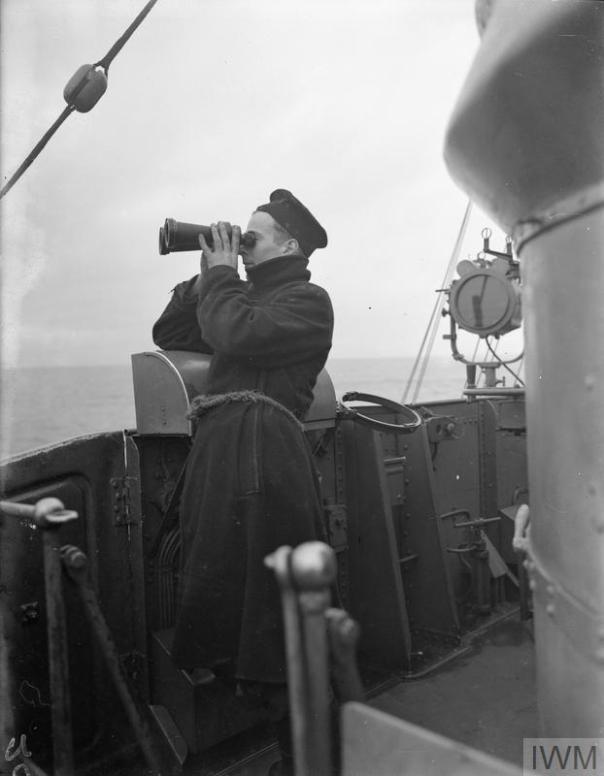
A seaman on watch at sea. Copyright: © IWM. object/205139887

Things changed again after Pearl Harbor and America’s entry into the war. US ships were re-deployed to the Pacific to face the Japanese threat, and the Germans found that shipping on the American east coast in early 1942 was unguarded. The situation led to a rise in Allied merchant shipping losses in the first half of 1942 with disastrous results – in those six months more tonnage was lost than in the entire preceding two and a half years. To make matters worse, the U-boat packs were ranging across the South Atlantic as well, targeting the shipping lanes from Asia and the Middle East, while Allied convoys to Russia were also suffering heavy losses.

Anti-Submarine Weapons: A Mk VII depth charge being loaded onto a Mk IV depth charge thrower on board HMS DIANTHUS. Copyright: © IWM.
object/205194536

It was Canada who once again came to the rescue, providing escorts for the North Atlantic convoys while America underwent a huge ship-building programme so that, by the autumn, they had caught up with losses and were increasing their fleet. The Allies were also intercepting German U-boat communications through the Ultra programme which made a real difference. Then, in March 1943, Ultra failed for a short time during which the Germans sighted every single Allied convoy and attacked over half of them. But, finally, the Battle of the Atlantic was turning in the favour of the Allies. Once more able to break the German codes, using more modern radar equipment, with the addition of new aircraft carriers to the escort groups, and more aggressive tactics meant that, by May 1943, the success of the German U-boat fleet in the North Atlantic was severely diminished. For the remainder of the war the Allies had more or less unchallenged control of the Atlantic sea lanes.

On board a destroyer on escort duty Copyright: © IWM. object/205139891

The men and women who served with the Army, Royal Air Force and Royal Navy are frequently remembered for their courage, and rightly so. But the men of the merchant navy who sailed the gauntlet of an ocean of hidden submarines to re-supply ‘Fortress Britain’ are often forgotten. Yet their courage and sacrifice under fire was no less heroic, and without them the war might well have been lost.

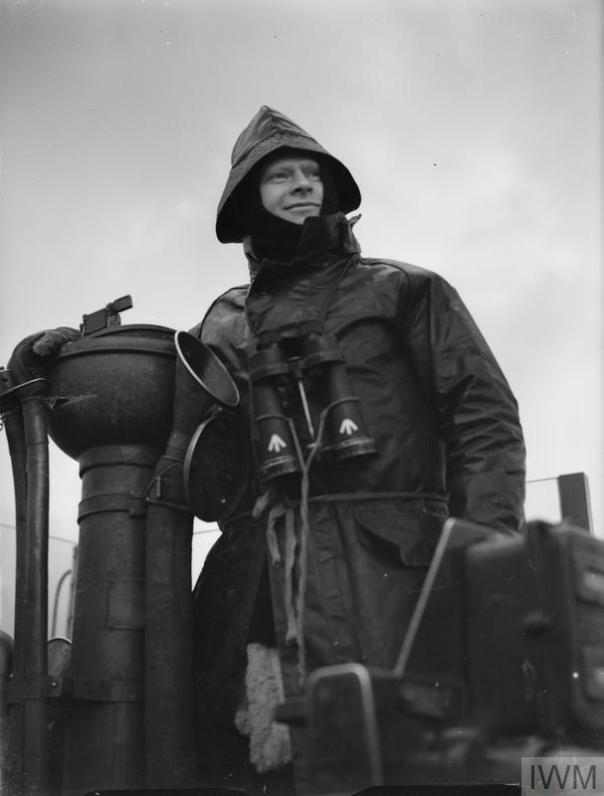
28 NOVEMBER TO 10 DECEMBER 1941, ON BOARD THE DESTROYER HMS VANOC. (A 6633) The officer of the watch dressed for the weather during an Atlantic winter. Copyright: © IWM. object/205140741

Allied losses during the Battle of the Atlantic

36,200 sailors killed
36,000 merchant seamen killed
3,500 merchant vessels sunk
175 warships sunk
741 RAF Coastal Command Aircraft lost in anti-submarine sorties

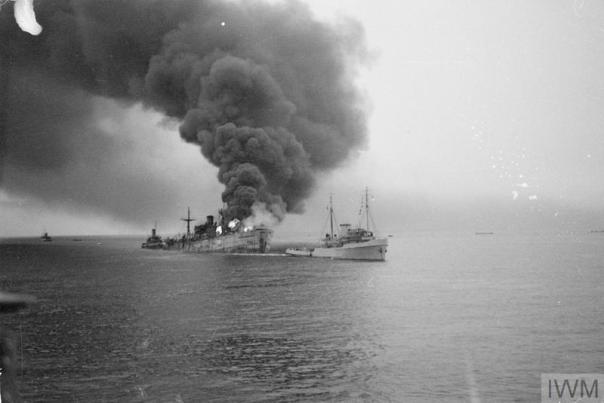
1943 (AX 44A) The Dutch tug ZWARTE ZEE tows back to harbour a blazing American freighter, probably the SS FLORA MACDONALD which had been torpedoed by a U-boat in the Atlantic during a convoy from Marshall, Liberia to Freetown, Sierra Leone, 29 May 1943. Copyright: © IWM. object/205133324

Bibliography

The Battle of the Atlantic by Andrew Williams

Captain Gilbert Roberts RN and the Anti-U-boat School by Mark Williams

In Great Waters: The Epic Story of the Battle of the Atlantic by Spencer Dunmore

The Battle of the Atlantic by Macintyre, Donald.

Life or death communications – the use of codes by Britain’s spies in the Second World War

Did you ever write messages in code when you were a child? I remember having fun believing that what I wrote to my friend was unreadable by anyone else – even though we only used a simple code where the letters of the alphabet were transposed a number of places. For instance, if we transposed the letters by two places we could send this message:

UJCNN YG IQ VQ VJG EKPGOC VQOQTTQY – I’m sure you’ll find it very easy to read!*

Communication is vital during war, particularly for agents who may be behind enemy lines, but sending messages can also be very dangerous. For agents of the Special Operations Executive (SOE) during the Second World War it was always possible that the enemy might decipher their messages or get a fix on the radio when the message was sent – both scenarios which could put the life of the agent in danger. To ensure a transmission was as safe as possible some sort of encryption was needed to keep the message secret.

Samuel Morse

Before learning how to encode a message the SOE agent would first have to learn how to send in Morse code which is a method of transmitting text as a series of ‘on’ and ‘off’ switches which are known as ‘dots’ and ‘dashes’ and are, in effect, a simple binary coding. The code is named after Samuel Morse who invented the telegraph in the 1830’s and needed a new electronic system to be able to send messages. Each letter or symbol in Morse code is represented by a series of these dots and dashes and it is the simplest and most versatile method of radio/telegraph communication. The most well-known grouping of letters in Morse code is the universal distress call    . . . _ _ _ . . . (dot dot dot dash dash dash dot dot dot), more commonly known as SOS.

But learning Morse code was only the first step for an agent who was preparing to go overseas as it was a universally known code and so the enemy would be able to read any messages that they sent. In the early days of the SOE agents used a simple, and consequently insecure, code known as ‘poem code’ to encrypt their messages. Both the agent and the person receiving the message would have a copy of the same poem. The sender would start his message with five letters to indicate which part of the poem his encryption would be based on; the message would then be written in columns before being transposed and transmitted. These poem codes worked well because they were quite secure but the agent didn’t need to carry a code book as they could memorise the poem. There were, however, weaknesses to this system. For instance, it was relatively easy to make a mistake when encoding; also, if the enemy managed to decode one message they then had all the information they needed to decode other transmissions from that agent in the future, and even ones they had intercepted in the past.

Leo Marks

The SOE knew that they needed to improve their communications system and so Leo Marks was appointed as codes officer. He found that the poems used for encryption had to be easy for agents to remember and so were often famous ones such as ‘Daffodils’ – the problem was that these famous poems would be known by the enemy and so make it easier for them to crack the codes. One of the first changes Marks made was to have original poems written for the agents to use rather than famous ones, these original poems were often comic, satirical or sexual to make them more memorable. Not all fell into these categories though, and one of the most famous of his original poems was, in fact, a love poem written for his girlfriend who had been killed in a plane crash; he later gave this poem to agent Violette Szabo to use when she was posted to France. (Violette was executed at Ravensbruck concentration camp in 1945 and her service in the SOE was commemorated in the 1958 film ‘Carve Her Name With Pride’).

The life that I have
Is all that I have
And the life that I have
Is yours.

The love that I have
Of the life that I have
Is yours and yours and yours.

A sleep I shall have
A rest I shall have
Yet death will be but a pause.

For the peace of my years
In the long green grass
Will be yours and yours and yours.

Violette Szabo

Another method Marks introduced was to simply use a different poem for each transmission to prevent any sort of pattern which might help the enemy. As it would have been hard for an agent to remember a number of poems correctly these were written on silk rather than memorised.

Leo Marks continued to work on more secure methods of encryption and the poem code was gradually replaced. The Worked-Out Key (WOK) system used a number of codes which were used only once and were written on silk (to be hidden in the agents clothing as described in my article on radio operators). Once a particular key had been used it would be torn off the silk and destroyed, leaving the next key ready for use. Marks went on to develop a One-Time Pad code where the letters of the alphabet were written in a list, the agent encoded his message by using a substitution square (i.e. substituting a different letter for each one in the alphabet). After being used once the list was thrown away and a different one used next time but still using the same substitution square. This was much safer than the poem code as there was no pattern to the listing of the letters of the alphabet and so even if the enemy managed to break the code for one message it wouldn’t help them with future ones. SOE agents liked this method as it was quick and secure.

As well as ensuring the safest possible codes Leo Marks worked on ways of deceiving the enemy through agent’s transmissions. One of these deceptions was Operation Gift-Horse which included key codes from the WOK system at the beginning of each message and fooled the enemy into thinking it was a poem code. The main aim of this operation was to get the Germans to waste their time trying to decipher coded poems when the message was, in fact, a completely different system. ‘Gift-Horse’ was used extensively just before D Day in 1944 at a time when there was already a huge increase in radio messages and so made the chances of the Germans decoding and compiling information about the invasion much more difficult.

So the types of puzzles which we find so enjoyable as a leisure activity had a far more serious role for a secret agent behind enemy lines. Maybe next time you do a puzzle in a magazine or a book you can take a moment to think of those for whom coding was not a simple pass-time but a key part of their work which, if not done correctly, could cost them their life.

*My code de-encrypted: SHALL WE GO TO THE CINEMA TOMORROW

A life on the line – SOE radio operators in the Second World War

England. June 1940. Things looked bleak for the Allies after the fall of France and the retreat from Dunkirk, Britain was on the defensive and most people believed that the invasion of England would soon begin. In an effort to take some of the fight to the enemy Winston Churchill authorised Hugh Dalton, the Minister of Economic Warfare, to set up a clandestine organization to help form, supply and run resistance movements in occupied countries. This new Special Operations Executive (SEO) was to be responsible for recruiting and training agents who would then be sent behind enemy lines. (The work of the SOE). One of the most difficult roles which members of the SOE undertook was that of wireless operator.

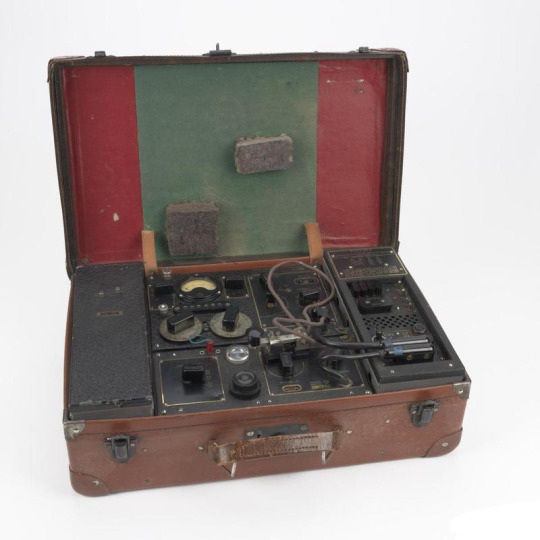
The early equipment needed by radio operators was cumbersome – a short-wave morse transceiver (capable of both sending and receiving messages) weighing a hefty 30 pounds along with a flexible aerial 70 feet long – all of which had to be concealed in a suitcase 2 feet long. It was hard to be inconspicuous and not act suspiciously whilst carrying such incriminating equipment in enemy held territory. The SOE realised how important the correct equipment would be for the survival of their agents and began to design their own lighter and more portable sets. The culmination of this work was the Paraset, a major improvement as it weighed just 9 pounds and was small enough to carry in a small attache case yet powerful enough to send and receive messages over distances in excess of 500 miles.

Type 3 Mark II (B2),

Type 3 Mark II (B2),used when longer range was required

An SOE wireless operator had to know the area they worked in intimately. It was vital that they transmit from a different place, and only very briefly, each time they made contact with base as it was estimated that, in an urban environment, the Germans were able to track down a transmitter in around half an hour. Agents also had to create schedules for their transmissions which did not involve making contact on the same day of the week or at the same time of day, as any sort of pattern which could be identified by the Germans would be disasterous. The ideal for an agent was to set up, transmit, dismantle and get away within a maximum of 20 minutes to avoid capture and torture. To be found transmitting would almost certainly mean death to the operator, but it could also be devastating to the resistance group they worked with. If the enemy captured a transceiver and code books they would try to use them to trap the rest of the grouup. To try to prevent such deceptions each wireless operator was instructed to spell certain words incorrectly – if a transmission was made with the word spelt correctly the handler back in England would know that the operator had been compromised and, hopefully, have time to warn field agents in time for them to make good their escape.

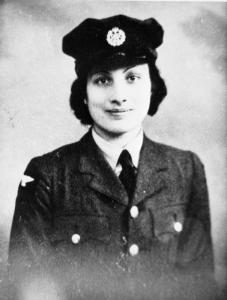
Noor Inayat Khan, a member of the SOE who was executed by the Germans

The majority of radio operators sent behind enemy lines by the SOE were women as it as believed that they would be able to move around with their equipment without drawing as much attention to themselves as a man would. After all, it was quite common for women to be out shopping with a bag during the day whilst a man in a similar situation would be much more conspicuous. The women who signed up to do this work were under no illusions as to the importance, and the danger, of what they were committing to – the life expectancy of as SOE wireless operator working in Occupied France was just six weeks. (The Women Who Spied For Britain)

Some resistance groups were set up by the SOE whilst others were formed by locals with SOE support, yet regardless of how they began all groups received their instructions directly from England (or one of the subsidiary bases in other theatres of war, such as Cairo). The wireless operator in the ‘circuit’ lived in isolation with only brief contact with a single member of the group. It was a lonely existence in order to protect the remainder of the group. A wireless operator would not take part in operations such as sabotage, their only role was to be responsible for transmitting orders, or arranging the transport of agents and drops of supplies. In the early days all transmissions went through the radio station at Bletchley Park but the SOE later had its own stations at Poundon and Grendon Underwood – messages from the field would come in there to be forwarded to SOE HQ in London by teleprinter.

Security was vital in this clandestine world, both for the agent in the field and the information being transmitted. One way of ensuring security was by having an agent who knew how to transmit safely and securely, but the use of codes was also incredibly important. To begin with insecure poem codes were used, but these led to a number of disasters and so Leo Marks was made chief cryptographer. As part of his role Marks helped to develop single use ciphers printed on silk in an effort to save agents lives. The reason for such an expensive material was simple – it didn’t make a rustling sound like paper so, once concealed in the lining of clothing, it would not be detectable during a casual search.

Wireless operators who served behind enemy lines played an incredibly important role during the Second World War, particularly in the weeks leading up to the D Day landings in June 1944. Without their courage and sacrifice the war could have dragged on for months longer, and many more lives been lost. In my novel, Heronfield, one of the characters is a young woman who places her life on the line to be an SOE wireless operative in St Nazaire. My creation is an amalgamation of many women who served, and is my tribute to them all.


The fruits that won the war – Mulberry Harbours

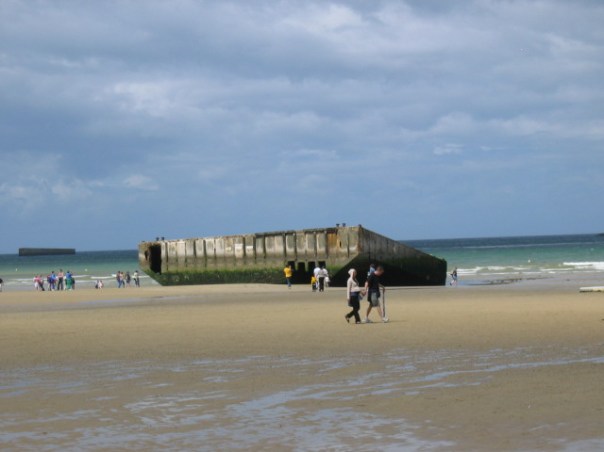
If you holiday in France you may like to visit Arromanches on the Normandy coast. This was the site of one of the Mulberry Harbours, an amazing engineering feat which helped to change the course of the Second World War. The remains of the harbour can still be seen today.

German coastal defences at Arromanches

Both the Allies and Hitler knew that an Allied invasion of Nazi held Europe was essential for the winning of the war. They also knew that any landing was unlikely to succeed without a safe harbour in Allied hands. Once the liberating forces had established a foothold on the Normandy coast enormous amounts of men and supplies would need to be landed to re-enforce the bridgehead before pushing on towards Germany. The problem for the Allies was that the Germans had occupied and heavily fortified all the ports on the northern coast of France. The disastrous Allied raid on Dieppe in 1942 showed that taking such ports would only be done with immense loss of life and would not be quick. What the Allies needed was access to a port that was not controlled by the Germans. Small fishing ports would not be suitable as the large ships needed to transport bulky supplies needed a deep port with harbourside cranes; the Allies therefore decided that if no such ports were available they would have to create their own.

The plan they came up with was simple yet would be incredibly complex to achieve – the construction of a new harbour the size of Dover at the site of the invasion. The plan was to prefabricate the elements needed in Britain before towing them across the English Channel and creating a harbour off the landing beaches. The schedule was to complete the construction within two weeks of the D Day landings in June 1944. Winston Churchill knew that there would be enormous problems with this idea but was determined that it should work if the invasion was to be successful. A trial of three competing designs for the floating harbour was set up in 1943 with prototypes built and tested on the Solway Firth. Once the design was finalised the War Office could begin the prefabrication of the concrete caissons.

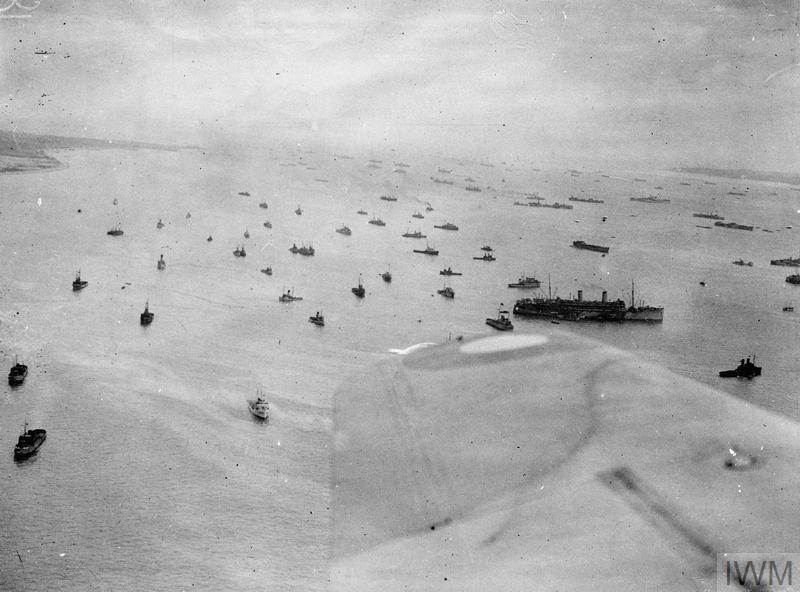
D Day Copyright: © IWM.

The invasion of Europe began on 6th June 1944, D Day, with thousands of Allied troops landing along the Normandy coast. Once the beachheads were secured the work on the floating harbours began, the first stage of which was to scuttle a number of old ships off the coast at Arromanches as temporary outer breakwaters (the Gooseberries) to protect the area where the harbour (the Mulberry) was to be built. The huge prefabricated caissons (water-tight concrete structures codenamed Phoenixes) were then sunk to provide the permanent breakwaters which would shelter the floating roadways and jetties.  Once the completed Mulberry Harbour was in place the Allies could begin unloading the supplies which would be so vital for their victory.

There were actually two Mulberry Harbours towed across the English Channel to support the Normandy beachheads. Mulberry A was constructed at Omaha Beach whilst Mulberry B (nicknamed ‘Port Winston’), was constructed off Gold Beach at the town of Arromanches. Once assembled the harbours could unload 7,000 tons of supplies a day. Each incredibly complex harbour had masses of pontoons which supported around 6 miles of flexible roadways ending in huge pier heads supported by underwater ‘legs’.

An incredible feat of engineering had both harbours almost fully functional when they were hit by a storm on 19th June. The Mulberry Harbours had been designed for summer weather not the worst storm to hit the Normandy coast for 40 years, and the harbour at Omaha beach was so badly damaged that it was beyond repair. This could have been a disaster for the Allied forces, but although the second Mulberry suffered some damage it survived the storm and continued to land supplies in support of the invasion. Although it had been designed to last for just ninety days Port Winston was in continuous use for ten months following D Day and in that time landed over half a million vehicles, two and a half million men and four million tons of supplies.

When the invasion had moved eastward and liberated ports from the Nazis the harbour was no longer useful and was abandoned. If you visit Arromanches today you can see the remains of the Mulberry Harbour from the beaches.

The scale and sheer audacity of the Mulberries took the Germans completely by surprise. At the Nurembeurg trials after the war Albert Speer, Reich Minister of Armaments and War Production for Nazi Germany, gave a German perspective on the Mulberry Harbours:

“To construct our defences we had in two years used some 13 million cubic metres of concrete and 1½ million tons of steel. A fortnight after the Normandy Landings, this costly effort was brought to nothing because of an idea of simple genius. As we now know, the invasion force brought their own harbours, and built, at Arromanches and Omaha, on unprotected coast, the necessary landing ramps.”

When we remember the troops who fought and died on the beaches of Normandy we should not forget those who designed and built the Mulberry Harbours which were so instrumental in making D Day and the invasion of Europe such a success.

The women who spied for Britain

The Invasion of France at the beginning of the Second World War is known as the Blitzkrieg – Lightning War – and it really was like lightning. It was just six short weeks from the start of the invasion on 10th May 1940 to the French signing an armistice with Germany on 22nd June. Yet although Germany had defeated the French army many French citizens were not ready to submit to the conquerors and so the British government set up the Special Operations Executive (SOE). Its instructions from Churchill were to ‘set Europe ablaze’ by helping to fight the Germans behind enemy lines.

German soldiers in Paris

Recruits to the SOE underwent commando training as well as learning how to use guns and explosives, to effectively sabotage enemy installations and transport, to use wireless radios, to be proficient in silent killing and unarmed combat. They also had to learn how to blend in and live in secret in occupied territory, sometimes for weeks or months at a time.

Many may find it surprising to know that women were members of the SOE right from the start. At first their role was only to work in the offices producing forged papers for the men who would be going into action (ration cards, passports etc.), or perhaps coding or de-coding messages from agents as well as transmitting these messages via wireless. It wasn’t until April 1942 that Churchill finally gave his approval for women to be sent as agents into Europe. Part of the reasoning for this was that women would be less conspicuous as they were always out and about – shopping or taking children to school etc. – men who were seen on the streets too frequently soon came to the notice of the Gestapo. So the SOE recruited women as wireless operators and couriers and, like the men, these women had to be proficient in the language of the country they were going to, know it’s customs etc. The ideal recruit would have spent some of their formative years in the target country and so would know how to ‘blend in’. In all 431 men and 39 women were sent as SOE agents to France during the Second World War, as well as agents sent to other occupied countries.

Paraset Mk II, 1943

It would be impossible to describe the ‘average’ female SOE agent as there was really no such thing. A recruit could come from an aristocratic background or be working-class, she might have only just left school or be a mature and experienced mother, she might be demure or a little wild; the one unifying factor was that they were prepared to go behind enemy lines as the only women to bear arms during the war. They knew what they were signing up for, the chances that they could be captured and tortured, sent to concentration camps or executed, but that didn’t stop them.

One of the first women to work for SOE was actually an American called Virginia Hall who was living in France when the Germans invaded. Although she was disabled (she had an artificial foot) she managed to escape to England where she was signed up by the SOE and went back to France as a ‘correspondent for the New York Post’ (America had not yet entered the war at this time and so was considered neutral). After some time the Gestapo became too interested in Virginia so she escaped over the Pyrenean mountains to Spain (which could not have been easy with her disability). When she got back to England Virginia joined the newly formed US equivalent of SOE, went back to France prior to D Day and, after the war, served in the CIA.

Virgina Hall

Another famous SOE agent was Noor Inayat Khan who was born in Russia, the daughter of an Indian prince and American. Noor grew up in Paris where she became known as a writer and musician, but when her family fled to England to escape the Germans she trained as a wireless operator with the Women’s Auxiliary Air Force. The SOE couldn’t ignore someone who spoke fluent French and could handle a wireless so they recruited Noor and she was sent to France in 1943. The network which she worked for was infiltrated and her colleagues arrested. Life was hard for Noor as she was forced to keep moving, finding a new place to stay every day in an effort to evade the Germans, carrying the all too conspicuous wireless with her. Noor continued to send reports to the SOE but her luck eventually ran out when she was betrayed and captured in October 1943. After spending months in solitary confinement Noor was sent to Dachau with three other female SOE agents where she was executed. Witnesses say that Noor spoke just one word at the end – liberté.

Noor Inayat Khan

Violette Szabo came from a very different background to Noor Inayat Kahn, a cockney working-class girl who had spent some time growing up in France and spoke the language well. She was married to a member of the French Foreign Legion, Etienne Szabo, who died at El Alamein. Violette had a one year old daughter but didn’t hesitate when the SOE came knocking at her door and immediately agreed to be sent to France, knowing the risks involved. Like Inayat Khan, Violette Szabo was captured and executed (at Ravensbruck concentration camp in 1945).

Violette Szabo

Although 13 of the women who were sent to France by the SOE were executed by the Germans and 2 others died of natural causes the other 24 survived until the end of the war. One of these was Odette Strugo Garay. Odette had a Czech father and a French mother. She was recruited by the SOE in 1944 after her husband, who was a Finnish RAF pilot, was killed in an accident. After undergoing her training, including four parachute jumps, Odette was sent to France, (she didn’t receive her RAF wings as she had not completed five qualifying jumps). After a time in France Odette returned to England via the route through Spain and on the way met the head of the escape network, Santiago Strugo Garay, who was later to become her husband. After the war Odette and  Santiago moved to Buenos Aires and it was there that she met the Air Attaché Wing Commander Dowling. During conversation she mentioned that although she had worked for the SOE and parachuted into France she had never received her RAF wings. He argued that her jump into France should count as a qualifying fifth jump and  Odette finally received her wings in 2007. She wore the badge every day until her death in 2015, proud of the contribution she had made to the work of the SOE in France.

Monument remembering all women who played a part in winninng the Second World War

The 39 female SOE agents who served in  France were ordinary women who did extraordinary things and, like their male counterparts, those who survived the war never sought the limelight but slipped back into civilian life as though their experiences during the war had never happened. They all felt that they were just doing their duty, no more than any other soldier who fought the Nazis. The women who went into enemy territory as agents of the SOE were pioneers – back at home women were working in the factories, taking over the roles of men who were away at the front, but the women of the SOE showed that not only could women do the work on the Home Front which had been done by men but that they could also fight like the men too. In my novel Heronfield Angeline is a radio operator who is parachuted into France by the SOE, her story is my tribute to the bravery of all women of any nationality who were prepared to put their lives on the line to preserve the freedom of others.

Horror in the beech forest – the liberation of Buchenwald, 11th April 1945

Would you like to visit somewhere called ‘Beech Forest’? It sounds idyllic, doesn’t it? But our impressions change immediately we find out the German for ‘Beech Forest’ – Buchenwald. Today marks the anniversary of the liberation of that infamous place.

The concentration camp at Buchenwald was built just 5 miles north of Weimar, on the slopes of Ettersberg mountain, and was the largest complex of its kind in Germany with a main camp as well as 139 subsidiary camps and extension units. Established before the Second Wold War began, most of the original inmates of the camp were criminals or political prisoners who arrived in July 1937. The number of prisoners rapidly increased during 1938 when ‘undesirables’ who opposed the Nazi ideal or were considered to be antisocial elements were incarcerated in Buchenwald. After the outbreak of war in 1939 the numbers of inmates increased dramatically when many Polish prisoners were interred. It is believed that around 239,000 prisoners from 30 countries passed through the hell of the Buchenwald camps during the eight years from 1937 to 1945. No-one knows exactly how many people died there as some of the records were incomplete, but estimates range from 43,000 to 56,000. The conditions in the camp were horrendous, many of the inmates died of disease or because of medical experimentation, and over 8,000 Soviet prisoners of war were shot in an area of the camp designed for that specific purpose. These estimates of the numbers who died don’t include the inmates who did not survive the death march from Buchenwald in April 1945, or the camps which they were moved to.

Prisoners during a roll call at the Buchenwald concentration camp.
— US Holocaust Memorial Museum

The prisoners held in Buchenwald were an amalgam of the kinds of people whom Hitler believed had no place in his Reich – Jews, the mentally and physically disabled, Roma gypsies, Freemasons, Jehovah’s witnesses, political prisoners, prisoners of war, homosexuals, criminals – but rather than simply killing them as happened in many of the other camps, these people were used as forced labour in local factories which were a part of the German war effort (mainly armament factories), or in the Buchenwald quarry. Like Auschwitz there was a slogan above the gates at Buchenwald; in Auschwitz the sign read Arbeit macht free which translates as ‘work sets you free’, in Buchenwald the message was Jedem das Seine, the literal translation of this phrase is ‘to each his own’ but the understood meaning in German is much more sinister – ‘everyone gets what they deserve’.

As World War Two was finally drawing to a close in the spring of 1945 the prisoners in Buchenwald began to hope that they might actually survive their ordeal. On 4th April the US 89th Infantry Division liberated the subcamp at Ohrdruf as they moved eastwards towards the Russian armies which were advancing from the opposite direction. By this time the Germans knew that they could not win the war and, with the Allies getting ever closer, the 6th April saw the start of the evacuation of over 28,000 prisoners from Buchenwald and the satellite camps in an effort to hide what had been happening there. Almost 8,000 of these prisoners died during the march to other camps further east. Some of the prisoners who remained in Buchenwald had built a secret short-wave transmitter and were able to send a Morse code message on 8th April saying ‘To the Allies. To the army of General Patton. This is the Buchenwald concentration camp. SOS. We request help. They want to evacuate us. The SS wants to destroy us.’ Only three minutes later they received a reply – ‘KZ Bu. Hold out. Rushing to your aid. Staff of Third Army.’  Most of the SS had already fled and, on receiving this message, the jubilant prisoners took control of the camp, effectively freeing around 21,000 of their fellow inmates.

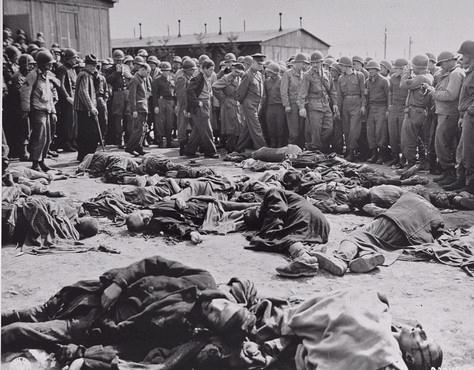
At 3.15pm on 11th April 1945 four soldiers from the 6th Armoured Division of the US Army were the first Allies to reach Buchenwald where they were greeted as hero’s by the survivors, some of whom even found the strength to throw their liberators in the air in celebration. (The clock at the entrance gate of Buchenwald is now stopped at 3.15 as a memorial).

Although the prisoners were delighted at their liberation and able to celebrate for a short time, most of them were so ill that the Americans wondered if they would survive to enjoy their freedom. As Edward Murrow reported for CBS – ‘I asked to see one of the barracks. It happened to be occupied by Czechoslovaks. When I entered, men crowded around, tried to lift me to their shoulders. They were too weak. Many of them could not get out of bed. I was told that this building had once stabled 80 horses. There were 1,200 men in it, five to a bunk. The stink was beyond all description…As we walked out into the courtyard, a man fell dead. Two others, they must have been over 60, were crawling toward the latrine. I saw it, but will not describe it.’

Allied soldiers liberate Buchenwald

The American soldiers were hardened men who had fought hard all the way from the beaches of Normandy but Buchenwald was almost beyond their comprehension, when Eisenhower entered the camp he said that “Nothing has ever shocked me as much as that sight.” The American liberators described finding lampshades made out of human skin and being shown where the land had been fertilised with the ashes of the dead. These horrific sights influenced their attitude when they arrived in Weimar the next day. The civilians in the town, just five miles from the camp, said that they hadn’t known what was happening there even though they had seen thousands of trains arriving laden with prisoner and none leaving. Elie Wiesel, arguably the most famous survivor of Buchenwald, later said that some of the inmates took jeeps and drove into Weimar where the American GI’s stood by and watched as the newly liberated men looted homes, killed German civilians, and even raped some of the German women. After what they had seen the soldiers felt little inclination to intervene and stop the former prisoners from taking their revenge.

Sadly, the liberation on 11th April 1945 was not the end of Buchenwald as a concentration camp. Between then and 10th February 1950 it was a ‘special camp’ run by the Russian NKVD. Finally, in October 1950, the Russian authorities decided to demolish the camp although parts were retained as a reminder of the atrocities committed by the Nazis during the Second World War. Today those remains contain a memorial and museum to the memory of the thousands who died in one of the most notorious of all concentration camps.

The Buchenwald Memorial

During the Second World War Buchenwald was the destination for many spies and resistance fighters who were captured in occupied France. In my novel Heronfield Tony was a member of the SOE and, as such, would have been sent to Buchenwald. I found writing that particular section of the book harrowing although the words I wrote in no way reflect the true horrors that the prisoners endured. In my own simple way I hope that my work can be seen as a tribute to all those who were sent to Buchenwald and other concentration camps simply because of their race, politics, religious beliefs or disabilities.

Sources

Official Memorial Site, Buchenwald and Mittelbau-Dora Memorials Foundation.

Film footage from 1945 inside Buchenwald Concentration Camp, British Pathé.

Buchenwald, jewishgen.org.

Guide to the Concentration Camps Collection, Leo Baeck Institute, New York City 2013. Includes extensive reports on Buchenwald collected by the Allied forces shortly after liberating the camp in April 1945.

Holocaust Research Project

United States Holocaust Memorial Museum

Hitler’s guidebook – The Baedeker Raids

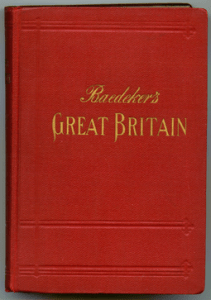
Have you ever used a Baedeker Guidebook when on holiday? The first of these travel guides was published in the 1820’s and were a ‘must have’ for travellers. But did you know that there was a series of air raids on England during the Second World War which got their name from these guidebooks? So why did the Germans use these books to target historic towns and cities in Britain during the spring of 1942?

guide-book

The intensive bombing of the German blitz ended in May 1941 when Hitler re-targeted his resources on his invasion of Russia; this meant that attacks on Britain were confined to hit-and-run raids on coastal towns. At the same time night bombing by the RAF was being scaled down as it was felt that the type of raids which targeted individual factories or military bases were ineffective. It was not until March 1942 that the RAF resumed their raids with new heavy bombers, improved navigation, new tactics, and a new commander, all of which helped to make these attacks much more devastating than those carried out earlier in the war. Instead of the previous attempts at precision bombing of factories and power stations the focus was now on area bombing. Planes would target a single area where there was not only the possibility of destroying military targets and factories but also affecting the morale of the civilian population. On 28th March 1942 the RAF bombed the city of Lűbeck in northern Germany. The historic centre of the city, known as the ‘Old Town’, consisted mostly of wooden buildings and was almost totally destroyed; over 1,000 people were killed.

Mass grave for the victims of the bombing of Lubeck

Nearby Rostock was bombed a month after the destruction of Lübeck. The two attacks shocked the Nazi leadership, and also the civilian population of Germany who had suffered little under previous RAF raids. The change of British tactics was very effective; Goebbels said that “the damage was really enormous” and “it is horrible… the English air raids have increased in scope and importance; if they can be continued for weeks on these lines, they might conceivably have a demoralizing effect on the population.” He described the raid on Rostock as more devastating than those before, saying “Community life there is practically at an end… the situation is in some sections catastrophic… seven tenths of the city have been destroyed… more than 100,000 people had to be evacuated… there was, in fact, panic.” Hitler was furious and determined that the Luftwaffe would retaliate in kind. On 14th April he ordered that “the air war against England be given a more aggressive stamp. Accordingly when targets are being selected, preference is to be given to those where attacks are likely to have the greatest possible effect on civilian life. Besides raids on ports and industry, terror attacks of a retaliatory nature are to be carried out on towns other than London.” Hitler’s aim was twofold, as well as revenge for the RAF raids he hoped that such attacks would break the morale of the British people and lead to a swifter end to the war.

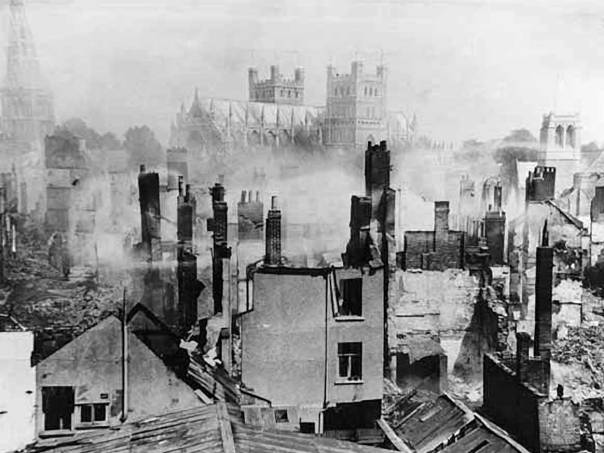
Exeter after the bombing

The first retaliatory raid took place on Exeter on 23rd April. Much of the city was damaged and around 80 people were killed and 55 wounded. The next day Baron von Sturm (a spokesman for the German Foreign Office) said “’We shall go out and bomb every building in Britain marked with three stars in the Baedeker Guide.” von Strum’s comments led to the raids being called the ‘Baedeker Raids’ by both the Germans and the Allies. Although Goebbels agreed with the tactic he was furious with von Strum for his thoughtless, off-the-cuff comment. Goebbels  had wanted to take the moral high ground, describing the British attacks as ‘terror bombing’, but now von Strum had effectively admitted that the Germans were deliberately targeting cultural and historical sites. Exeter was bombed again within hours of von  Strum’s statement. A third raid on Exeter took place on 3rd May when high explosives, incendiaries and parachute mines were dropped by 90 planes, devastating the city’s shopping centre. 163 people were killed and 131 seriously injured in the attacks on the town which was poorly prepared for such raids, as were the other locations chosen from the guidebook. (Intersetingly, Hitler forbade any bombing of the beautiful Blenheim Palace in Oxfordshire as it was the place where Churchill had been born; Hitler was determined to live  there after he had invaded and subdued the UK).

Goebbels in 1942
Goebbels in 1942

Each of the Baedeker raids involved between 30 and 40 bombers which flew two sorties each night. This meant that each raid would begin with a period of bombing lasting one and a half to two hours. There would then be a lull of two to three hours while the Germans returned to base to re-arm and re-fuel. Finally, another bombing run like the first.

Exeter was not the only city to be targeted. 400 people were killed in raids on Bath on two consecutive nights (25th + 26th April), during the raid the railway station was put out of action and communications severely affected. After the raids on Bath Goebbels reported that Hitler intended to “repeat these raids night after night until the English are sick and tired of terror attacks” and that he “shared [Goebbels’] opinion absolutely that cultural centres, health resorts and civilian centres must be attacked… there is no other way of bringing the English to their senses. They belong to a class of human beings with whom you can only talk after you have first knocked out their teeth.”

Bath after the raid
Bath after the raid

The 27th of April saw 90 tons of bombs dropped on Norwich; the city was attacked again on the 29th. In all, 222 people died during these raids on Norwich. It was the turn of York on 28th April when high explosive bombs and incendiaries caused a huge amount of damage, including the destruction of the medieval Guildhall. In May there were more raids on Cowes, Norwich, Hull, Poole, Grimsby and Canterbury. The RAF responded by sending 1,000 bombers in a massive raid on Cologne.

The German raids on historic cities in England during April and May 1942 were responsible for 1,637 civilian deaths and left another 1,760 injured. Over 50,000 homes were destroyed along with some important buildings such as the Bath Assembly Rooms and the Guildhall in York. But the raids did not cause as much damage as Hitler had hoped, and rather than breaking the morale of the British people it strengthened their resolve to defeat the enemy at all costs. German bomber losses were high and this, coupled with the need for Hitler to reinforce his troops in North Africa and Russia, resulted in a scaling back of attacks to hit-and-run raids on the coast. The Luftwaffe did occasionally raid towns and cities of historic and cultural importance in the months that followed (Ipswich, Poole, Norwich, Bristol, Swansea and Colchester), but these raids were much smaller (about 20 aircraft instead of 40+) and the damage was more limited; even so, by the end of the year over 3,230 people had been killed and 4,150 injured in German air raids on Britain. There were some attacks on towns of no military or strategic value in 1943, but by 1944 the Germans gave up their ‘Baedeker Raids’ as they were ineffective and the losses to the Luftwaffe were unsustainable. London once again became the target, along with the ports which Hitler believed would be used for the Allied invasion of Europe.

cologne
Cologne

In my novel, Heronfield, Bath holds a special significance for two of the main characters, and it is through the eyes of Sarah that we see the significance of the bombings, and the resilience of the civilians whose resolve was strengthened rather than broken by the Baedeker Raids.

Heronfield

Grayling, A. C.  Among the dead cities

Price, A. Blitz on Britain 1939–1945

Terraine, John The Right of the Line