 ‘A Fine Balance’ tells the story of the lives of four individuals who are brought together by circumstances. While we learn a lot about their background the main focus of the novel is the political and social situation in India in the 1970’s. Through their relationships with each other and interactions with other people Rohinton Mistry paints a compelling picture of poverty and prejudice in India. The levels of corruption and injustice portrayed in the novel give a sense of the hopelessness of life for many, yet the fact that the poorest characters can find a joy in their lives which evades those of a higher social standing is humbling.
This is a novel which tells the truth of the brutality if a government which could force sterilization on people in an effort to control the population; and the brutality of people who , by a simple accident of birth, found themselves in a position of power. The title ‘A Fine Balance’ is well chosen as Mr Mistry balances this darkness with a lightness and humour from both the characters and their situations. As one who has lived in India for the last few years I found many of the descriptions incredible accurate – from the chaos of the courthouse and other official institutions to the busy streets, chaotic trains and remote village life.
Sadly, my experience tells me that although the caste system is now illegal in India it is still all pervading, and it would not be difficult to imagine aspects of this story happening today. Yet alongside this the humour, love and hope which Mr Mistry describes are still there and the road to change, which often seems too long and slow, is still progressing.
The only aspect of this novel which I found difficult was the number of coincidences which occurred, bringing minor characters into the story at frequent intervals which are unlikely to happen in life. Having said that, I recognise that these characters and their meetings are an essential part of the story which Mr Mistry is telling, so if you can set aside the coincidences and accept the truths that the characters bring to the story it will not spoil your enjoyment.
‘A Fine Balance’ is a well written novel with deeply nuanced characters, all the more real to me as I see in them much that reminds me of the Indians I know and love. It is well structured, invoking a sense of place so that we can almost feel the heat, smell the streets, taste the food, bathe in the dust or rain. This is a novel which shows the real India, where life can be hard for all but the most wealthy; it is therefore interesting that the character who has the easiest life, the best situation, finds it the most difficult to cope. As for the reader, I think we can all learn from the attitude of the main characters, and Indians in general – life is not easy, we all face difficulties challenges and heartaches; what defines us though is how we face what life throws at us, and move on.
‘A Fine Balance’ is up there as one of my favourite novels about India, alongside ‘A Suitable Boy’ by Vikram Seth. Anyone who wants to try to understand the complexities, mysteries and universal truths of India presented by an author with an exceptional command of language should read this novel.
Highly recommended.
A Fine Balance is available on Amazon
More of my Recommended Reads can be found here
 A Russian grand duchess and an English journalist. Linked by one of the world’s greatest mysteries . . .
 I woke up this morning with just days to go before
  ‘Captivate, kill or destroy the whole force of the enemy’ was the order given to the American soldiers in the summer 1779.
 Summer 1942. When Bernie Gunther is ordered to speak at an international police conference, an old acquaintance has a favour to ask. Little does Bernie suspect what this simple surveillance task will provoke . . .
 ‘Winter Of The World’ is the second part of Ken Follett’s trilogy about the twentieth century. It is an ambitious novel, taking readers from 1933 through the Second World War to 1949. The plotting is complex with characters in the US, England, Germany and Russia who experience some of the key points of this period of history – the rise of Hitler, the Nazi euthanasia programme, the war in Europe, Pearl Harbour, war in the Pacific, the development of the atom bomb, the aftermath of war in Germany – the list could go on and on. The raft of characters and wide ranging storylines does mean that some important parts of this period of history are missed or skimmed over, but that is perfectly understandable.
 ‘The Nightingale’ is a novel which will grip you from start to finish with its portrayal of life for two sisters in France during the Second World War. Vianne’s husband is taken by the Germans to a labour camp. Having a daughter makes Vianne cautious, intent on ensuring that they both survive the war. Her sister, Isabelle, is younger, more daring; a girl who has felt unloved for most of her life and feels she needs to do something, anything, to give meaning to her existence. Yet as the years progress, as hunger and lack of all luxuries set in, so the characters change to meet their changing circumstances. Small changes at first, but for each action there is a consequence leading, almost inevitable, to more dangerous actions. This is real life in the sense that it is moral choices that people make which mould them, choices which they sometimes wish they didn’t have to make but which cannot be avoided.
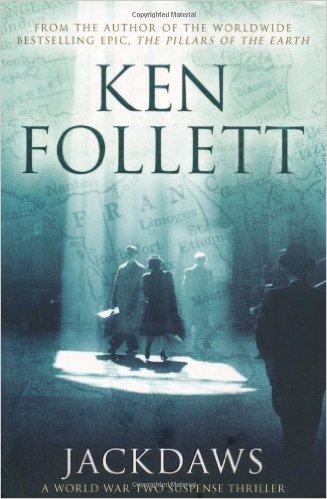 Two weeks before D-Day, the French Resistance attacks a chateau containing a telephone exchange vital to German communications – but the building is heavily guarded and the attack fails disastrously.
 Paris in 1895. Alfred Dreyfus, a young Jewish officer, has just been convicted of treason, sentenced to life imprisonment at Devil’s Island, and stripped of his rank in front of a baying crowd of twenty-thousand. Among the witnesses to his humiliation is Georges Picquart, the ambitious, intellectual, recently promoted head of the counterespionage agency that “proved” Dreyfus had passed secrets to the Germans. At first, Picquart firmly believes in Dreyfus’s guilt. But it is not long after Dreyfus is delivered to his desolate prison that Picquart stumbles on information that leads him to suspect that there is still a spy at large in the French military. As evidence of the most malignant deceit mounts and spirals inexorably toward the uppermost levels of government, Picquart is compelled to question not only the case against Dreyfus but also his most deeply held beliefs about his country, and about himself.
 Dorinda Balchin - Author