Tag Archives: history

Accident or murder? The mysterious death of Leslie Howard

Leslie Howard

Leslie Howard was a superstar actor of his day. The son of Jewish immigrants from Hungary he was born in London in 1893 and served during the First World War, he was mustered out of the army a few weeks before the Battle of the Somme began in 1916 as he was suffering from shell shock. It was actually his doctor who suggested acting as a therapy little knowing that Howard would go on to international fame, particularly for his roles in Pygmalion and Gone With The Wind. When the Second World War broke out the English actor gave up his lucrative Hollywood contract (including his share of the box-office takings for Gone With The Wind) and returned home to see what he could do to further the war effort.

Leslie Howard in Gone With The Wind

Howard was not the only Hollywood actor to join up at the first opportunity, Americans Kirk Douglas, Paul Newman and Charles Bronson also served whilst Clark Gable and James Stewart were awarded medals for their bravery; on the other side of the Atlantic British actors Richard Todd, Alec Guinness and Dirk Bogarde all served in the armed forces.

Leslie Howard, however, decided that rather than fighting he would put his acting skills to use and so offered to do whatever he could for the British government. One of the first things he was asked to do was to make broadcasts to the United States which still remained a neutral country with Churchill doing everything he could to get the Americans to join the war as Britain’s allies. Many women in America were isolationists and strongly against the war, it was recognised that their views had a not insubstantial effect on the views of American men so it was thought that a matinee idol such as Howard might go a long way towards making them change their minds. But America was only a part of his focus as Leslie Howard also made programmes for the domestic audience appearing on ‘Britain Speaks’ and making National Savings documentaries for the Ministry of Information. Many of his broadcasts focused on British values which the soldiers at the front were fighting to protect – freedom, tolerance and decency. The propaganda programmes which Howard was involved in were so successful that William Joyce (better known as Lord Haw Haw) singled out Howard as a target in his radio broadcasts from Europe (‘Germany Calling’) saying that he should ‘stick to acting’.

Howard’s work for the government also included directing, co-producing and starring in several war films including 49th Parallel, The First Of The Few (the story of RJ Mitchell, the inventor of the Spitfire) and Pimpernel Smith (based on the story of the Scarlet Pimpernel who rescued aristocrats from Paris during the French Revolution, only this time the plot revolved around an English professor rescuing refugees from the Germans). The work that Howard did was obviously propaganda but he felt that it was justified whilst the country was at war with Hitler, in one broadcast Howard even used what was considered strong language for the 1940’s when he said “To hell with whether what I say is propaganda or not, I’ve never stopped to figure it out and I don’t think it matters anymore.”
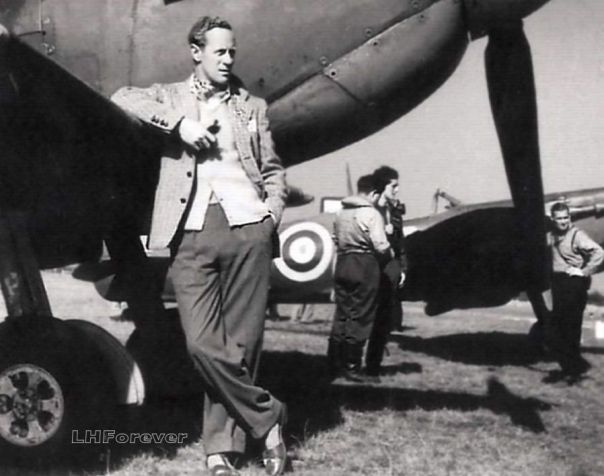
On the set of The First of the Few

Howard had met Winston Churchill in 1937 when they had several informal talks where Howard made his anti-Nazi views known. Churchill remembered this and when he became Prime Minister he used Howard and other actors, including Laurence Olivier and Noel Coward, to get access to famous or important people who might be able to help with the war effort. To this end Howard went to Spain and Portugal in May 1943 purportedly to open links between Spanish and British film-makers and present a series of lectures on his films and the role of Hamlet, but it is believed that his real purpose was to try to prevent General Franco from joining the Axis powers. The Iberian peninsula was neutral during the war and so became a magnet for spies from both sides which meant that the actor was closely watched by German agents during his visit.
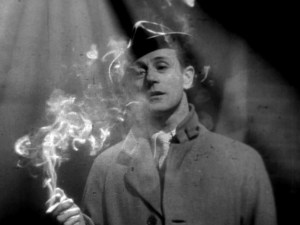
Pimpernel Smith

Howard left Portugal in June 1943 on a civilian Douglas DC-3 which flew regularly across the Bay of Biscay as there was an informal agreement for both sides to respect the neutrality of civilian planes. On this day, however, the agreement was ignored and six Junkers JU88 fighters shot it down killing all seventeen passengers and crew. The news of the death of incredibly popular Leslie Howard shocked the British people, and the reason for the German action raised many questions which have not been fully answered to this day.

Why was the plane shot down? Was it an accident or deliberate? If deliberate, who was the target?

One thing we do know is that this same plane making its daily Lisbon to London run had been attacked for the first time two weeks earlier, but it was assumed that the aircraft had been hit by mistake and so the flights continued. Now the plane had been fired on again, and this time shot down with a number of people on board who could have been a possible target. There was Arthur Chenhall, Howard’s manager who was travelling with him and who looked a lot like Churchill. There was also Kenneth Stonehouse who was a reporter for Reuters, Wilfred Israel who was a Jew from Berlin whose work with the Kindertransport had been, in part, the inspiration for Pimpernel Smith, Tyrrel Shervington who was the Lisbon manager for the Shell Oil Company, and Ivan Sharp who had been negotiating tungsten and wolfram imports which were important for the British war effort and deals which the Germans would obviously like to prevent. Any one of these men could have been targeted by the Germans although many thought that the clear target was Howard as when Goebbels (the German Propaganda Minister) had seen the film Pimpernel Smith he had taken it as a personal parody of himself and wanted to kill the director and star.

Pimpernel Smith

There is, however, another possibility. On the same day that Howard’s ill-fated plane set off from Portugal Winston Churchill also took off from Gibraltar to return to Britain after a visit to North Africa. The British Prime Minister was to have flown in a similar flying boat and on a similar flight path to the plane which was shot down but, due to bad weather, he decided to take a bomber instead. The German pilots who brought down the plane took photographs of the wreckage before flying back to their base in France. So, was Leslie Howard the target of the German Junkers, or did they mistake the civilian plane for the one carrying the British Prime Minister? What a coup it would have been if they had been able to shoot down and kill the man who was the inspiration for so many of the Allies.
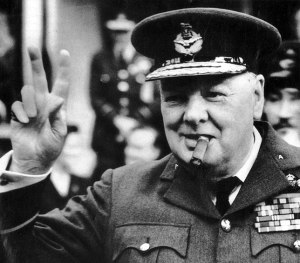
Three days after the plane was shot down the New York Times reported that “It was believed in London that the Nazi raiders had attacked on the outside chance that Prime Minister Winston Churchill might be among the passengers.” When secret files about Ultra (the Allies’ secret Nazi code-breaking capabilities) were finally made public decades after the Second World War it was learned that the British had known in advance that the Germans assumed Churchill was on Flight 777 and so might target the plane. It was obviously vital for the war effort that Ultra could not be compromised and so the intelligence was not passed on to the Portuguese authorities or the airline. When Churchill wrote his history of the war he fed the flames of the mistaken-identity thesis when he referred to Leslie Howard’s death as one of “the inscrutable workings of fate.”

We will never know for certain the true circumstances of the death of Leslie Howard, but JB Priestley spoke for many when he made a broadcast after the actor’s death was announced on the BBC – “The war has claimed another casualty, the stage and screen have lost an unselfish artist, and millions of us have lost a friend.


Recommended Read – I, Claudius by Robert Graves

Despised for his weakness and regarded by his family as little more than a stammering fool, the nobleman Claudius quietly survives the intrigues, bloody purges and mounting cruelty of the imperial Roman dynasties. In I, Claudius he watches from the sidelines to record the reigns of its emperors: from the wise Augustus and his villainous wife Livia to the sadistic Tiberius and the insane excesses of Caligula. Written in the form of Claudius’ autobiography, this is the first part of Robert Graves’s brilliant account of the madness and debauchery of ancient Rome, and stands as one of the most celebrated, gripping historical novels ever written.
I, Claudius is an enduring favourite of mine. A fictional autobiography of Claudius based on meticulous research and an incredible depth of knowledge of the Roman Empire places the reader at the heart of events in Rome. The Roman way of life – dress, food, customs, religion etc.– are woven into the story in such a way that the reader comes away from this novel with a deeper understanding of the time and place yet never feeling that they have been educated in any way. Graves’ light touch in this transfer of knowledge is balanced by his deft use of language which, particularly in dialogue, draws out the aspirations, jealousies, fears, hatreds and loves of real historical characters in a way which the source documents never could.

As well as a cleverly plotted novel I, Claudius is also a study of human psychology, to see how Claudius understands and manipulates those around him in order to stay alive is an underlying pleasure of this book. From the relative calm of the rule of Augustus this fictional autobiography details the cruel reign of Tiberius followed by the madness of Caligula all purportedly written from the viewpoint of an historian who likes nothing more than to study the past yet must spend his time balancing the politics of his present in order to stay alive.

It is necessary for Mr Graves to introduce us to a number of generations of the imperial family to tell his story and some readers may find the number of Latin names difficult at first, but I urge you to persevere for it is this richness of connections and understanding of family which underpins the novel and gives it a wholeness which many other historical novels focussing on the Roman  era do not have.

I, Claudius is a classic work of historical fiction telling a story of intrigue, lust, murder and dynastic politics from the point of view of a man who appears such a hapless fool that it is not worth the effort to kill him, yet this supposedly incompetent historian becomes, at the end of the novel, the next Roman Emperor. If you enjoy this read, which I hope you will, then you will be more than happy with its sequel – Claudius the God – which continues Claudius’ autobiography in recounting the reluctant emperor’s surprisingly successful reign.

I, Claudius is a classic in every sense of the word.

I, Claudius can be found on Amazon

You can find out more about Robert Graves here

You can  find more of my Recommended reads here

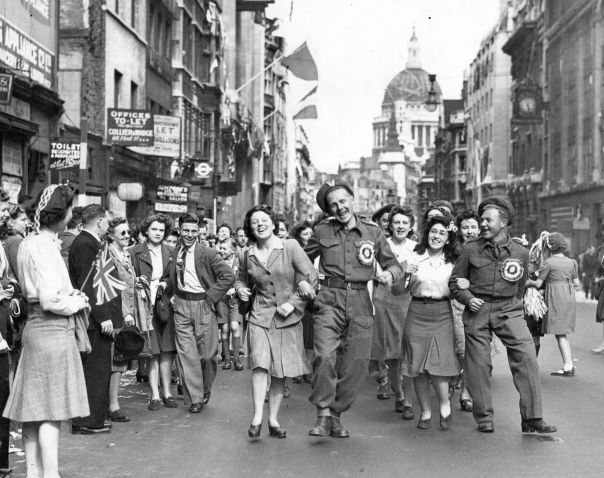
VE DAY – The end of the Second World War in Europe

The long weekend of 8th – 11th May 2020 was supposed to see massive celebrations of the 75th anniversary of VE Day (the ending of the Second World War in Europe) with the British May Bank Holiday being moved for only the second time in history to accommodate this. We are, however, living in unusual times with many countries in lockdown due to the Covid-19 Pandemic so ceremonies and celebrations will not go ahead as planned. I believe it is hoped that these can be postponed until August to coincide with VJ Day (Victory against Japan), but until then we can remember and celebrate online…

(Please read this article for some ideas on how to celebrate VE Day during lockdown).

VE Day in London

VE Day marked the end of six long years of war against Germany which had caused so much suffering and death for many countries. April 1945 saw many of the Allied forces beginning to overrun Germany from the west whilst Russian troops were advancing on the eastern front. The two armies met at the River Elbe on 25th April and it was obvious to everyone that Germany could not win the war.

The inevitable defeat of the Nazi forces had long been anticipated, and with Berlin surrounded by Allied armies Hitler took what many saw as the cowards way out by naming Grand Admiral Donitz as his successor then killing his dog and his new wife, Eva, before committing suicide himself on 30th April 1945.

© IWM (EA 65715) Jodl signs the instrument of surrender at Rheims.

On 4th May Field Marshal Montgomery accepted the unconditional surrender of German forces in northwest Germany, the Netherlands and Denmark at Lunehurg Heath near Hamburg. Three days later The Supreme Allied Commander, General Eisenhower, accepted the unconditional surrender of all German forces at Reims with General Jodl signing the document on behalf of the German people. The agreement was for the war to officially end the following day on 8th May 1945.


The long-awaited end of the war in Europe was announced in a radio broadcast on 7th May and the following day declared a national holiday.


Building a bonfire to celebrate


As soon as the news of victory was announced flags and bunting were strung across streets and house fronts, bonfires were built and lit, and the pubs were full as many people did not want to wait one more night to begin their celebrations!


After years of rationing people were told on the morning of the 8th that they could buy bunting without ration coupons, many restaurants quickly put together a ‘victory menu’, there were parades, street parties, and services of thanksgiving – St Paul’s Cathedral in London accommodated 10,000 people in ten services which ran one after the other.

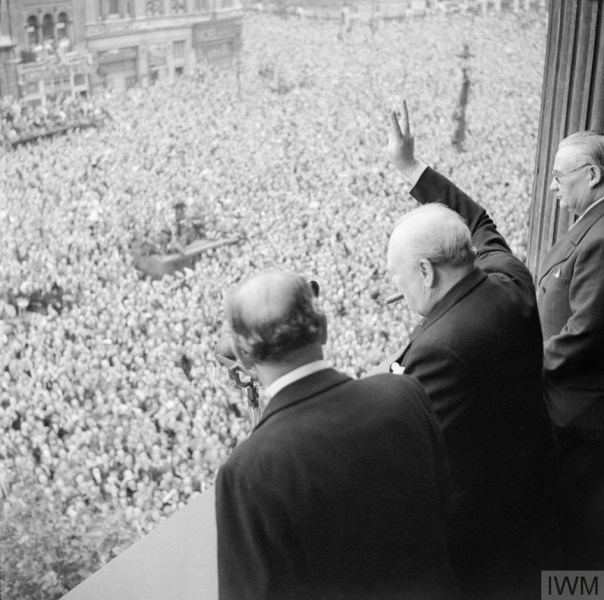
Throughout the war years the British people had been led by Winston Churchill who spoke on the radio in the afternoon of the 8th reminding people that ‘We may allow ourselves a brief period of rejoicing; but let us not forget for a moment the toil and efforts that lie ahead.’ He was, of course, referring to the fact that the war in the Far East was still on-going with British soldiers, sailors and airmen still fighting and dying for freedom. Later in the day the Prime Minister stood on the balcony of the Ministry of Health and thousands listened to his speech declaring that ‘This is your victory’ to which the crowd replied ‘No, it’s yours!’

© IWM (H 41849)

As the victory celebrations unfolded huge crowds collected in the Mall and in front of Buckingham Palace to see the royal family. King George VI and Queen Elizabeth went out onto the balcony no less than eight times, once accompanied by the Prime Minister. During their last appearance two young women standing looking up at them were no less than the princesses Elizabeth and Margaret who had been allowed to go out incognito to join the celebrating crowds. Queen Elizabeth later said ‘We stood outside and shouted, “We want the King”… I think it was one of the most memorable nights of my life.’ (see The Windsors at War – Part 2 Queen Elizabeth II).

© IWM (MH 21835)

It is thought that around 50,000 people were crowded around Piccadilly Circus as the first VE Day came to an end with people dancing and singing in the streets. The joy of victory broke down the famous British reserve as people spoke and danced with complete strangers as pubs and dance halls stayed open until midnight to allow the celebrations to continue.

VE Day in London

Celebrations took place around the world, although there was sadness in America that President Roosevelt who had led the country throughout the war did not live to see the final victory (he died on 12th April 1945). Even so the celebrations were so great that large numbers of police officers were detailed to control the crowds in Times Square. In Paris huge numbers flocked to the Champs Elysees and Place de la Concorde. There were also celebrations in Australia although the war so close to them in the Far East was still ongoing. In Canada where the liquor stores had been closed for the celebrations military personnel in Halifax rioted and led the looting of liquor stores which led to a number of deaths.

Amidst the celebrations for the ending of the war in Europe there was also sadness at the thoughts of those who had died and would never return home to a country at peace, and people were aware that the hard times were not yet over – the war against Japan still had to be won, rationing would no doubt continue and there was a great deal of re-building to be done. But for now, for one day, they celebrated the ending of an era of destruction and a new beginning…

A Gentleman in Moscow by Amor Towles

On 21 June 1922, Count Alexander Rostov – recipient of the Order of Saint Andrew, member of the Jockey Club, Master of the Hunt – is escorted out of the Kremlin, across Red Square and through the elegant revolving doors of the Hotel Metropol.

Deemed an unrepentant aristocrat by a Bolshevik tribunal, the Count has been sentenced to house arrest indefinitely. But instead of his usual suite, he must now live in an attic room while Russia undergoes decades of tumultuous upheaval.

Can a life without luxury be the richest of all?

A Gentleman in Moscow is a novel full of engaging characters who surround Count Rostov as we are immersed in his life confined in the Metropole Hotel for 32 years. You may wonder how following the day to day life of one man in captivity for such a long period of time can create a storyline varied enough to fill a novel, and perhaps some people have not picked up this book for that reason – if so they have missed a gem. This book has been a favourite of mine since I first read it and was drawn into a country in upheaval, following the dramatic changes within Russia during the first half of the 20th century.

The novel begins with Count Rostov being condemned by a tribunal in Moscow as an unrepentant aristocrat, but because of a poem he wrote in his youth which showed a sentiment for revolutionary change he was not put to death, instead he was sentenced to spend the remainder of his life in his current residence – the Metropole Hotel. As we follow him through the long years of his confinment we come to know the Count as a learned man, a philosopher at heart, who is determined to adapt to his new way of life. Through his friendship with a young girl called Sophie he learns of the rich life behind the scenes of the hotel. Through friends who visit him he is able to follow the turbulent events taking place in his country from both sides – the oppressed and the oppressor. When an unforeseen event changes his life even further Count Rostov becomes a father in all but name and focusses his life on educating and raising a daughter to go out and face a world in which he can no longer partake himself.

This is a book full of humour, pathos, laughter, friendship and love. It is written in an elegant style with beautiful prose and insightful dialogue which subtly explore deep questions about the purpose of our lives and how we can make a difference through many small acts. The characters are well observed, the writing sophisticated, the humour at times gentle and at others farcical. It is a rich, multi-layered novel with much to offer even the most discerning of readers.

As Count Rostov muses towards the end of the novel ‘it was, without question, the smallest room that he had occupied in his life; yet somehow, within those four walls the world had come and gone’. I urge you to join him within the four walls of his attic room and experience the rich delights of this novel

A Gentleman In  Moscow can be found on Amazon

You can find out more about Amor Towles here

You can find more of my Recommended Reads here 

The war-gaming Raspberries who helped to win the Battle of the Atlantic

After the fall of France in the early days of the Second World War Britain stood alone in her opposition to Germany in Europe. As an island nation she was vulnerable because food and materials for the war had to be brought across the Atlantic from America, running the gauntlet of German U-boats hunting in ‘Wolfpacks’. Britain needed more than 1 million tons of imports a week to survive so it was imperative to find ways to combat the U-boat threat in what was known as the Battle of the Atlantic.

HMS BARHAM explodes as her 15 inch magazine ignites, 25 November 1941. Copyright: © IWM. object/205022049

Britain had prepared her sea defences based on the belief that Germany would fight a similar sea war to the one fought during World War I. No one had anticipated that France would fall so quickly thereby placing its ports on the western coast of Europe in the hands of Germany and enabling the Nazis to have a stranglehold on the Atlantic crossing. A new approach to the war at sea was needed.

‘War games’ have always been an important feature of military tactical planning and so the Western Approaches Tactical Unit (WATU) was set up in Liverpool led by Captain Gilbert Roberts under Sir Percy Noble who was made responsible for protecting convoys from the threat of German U-boats. Roberts brought together a group of officers and ratings from the Women’s Royal Navy Service (the Wrens) to ‘explore and evaluate new tactics and then to pass these on to escort captains in a dedicated ASW (Anti-Submarine Warfare) course’. Churchill’s instructions to the new unit were clear – “Find out what is happening in the Atlantic, find ways of getting the convoys through and sink the U-Boats!” The small staff under Roberts consisted of Chief Petty Officer Raynor, four Wren officers, and four Wren ratings, two of whom were only seventeen.

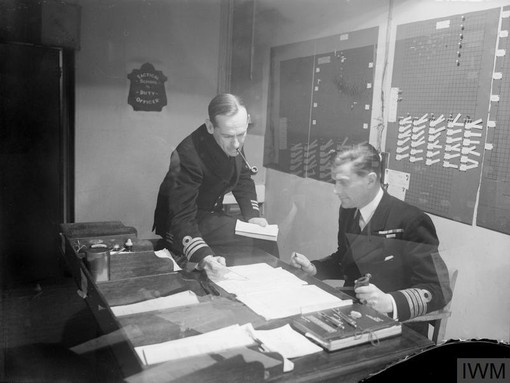
Captain Roberts consults with Commander J M Rowlands, DSO, RN, an Escort Group Commander. One of the most important phases of the Tactical Unit is the consultation with Escort Group Commanders and Commanding Officers of Escort Vessels when they come in from sea. © IWM (A 27825)

Roberts first analysed reports of attacks on convoys and came to the conclusion that only one Commander, F Walker, had any sort of tactic against the U-boats – he had set up a system whereby when the signal ‘Buttercup’ was given all escort ships under his command turned outwards and fired starburst shells to illuminate any German submarines on the surface. Robert’s analysis also led him to believe that rather than U-boats moving in to attack the perimeter of a convoy at night they were already amongst the supply ships and using their targets as cover!

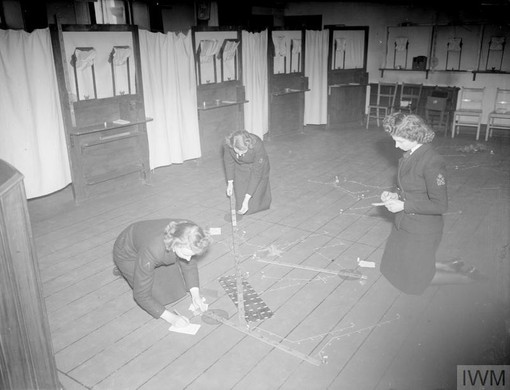
The facility which housed WATU was very simple – a pattern of squares painted on the floor, some basic ships models, and a number of tactical tables. The first thing that the new team needed to do was to learn current ASW techniques and get an understanding of their technology before they began to create a set of rules so that they could play ‘real-time’ games where they responded to simulated naval attacks, developed tactics to combat them and analysed communications problems. The first problem they approached was the perceived tactic of U-boats hiding withing the convoys. By playing their war games they came to the conclusion that a U-boat would fire on the stern of a ship, dive and fall back behind the convoy, then surface again. To counter this they moved the escort back after an initial attack to sweep the area where the U-boats were expected to re-surface. This seemed to be a successful defence.

Measuring up and preparing contact chits. © IWM (A 27823)

Sir Percy Noble thought that the plan for wargaming was unlikely to work, but after visiting WATU and watching the team at work he changed his mind. He observed a series of attacks on a convoy where the logic behind the assumptions made about U-boat movements were explained as were the tactics to combat these. Immensely impressed he gave his full support to ‘Operation Raspberry’ and ordered that all escort officers should attend the course.

Sir Max Horton (Western Approaches Command) attended one of the courses where he played the role of a U-boat captain. During the course he initiated five attacks on a convoy and each time his submarine was tracked and destroyed using the tactics derived from the war games. He was astonished that an eighteen year old Wren was able to outperform him so well and made sure that the new tactics were included in the next set of orders sent to the Fleet. King George VI was also impressed by the work coming out of Liverpool and visited WATU in November 1942.

© IWM (A 27821)

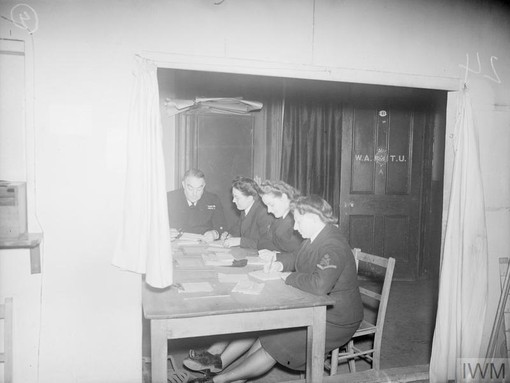
After a time the unit adapted the training room so that the players who represented the commanders of the Allied convoy escort ships could only have a limited view of what was happening as would be the case in real life situations; only the umpires of the game were able to see the U-boat’s position. As each German tactic was countered and new ones introduced the war gamers of WATU came up with new counter-measures and Germany’s losses in the Atlantic grew. During the remainder of the war 5,000 officers attended the course, one of the very few military courses at the time which were run by women. By the end of the war WWATU had a complement of eight male officers as well as thirty six Wren officers and ratings.

The models used on the Tactical Table. © IWM (A 27824)

At the end of 1943 Roberts was invested as a ‘Commanded of the British Empire’ for his work at WATU. He took a Wren Officer and a Wren Rating with him to Buckingham Palace for the investiture in recognition of the remarkable team of young women who played the war games which saved British shipping in the Battle of the Atlantic.

The battleship which failed to deliver – the German warship Tirpitz

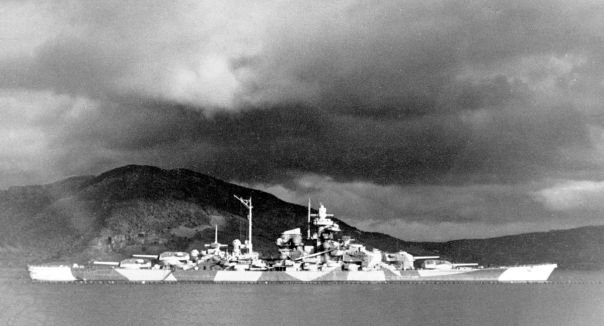
In my previous article about the North Atlantic Convoys I mentioned the German battleship Tirpitz. This ship was over 250 metres long and weighed over 50,000 tons with a hull made of 30cm thick steel. Tirpitz also had not one but eight of the biggest naval guns ever built – 38cm. With a crew of over 2,600 men and a speed of 30 knots it was bigger and faster than any of the opposing Allied ships, a formidable weapon which instilled fear in all those who faced her. Yet this behemoth which could have played such a significant role in the war at sea was rarely out of coastal waters and contributed little to the German war effort.

Tirpitz

One would have thought that Germany’s biggest warship should be deployed in the Atlantic but instead it was sent to a remote area in Northern Norway for one simple reason – the Arctic convoys which set out from Britain to supply the beleaguered Soviet Union. With the Tirpitz in northern waters Hitler hoped that he would be able to attack the convoys whilst at the same time preventing any Allied attack against Nazi-occupied Norway.

When the Tirpitz originally arrived in Norway in January1942 she was anchored in Trondheimsfjord from where she made an attack on the mining communities of Spitsbergen, the only major attack that the ship ever carried out. Then, in March 1943, her mooring was moved to Kåfjorden; with an approach to the fjord which was easy to defend and a greater distance by air from Britain the Tirpitz was well protected and able to continue to menace the convoys.

X-craft midgit submarine © IWM (A 22900)

Winston Churchill saw the Tirpitz as a direct threat to the success of the supply convoys to Russia and was determined to sink her. Kåfjorden was out of reach for the British bombers so the Allies decided to try an underwater attack using X-craft – 51ft long submarines with a diameter of just 5ft and with a four-man crew. The plan was for each submarine to drop two 1.5 ton charges of Amatex high explosive beneath the Tirpitz. This was not going to be an easy attack as anti-torpedo nets protected the ship but it was hoped that the midgit submarines would be able to get around these. Moonlit nights between the 20th and 25th September provided ideal conditions for an attack so six normal sized submarines towed the smaller X-craft close to the target where the operational crews then took over ready for the attack – two submarines targeting a small battleship called the Scharnhorst,  one targeting a heavy cruiser called the Lutzow, and the final three making for the Tirpitz, although two of the attacking X-craft were lost en-route.

The Fleet Air Arm preparing for the attack on the TIRPITZ, April 1944 © IWM (TR 1812)

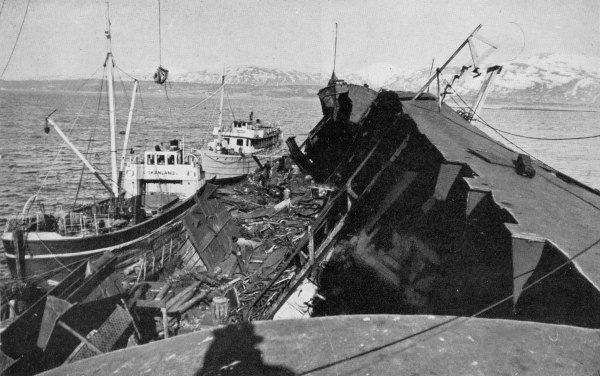
Although the raiders were able to plant explosives which tore an 18 meter long gash in the hull of the Tirpitz they were unable to sink the ship which was fully repaired by April 1944. Over the next seven months the Allies carried out six bombing aids on the Tirpitz which although unable to sink the ship did enough damage for her to be kept in port undergoing constant repairs. The Germans eventually moved the ship to Håkøybotn near Tromsø in October 1944 in the hope of getting better protection, but things went badly wrong for them on 12th November that year when thirty-two Lancaster bombers attacked with Tallboy bombs weighing five-tons each and capable of piercing the thick armour of the Tirpitz. Following three direct hits the pride of the German fleet sank in only eleven minutes with the loss of between 1,000 and 1,200 men.

The Tirpitz was arguably the finest battleship of the Second World War yet she made very little contribution to the conflict. It is true that her presence in the Norwegian fjords was a constant threat to the Arctic Convoys but she did very little actual damage there. The Germans were not able to utilize the Tirpitz as much as they had hoped in Norwegian waters as there was a constant shortage of fuel. Neither was the ship deployed into the Atlantic where she could have created havoc amongst the convoys bringing food and supplies from America to the hungry and beleaguered United Kingdom. It is possible that the Tirpitz tied up men and resources which could have been used to better advantage elsewhere, indeed it could be argued that when all actions are taken into consideration the huge battleship which saw so little action was more of a hindrance than a help to the German war effort; it seems likely that the journalist Ludovic Kennedy was right when he wrote that the Tirpitz had “lived an invalid’s life and died a cripple’s death”.

The end of the Tirpitz © IWM (CL 2830)

Recommended Read – A Burnable Book by Bruce Holsinger

A stunning debut historical thriller set in the turbulent 14th Century for fans of CJ Sansom, The Name of the Rose and An Instance of the Fingerpost.

London, 1385. A city of shadows and fear, in a kingdom ruled by the headstrong young King Richard II, haunted by the spectre of revolt. A place of poetry and prophecy, where power is bought by blood. For John Gower, part-time poet and full-time trader in information, secrets are his currency. When close confidant, fellow poet Geoffrey Chaucer, calls in an old debt, Gower cannot refuse.

The request is simple: track down a missing book. It should be easy for a man of Gower’s talents, who knows the back-alleys of Southwark as intimately as the courts and palaces of Westminster. But what Gower does not know is that this book has already caused one murder, and that its contents could destroy his life. Because its words are behind the highest treason – a conspiracy to kill the king and reduce his reign to ashes…

A Burnable Book is a medieval thriller with London in 1385 as its main setting, but it is not London as we know it. It may surprise some readers to discover that it was really three cities at that time – the walled city of London with Southwark and Westminster beyond. Each of these areas is described in fascinating detail, from the houses to the places of work, the bishop’s palaces to the slums, the law courts to the brothels. Bruce Holsinger has conducted an incredible amount of research which enables the reader to feel that they are there, experiencing the sights and sounds and smells of medieval London. I found the detail of the developing legal profession particularly fascinating as the Inns of Court came into being during this period at the end of the fourteenth century. Here we learn something of the education system which underpinned this legal system, the serjeants-at-law and other members of the legal profession, all within the framework of a novel which keeps the reader engrossed until the last page has been turned.

A Burnable Book is set during a turbulent time in English history with renewed tensions with France, Scottish incursions to the north, and friction amongst nobles all vying for power. This political intrigue is the backdrop for a story with Chaucer and his contemporary writer, Gower, as two of its main characters. Whilst planning his Canterbury Tales Chaucer has written a fictional poem which is then taken and used by enemies of the king who present it as a prophesy of his death, then work to fulfil that prophecy. Can Gower prevent this from happening? (An interesting plot device is the use of playing cards, which were fairly new to England at this time, and which introduce an element which would not be out of place in a modern crime novel).

Mr Holsinger has created a believable cast of characters (some based on real historical figures), they are well rounded with strengths and weaknesses which we will all recognise and who are brought to life by well crafted dialogue which gives the reader a feel for the time without being too anachronistic and difficult to read.

A Burnable Book is a good read; there are admittedly one or two weaknesses in the plot but these can be forgiven by a reader who likes to immerse themselves in past times, and one cannot fault Mr Holsinger’s knowledge and ability to present this in a style which draws the reader in. If you like crime novels, thrillers, and history, then this is a book for you.

A Burnable Book can be found on Amazon

You can find out more about Bruce Holsinger here

You can afind more of my Recommended Reads here

The Canaries who helped win the war

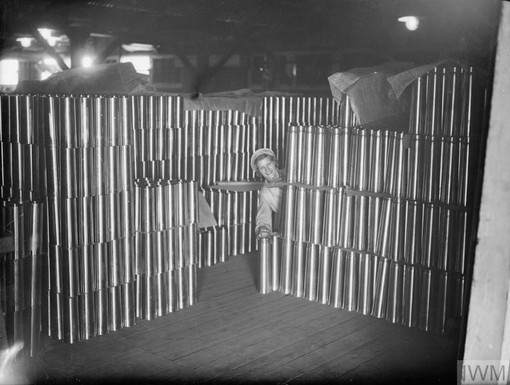
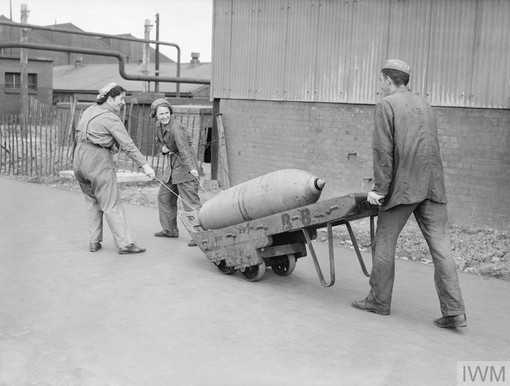
This year sees 75 years since the end of the Second World War and no doubt there will be many events to commemorate that fact. Often memorials focus on the soldiers who fought and died for their country, but while the men were away at the front it fell to the women to work in the factories and fields on the Home Front of England. Approximately 950,000 women worked in the munitions factories alone, producing the shells and bullets used by their fathers, husbands, and sons at the front. One of the largest of these factories was at Rotherwas, Herefordshire, which employed up to 4,000 women at its height and produced around 70,000 shells a week. Many of the women who worked there were as young as 16 but others were considerably older, some were even the daughters of women who had worked in the munitions factories during the First World War.
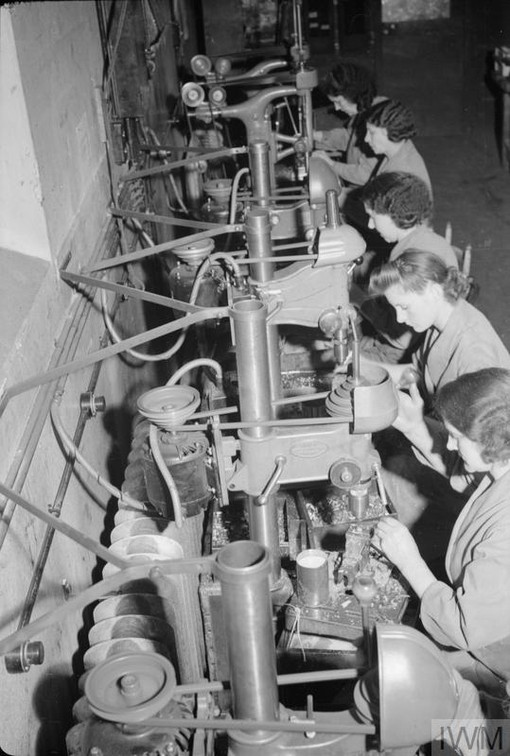
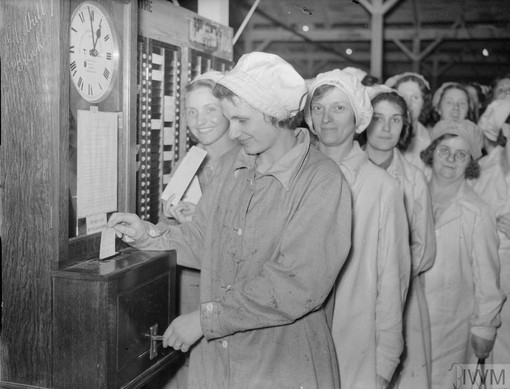
© IWM (D 10480)

The job was relatively well-paid for a woman at that time, but the hours were long with the women often working eleven- or twelve-hour shifts to keep the factories running day and night. During these mammoth shifts the workers were only allowed a couple of short breaks, and this went on day after day, seven days a week, with just the occasional leave day granted every now and then. As well as long hours the job was also dangerous. There was the ever-present threat of an explosion, and the women suffered physically due to the effects of the chemicals which they were handling constantly. The TNT reacted with melanin in the body causing the women’s skin and hair to turn yellow, which earned them the nickname ‘Canary Girls’. The effects of the chemicals were more than skin deep however, as any of the women who became pregnant whilst working there gave birth to yellow ‘Canary Babies’. The colour gradually faded away but the women must have been afraid that there might be long term effects on their new born babies.

© IWM (D 13575)

Little, if any, training was given to the women who worked in the munition’s factories – they would simply turn up for their first shift and within minutes were filling shells with TNT. It was delicate work as they collected the hot explosives from a huge mixer (something like a cement mixer), filled the shells and inserted the tube to take the detonator which they then had to tap in very carefully in order not to cause an explosion. In other parts of the factory women had to clean the shells ready to be filled, they did this by rubbing a pad on something like an emery board before inserting the pad into the top part of the shell, this was followed by another disc, tiny screwdrivers and screws were used to finish the fuse and  put it in place. It was tedious, and dangerous, work. As well as the constant fear of explosions the workers were also at serious risk from accidents with dangerous machinery. It was not uncommon for women to lose fingers and hands, to suffer burns and blindness. In February 1944 19 workers, mainly women, were in a shed in the Royal Ordnance Factory in Kirby, Lancashire when one of the anti-tank mine fuses they were working with exploded, setting off a chain reaction amongst the other fuses. The girl who was working on that tray was killed outright, her body blown to pieces, other workers were injured, one fatally, and the factory badly damaged. There were also explosions at factories in Barnbow near Leeds, Chilwell in Nottinghamshire and Ashton-under-Lyne.

© IWM (D 679)

To reduce the risk of explosions the women had to pass through the `Shifting House` twice daily – on the way in to work and on the way out again. This was a long building divided down the centre by a red barrier, one side being the dirty side and the other side the clean. Such were the fears that a rogue spark caused by static might lead to an explosion that the women were banned from wearing nylon and silk. On arriving to start their shift their outdoor clothing, jewellery and hairpins were removed along with any matches and metallic items in their pockets (although jewellery was taken off women could continue to wear their wedding rings as long as they were taped up). The women would then be checked for any metallic fasters on their under garments (only lace up corsets could be worn, no bras with metal clasps) before they could pass to the clean side and put on their regulation cream coloured gowns buttoned right up to their neck and tight around their wrists, and their regulation issue hats – a tightly fitted mop cap with as much hair tucked away under it as possible. Of course, at the end of a shift or to leave the danger buildings area for any reason the complete reversal had to be undertaken so to save time the women were not allowed out on their breaks but had to use their own canteen inside the Danger Building where everything was stained the same ubiquitous yellow as the girls.

© IWM (D 674)

If the dangers inherent in the job weren’t enough there was always the threat of bombing by the Germans. The factory at Rotherwas was bombed at dawn on 27th July 1942 when the Luftwaffe dropped two 250kg bombs on the 300 acre site. The women were coming to the end of their shift and ran out when the sirens sounded. To their dismay they found that the air-raid shelters were locked so they sought cover wherever they could. The attacking plane flew in so low that the women could clearly see the black cross on its wings and the bombs falling from beneath it. There was a direct hit which ignited some of the munitions on the ground, the result was absolute carnage – from one unit of two hundred and thirty women only two survived.

© IWM (P 126)

It is a credit to the Canary Girls that despite all that they endured they rarely complained about the terrible working conditions, they were proud to know that they were doing their bit for the war effort and saw it as a patriotic duty. These women were putting their lives on the line every bit as much as the men who had gone to war, yet the numbers of women who were killed or seriously injured whilst working in the munitions factories is not known, and few people know of the work that they did and its lasting effects on their lives. Although the Canary Girls lost their yellow colouring when they left the factories the women often suffered with illnesses in later life ranging from throat problems to dermatitis, the most debilitating was a liver disease called toxic jaundice caused by prolonged exposure to TNT, which often proved fatal. As we celebrate 75 years since the end of the war this year, I hope we take time to remember all those who served, including the Canary Girls of the munition’s factories.

© IWM (P 107)

Recommended Read – Dictator by Robert Harris

There was a time when Cicero held Caesar’s life in the palm of his hand. But now Caesar is the dominant figure and Cicero’s life is in ruins. Exiled, separated from his wife and children, his possessions confiscated, his life constantly in danger, Cicero is tormented by the knowledge that he has sacrificed power for the sake of his principles. His comeback requires wit, skill and courage – and for a brief and glorious period, the legendary orator is once more the supreme senator in Rome. But politics is never static and no statesman, however cunning, can safeguard against the ambition and corruption of others.

Riveting and tumultuous, DICTATOR encompasses some of the most epic events in human history yet is also an intimate portrait of a brilliant, flawed, frequently fearful yet ultimately brave man – a hero for his time and for ours. This is an unforgettable tour de force from a master storyteller.

Dictator tells the story of Cicero, the great Roman statesman and orator, from the time he was forced to flee Rome to escape Julius Caesar to his eventual death*. Written in the style of a biography (purportedly by his former slave and secretary, Tiro) it gives us a glimpse into the tumultuous times which saw the death of the Roman Republic and the birth of an Empire. Tiro collated the works of Cicero as well as recording speeches in the senate verbatim (he developed the first system of shorthand, we still use some of his symbols today – &, etc., i.e., NB, e.g.), and it is his works which Robert Harris has drawn on to create his descriptions of the key characters in the early days of the Roman Empire, the political turmoil and martial conflict which they lived through.

It would be impossible to write about this period of history without a focus on politics, but Mr Harris cleverly entwines this with the personal lives of his characters, people whom he brings to life in all their complexity. We see their loves and hates, their strength of character, the ebb and flow of their allegiances; and it is these well-rounded characters who breathe life into this engrossing novel. Mr Harris is a skilful author who creates a believable Cicero, a man of lowly birth who rose to the greatest heights in the Roman Republic, a man of incredible intellect who had the gift of holding an audience in the palm of his hand with the strength of his oratory; a Cicero who we can all believe in and sympathise with. The descriptions of Roman life, the cities, travel by sea and on land, all are well researched and believable as Mr Harris utilises his apparently simple style to great effect, weaving a world which we can almost feel and smell and taste.

Many people believe that Cicero was one of the greatest Romans, not only as a politician and statesman but also a philosopher with deep insights into the human condition, a man who studied the ethics of the Greek masters and tried to apply them to his own time. All of this is portrayed in Dictator through Cicero’s own letters and speeches, bringing to life a man of personal courage whose strong principles had a profound impact on his world, for good and evil. I highly recommend this book to anyone with an interest in history and the human condition.

*I saw Dictator on the shelves in the library and it immediately appealed to me; it was not until I was half way through the book that I became aware that it is the final part of a trilogy about Cicero by Robert Harris. I enjoyed the book immensely and will definitely go back and read the first two parts – Imperium and Lustrum. If my review of Dictator appeals to you then I would recommend reading these two books first!

Dictator can be found on  Amazon

You can find out more about Robert Harris here

You can find more of my Recommended Reads here

The worst journey in the world – the Arctic Convoys of World War 2

On 23rd August 1939, just days before Germany invaded Poland in the opening moves of the Second World War, the world was surprised to see two sworn enemies – Germany and Russia – sign a Non-aggression Pact in which they agreed not to go to war against each other for the next ten years. For Stalin the treaty meant that Russia could stay on peaceful terms with Germany whilst building up her own military strength; for Hitler it meant that he would be able to invade Poland unopposed. In September Hitler attacked Poland and the country was soon under Nazi control, this meant that Hitler had got what he wanted from the Pact so in June 1941, much to the anger of Stalin, Germany invade Russia with more than 3 million troops. This was the largest invasion in history (in comparison the D Day landings in Normandy saw 156,000 Allied soldiers come ashore). Operation Barbarossa (the attack on Russia) was initially a success with the Russians losing 4,500 planes in just nine days, a number which constituted half of their air force, within six months the Russian army had lost 20,000 tanks. By the end of the year the Germans were within 15 miles of Red Square in the centre of Moscow and a desperate Stalin begged Churchill to send Russia tanks, planes and guns to halt the German progress.

Operation Barbarossa © IWM (HU 111387)

Churchill didn’t like either communism or Stalin, but he knew that Britain would not be able to defeat Hitler alone. So far America was only sending supplies to Europe not troops and so Churchill had no real alternative but to help Stalin in an effort to keep a large part of Germany’s troops occupied in the east rather than freeing them up for an invasion of the British Isles. Churchill knew that to defeat Hitler in Russia would be a colossal undertaking and so he promised Stalin that there would be deliveries of supplies every 10 days. But how would they get there? They could be sent across the Pacific from America and then by train across Russia, or they could go around Africa and then overland from India, but both of these routes would take weeks, if not months. The only realistic route to deliver supplies quickly and regularly would be to go the north of Norway to the Russian ports of Murmansk and Archangel; the problem with that route was that Germany already held Norway so the convoys would have to run the gauntlet of German ships, submarines and planes as well as struggling with the treacherous conditions of the Arctic Ocean. As Churchill said, it should take about 10 days but it would be the worst journey in the world.

ARCTIC CONVOY. ON BOARD HMS INGLEFIELD , 14 FEBRUARY TO 13 MARCH 1943, DURING CONVOY DUTY IN ARCTIC WATERS. © IWM (A 15400)

The Merchant Navy was delegated to man the convoys. Before the war merchant vessels had brought trade goods to Britain from all parts of the world, but the experienced sailors who served in the Merchant Navy had never signed up for active service during a war. As a non-military fighting force these men – aged from 14 to 70 – were ill-equipped with little more than a long coat, leather boots and balaclava. One of their main jobs whilst the ships were on the arctic run was to clear the ice from the decks so that it didn’t jam up the winches and guns, or build up until the ship became so top-heavy that it would capsize. Most of the ships in the Merchant Navy were old and slow, many dating from the First World War, and they had certainly not been designed for the harsh Arctic Ocean. The brave merchant seamen who took on this task were paid as little as £10 a month, and it was the rule that a sailor’s pay would be stopped the moment his ship sank!

Ice forms on a 20-inch signal projector on the cruiser HMS Sheffield while she is helping to escort an Arctic convoy to Russia

Only 1 of the 103 ships which sailed in the first 12 convoys to Russia was lost and so huge numbers of supplies reached their destination, so much so that in the Battle of Moscow at the end of 1941 75% of the tanks used by the Russians were British made and had arrived via the convoys. As well as tanks the ships cargos included fighter planes, fuel, ammunition, raw materials, and food. Ships would return to Britain either with ballast or some passengers who were mainly survivors of sunken merchant ships, British servicemen and Russian diplomats.

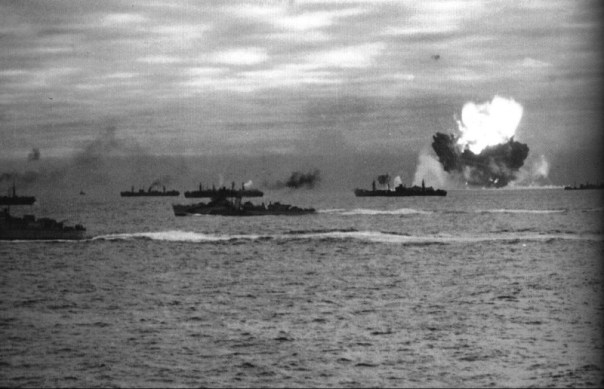
The convoys were co-ordinated by a control centre in Liverpool. At the heart of the convoy were the merchant ships with the supplies, usually travelling in rows eight abreast. Surrounding these were the warships which offered close protection – destroyers, armed trawlers and anti-aircraft ships. The distant protection was provided by heavy cruisers which would be 30 or 40 miles further out to combat any threat from German surface ships – the German ship Tirptz in particular was in Norwegian waters and considered a constant threat. Sometimes there were also one or two submarines offering protection to the convoy. In the summer months as the ice retreated the convoys would take the route from Iceland (usually off Hvalfjörður) north of Jan Mayen Island to Archangel, but as winter approached and the pack ice increased the convoys would take a more southerly route to Murmansk. From February1942 convoys also assembled and sailed from Loch Ewe* in Scotland.

Loch Ewe during the war

As if the threat of German attacks wasn’t enough the merchant convoys also had to contend with the severe weather conditions of the Arctic Ocean – fog, freezing temperatures which went down to -60, gales with winds of up to 100mph, mountainous waves, strong currents, drift ice, and the difficulties of navigating so close to the North Pole all meant that the loss rate for ships was higher than any other Allied convoy route. The journey meant days of heightened tension for the sailors, a particular fear was that your ship might sink because if it did there was little hope of rescue as you would only be able to survive for minutes in the freezing waters and the other ships in the convoy needed to keep moving as a unit and so often couldn’t stop to help.

The most infamous convoy was PQ17 which had the distinction of being the first significant joint Anglo-American operation of the war, was the largest arctic convoy to sail, and was also one of the biggest naval disasters of the 20th century.

The convoy of 35 ships in PQ17 assembled at Hvalfjord, Iceland, at the end of June 1942.  One ship grounded when leaving harbour and another was damaged by floating ice and had to withdraw, but the remaining 33 merchant ships headed east for Russia on 27th June. The 33 British and American merchant ships were carrying enough tanks and munitions to equip an army of 50,000 men. By this time Germany had realised that the convoys had to be stopped if they were ever to defeat Russia and so Hitler had increased the number of planes, ships and submarines in Norway. British command recognised the danger and gave PQ17 a massive armed escort – a close escort of 19 ships and a cruiser force of 7 further out. The British were also put in charge of this joint Anglo-American force as they were the only ones with the experience of Arctic convoys. The ships set out at their top speed on a voyage that was expected to take about 10 days, and for the first 7 days there were no major incidents as any U-boats that came close were driven away by the destroyers, and the anti-aircraft ships saw off any German planes. (Film star Douglas Fairbanks Jr served onboard one of the escort ships for PQ17).

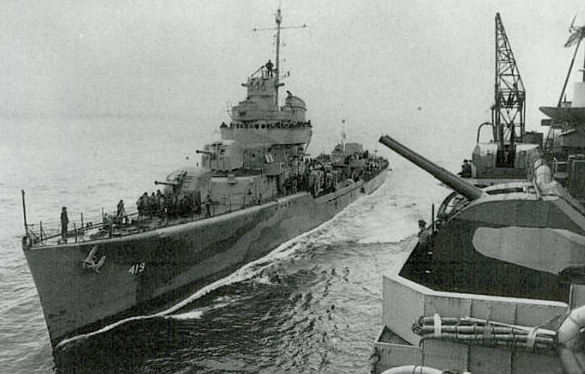
USS Wainright

But the massive convoy’s luck did not hold out and disaster struck on 4th July at 8.20 pm when the Germans launched a full assault. The first wave of the attack came from a flight of Heinkel 111 torpedo bombers. The USS Wainright broke ranks, turned away from the convoy and headed off alone to try to shoot down the planes; the heavy fire they gave caused most of the German planes to drop their torpedoes too early or turn back. After this initial success another more persistent wave of bombers came and within a short time 3 merchant ships had been hit with a loss of just 3 German planes. At the same time Naval HQ in London received news from Swedish intelligence that German surface ships had left Norway and were heading for PQ17, they reported that the Tirpitz was with them. The Tirpitz was the most advanced warship in the world with massive armour yet it was fast and had a huge number of colossal guns. The ships protecting the convoy could fire their shells a distance of 16 miles, but the Tirpitz’s guns could hit them from 22 miles away. The convoy stood no chance against such a ship.

Tirpitz

First Sea Lord Sir Dudley Pound (who was suffering with a brain tumour) had to make a decision – should he order PQ17 to turn back? If he did so it was possible that without the supplies Russia could lose the war, but if he ordered the convoy to continue it was likely to be destroyed and Russia could still lose the war. Pound decided that the Cruiser escort should turn around and return to Britain because they couldn’t take on the Tirpitz and the British could not afford to lose so many ships. The convoy itself should be ordered to disperse and head for Russian ports on their own. His theory was that if the merchantmen remained together the Tirpitz would be able to sink them all, but if they scattered at least some of them should get through. The messages from London created a sense of panic amongst the convoy who were not sure what to do. When the cruiser escort turned around Captain Broome was left in charge of the close escort and took overall control of the convoy, but with the merchant ships scattering in all directions he believed that it would be impossible to protect them so he turned around too, thinking that he could perhaps help the cruisers fight the Tirpitz. The merchant ships were left alone with no protection and 800 miles still to go.

Sir Dudley Pound

The Germans began their main attack on PQ17 with a force of 133 bombers, 12 torpedo planes and 12 U-boats; the unprotected ships were sitting ducks and it was a disaster for the convoy. The attack continued for 2 days with 12 merchant ships lost in the first 24 hours; and during that time there was still no sign of the Tirpitz. First Sea Lord Pound was eventually informed that the Tirpitz was still at anchor in Norwegian waters, there had been no need to abandon the convoy after all.** This is when the most puzzling decision of all was made, rather than bring the convoy back together Pound, for some unknown reason, said it must remain scattered. That order meant the effective end of PQ17.

It was at this point that the hero of Convoy PQ17 appeared. Captain Gradwell was a volunteer sailor who had been a barrister before the war but was now in command of a trawler which had been converted with a couple of guns and depth charges, and whose crew was mainly fishermen. Gradwell decided that the order to abandon the convoy was so bad that he would disobey it and stay with the scattered merchant ships. He found 3 US merchantmen whose officers agreed to follow his trawler as he led them as far north as possible, intending to hide amongst the ice until the attack was over and then head for Archangel. Gradwell didn’t have the charts he needed for the area and so was using a Times Handy Atlas! And he only had a certificate to captain a leisure cruiser in coastal waters! Gradwell took the ships as far north as he could, only stopping when the ice was too thick to go further, then he ordered the crews to paint the ships white and cover the decks with white sheets and tablecloths. At least one German plane flew over but didn’t see the camouflaged ships against the ice. Gradwell then ordered the tanks on deck to be loaded and pointed south to where any enemy would come from. And there the ships waited whilst chaos reigned in the south. When a fog came down Gradwell decided that it was time to try to escape and led the ships back south. On the morning of 25th July, two weeks overdue, Gradwell and the three ships he was escorting arrived in Archangel. Only 11 out of 33 of the convoy’s ships reached the Soviet Union, and 153 men lost their lives on those that were sunk. Captain Gradwell was awarded the DSC for his actions on Convoy PQ17.

Arctic convoys continued to the end of the war and the mistake of scattering the ships in the face of a German attack was never made again; but PQ17 was not the only one of the 78 arctic convoy missions to suffer losses. A total of 104 Allied merchant ships and 18 warships were sunk with the arctic convoys; over 3,000 personnel were killed. Russia also lost 30 merchant ships and an unknown number of personnel. Germany lost 5 surface warships, 31 submarines, and an unknown number of aircraft in her attacks on the convoys.
Over four million tons of supplies were delivered to the Russians by the Arctic convoys including tanks, aircraft, trucks, tractors, telephone wire, railway engines, sheet metal, food, and boots. The supplies were not as vital towards the end of the war but the convoys continued as a symbolic show of unity amongst the Allies.

The role which the convoys played in keeping Russia in the war cannot be overstated, but because they were Merchant Navy those who crewed the merchant ships did not receive a medal at the end of the war. It wasn’t until March 2013 that the role they played was finally recognised and they were awarded the Arctic Star.

*RUSSIAN ARCTIC CONVOY MUSEUM  near Loch Ewe in Scotland. Please take a look at their website, and call in if you are ever in the area – it is a fascinating museum.   There is some interesting video of Loch Ewe here (filmed in 2012 so some information about the museum and medal is out of date).

**Aside from an abortive attempt to intercept PQ12 in March 1942 and a raid on Spitsbergen in September 1943, the Tirpitz spent most of the war in the Norwegian fjords. She was repeatedly attacked by Allied forces and was finally sunk in Tromsø fjord on 12th November 1944 by the RAF.