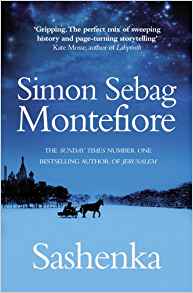
 Winter, 1916. In St Petersburg, snow is falling in a country on the brink of revolution. Beautiful and headstrong, Sashenka Zeitlin is just sixteen. As her mother parties with Rasputin and her dissolute friends, Sashenka slips into the frozen night to play her role in a dangerous game of conspiracy and seduction.
Twenty years on, Sashenka has a powerful husband and two children. Around her people are disappearing but her own family is safe. But she’s about to embark on a forbidden love affair which will have devastating consequences.
Sashenka’s story lies hidden for half a century, until a young historian goes deep into Stalin’s private archives and uncovers a heart-breaking story of passion and betrayal, savage cruelty and unexpected heroism – and one woman forced to make an unbearable choice …
Sashenka is a classic historical fiction novel focusing on the lives of a family across generations. Encompassing the story of Russia through the 20th century Mr Montefiore has woven a fascinating tale of the rise and fall of Soviet Russia and its impact on Sashenka, the daughter of a wealthy family, who embraces the message of equality within the communist doctrine. As with all good books in this genre a number of historical figures are featured, and it is their interaction with fictional characters which is so appealing – you can know the history of Russia, but the way it impacts on this fictional family is new to you and, as such, draws you in.
As always, Mr Motefiore has conducted detailed research into the period he is writing about. The description of St Petersburg under the last of the Tsars gives an insight into two very different Russias – high society with its materialism and decadence, coupled with the secret police and their attempts to destroy the fledgling communist party set against the extreme poverty of millions of women and children whose men are sent to fight in the First World War. The novel then leaps forward to the Soviet period under Stalin and focuses on the fear and insecurity of people like Sashenka, people who have been loyal communists from the very beginning yet are just as likely to suffer under Stalin’s mercurial rule. The final section is moving in the way it portrays life after communism, the search of people who lived through difficult times for those they loved and lost, most not expecting any kind of reunion but just wanting to know what happened to their families.
The author of Sashenka has created believable characters who can be idealistic yet brutal, worldly yet naïve, and who it is easy to sympathise with. This is not a comfortable novel to read, at times it can be quite brutal, but to omit such sections would give a false picture of those times in Russia and do a great disservice to the real people on whose lives these fictional characters are based. The style of Mr Montefiore’s writing is clear and precise at times but can then switch to a description of deep love and passion, whether between a man and woman or a woman for her children, and as such the book has a great emotional impact.
Sashenka is a novel full of plot twists and turns, it is well-paced and vivid, complex and passionate, and incredible evocative of time and place with its accurate historical backgound; in all a gripping read which I would recommend to anyone with a love of historical fiction or of Russia.
Sashenka can be found on Amazon
You can find out more about Simon Sebag Montefiore here
You can find more of my Recommended Reads here
 In the summer of 1913, the world seems full of possibility for four very different young men.
  A boat washes up on the shore of a remote lighthouse keeper’s island. It holds a dead man – and a crying baby. The only two islanders, Tom and his wife Izzy, are about to make a devastating decision.
 1939: In a hotel room overlooking Piccadilly Circus, two young men are arrested. Charles is court-martialled for ‘conduct unbecoming’; Anselm is deported home to Germany for ‘re-education’ in a brutal labour camp. Separated by the outbreak of war, and a social order that rejects their love, they must each make a difficult choice, and then live with the consequences.

 Penang, 1939. Sixteen-year-old Philip Hutton is a loner. Half English, half Chinese and feeling neither, he discovers a sense of belonging in an unexpected friendship with Hayato Endo, a Japanese diplomat. Philip shows his new friend around his adored island of Penang, and in return Endo trains him in the art and discipline of aikido.
 ‘A Fine Balance’ tells the story of the lives of four individuals who are brought together by circumstances. While we learn a lot about their background the main focus of the novel is the political and social situation in India in the 1970’s. Through their relationships with each other and interactions with other people Rohinton Mistry paints a compelling picture of poverty and prejudice in India. The levels of corruption and injustice portrayed in the novel give a sense of the hopelessness of life for many, yet the fact that the poorest characters can find a joy in their lives which evades those of a higher social standing is humbling.
 A Russian grand duchess and an English journalist. Linked by one of the world’s greatest mysteries . . .
 Dorinda Balchin - Author