
What if you had the chance to live your life again and again, until you finally got it right? During a snowstorm in England in 1910, a baby is born and dies before she can take her first breath. During a snowstorm in England in 1910, the same baby is born and lives to tell the tale. What if there were second chances? And third chances? In fact an infinite number of chances to live your life? Would you eventually be able to save the world from its own inevitable destiny? And would you even want to?
‘Life After Life’ is not the usual type of historical novel that I review. This is a fascinating story which explores the concept of life and time. What would happen if we lived the same life over and over again? Would it always be the same or would things change? Would we be able to guide our destiny to avoid the bad things which happen in life or to seek to achieve a goal which appears to be out of reach? Ms Atkinson uses the life/lives of Ursula to explore this theme.
Ursula is born one snowy day in 1910. She dies without taking her first breath but then is born again in the same situation with one minor difference which allows her to live. The novel continues to follow Ursula as she is born and dies, again and again. Each time her life is changed in some small way which leads to much larger changes as the years go by. Edward Lorenz asked, ‘Does the flap of a butterfly’s wings in Brazil set off a tornado in Texas?’ In this novel Ursula finds that her choices, as well as the decisions which people make all around her, do indeed lead to great changes – lives saved or lost, war or a chance for peace, all made possible through something as small as the proverbial flap of a butterfly’s wings.
Knowing, in part, what is going to happen to Ursula leaves you rooting for her, hoping that she will make a certain choice, speak to a certain person, avoid a certain action. In some of her incarnations you find yourself hoping that she survives and is happy, in others you hope that her death comes more quickly and she can start a new and better life. It is a strange novel in this sense, yet compulsive reading.
The reason I am recommending this book as historical fiction is the period in which it is set. Ursula lives during the turbulent years of both World Wars, and Ms Atkinson conveys these times in incredible detail. Her fictional accounts of the London blitz are some of the best I have read – both harrowing and inspiring. In another life Ursula lives in Germany during the Second World War. The descriptions of the changes from pre-war euphoria through nationalism to war and, finally, despair in Berlin during the last days of the Reich bear testimony to the depth of research which the author has carried out.
‘Life After Life’ is a unique novel in its structure. It is also a novel rich in historical detail and, in addition, a compelling portrait of Ursula and her family. Ms Atkinson’s writing cuts to the heart of human hopes and dreams, ambitions, loves and losses; the reader comes to love or hate the characters who are well drawn and believable, the kind of people you could meet almost anywhere.
The author writes with great skill, producing a novel which is thought provoking, moving and at times uncomfortable. It is the sort of book which leaves the reader reflecting on life, destiny and fate. What might be the consequences of our actions? Can we shape the future by a single word or deed or is it all pre-ordained? This is not a light read, but if you are looking for something entertaining and educational which leaves you asking questions and wanting more then I heartily recommend that you read ‘Life After Life’.
This novel won the 2013 COSTA Novel Award, and deservedly so.
‘Life After Life’ can be found on Amazon
Kate Atkinson’s website can be found here
More of my Recommended Reads can be found here.
 ‘A Fine Balance’ tells the story of the lives of four individuals who are brought together by circumstances. While we learn a lot about their background the main focus of the novel is the political and social situation in India in the 1970’s. Through their relationships with each other and interactions with other people Rohinton Mistry paints a compelling picture of poverty and prejudice in India. The levels of corruption and injustice portrayed in the novel give a sense of the hopelessness of life for many, yet the fact that the poorest characters can find a joy in their lives which evades those of a higher social standing is humbling.
 A Russian grand duchess and an English journalist. Linked by one of the world’s greatest mysteries . . .
 ‘Captivate, kill or destroy the whole force of the enemy’ was the order given to the American soldiers in the summer 1779.
 Summer 1942. When Bernie Gunther is ordered to speak at an international police conference, an old acquaintance has a favour to ask. Little does Bernie suspect what this simple surveillance task will provoke . . .
 ‘Winter Of The World’ is the second part of Ken Follett’s trilogy about the twentieth century. It is an ambitious novel, taking readers from 1933 through the Second World War to 1949. The plotting is complex with characters in the US, England, Germany and Russia who experience some of the key points of this period of history – the rise of Hitler, the Nazi euthanasia programme, the war in Europe, Pearl Harbour, war in the Pacific, the development of the atom bomb, the aftermath of war in Germany – the list could go on and on. The raft of characters and wide ranging storylines does mean that some important parts of this period of history are missed or skimmed over, but that is perfectly understandable.
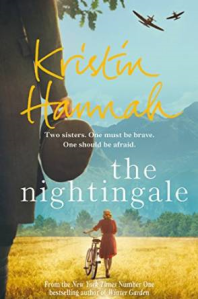 ‘The Nightingale’ is a novel which will grip you from start to finish with its portrayal of life for two sisters in France during the Second World War. Vianne’s husband is taken by the Germans to a labour camp. Having a daughter makes Vianne cautious, intent on ensuring that they both survive the war. Her sister, Isabelle, is younger, more daring; a girl who has felt unloved for most of her life and feels she needs to do something, anything, to give meaning to her existence. Yet as the years progress, as hunger and lack of all luxuries set in, so the characters change to meet their changing circumstances. Small changes at first, but for each action there is a consequence leading, almost inevitable, to more dangerous actions. This is real life in the sense that it is moral choices that people make which mould them, choices which they sometimes wish they didn’t have to make but which cannot be avoided.
 Dorinda Balchin - Author