
Coco Chanel is a name recognised the world over as the French fashion designer and business woman who founded the global brand which carries her name. There have been questions since the end of the Second World War about her links with Germany during the conflict, particularly her liaison with German diplomat Hans Gunther von Dincklage. So how much of this was true and how much mere rumour?
Gabrielle ‘Coco’ Chanel was born in 1883 to a poor family; her mother died of TB when she was 12 and her father sent her and her two sisters to live in an orphanage at the convent of Aubazine where Chanel learnt how to sew, something which was to influence the whole of her life. When she was 18 the young Gabrielle moved to a Catholic girls boarding house in Moulins where she earned her living as a seamstress; she also liked to sing in cabaret, and it was whilst doing this that she got the nickname ‘Coco’.

In the years between the wars Chanel had a couple of love affairs with wealthy and influential French aristocrats. She always wanted to be at the height of fashion and so designed her own hats; from that humble beginning she moved on to open her own boutiques in Deauville (which was the fashion centre of the ‘Roaring Twenties’) and Biarritz. Her boutiques, funded by her wealthy lovers, sold hats and fashionable clothing. The poor young girl who grew up in a Catholic orphanage now mixed with politicians and aristocrats from across Europe including Hugh Grosvenor, the Duke of Westminster, and it was at this time that she met and became friends with Winston Churchill.
In 1924, Chanel was looking to expand her empire and reach by putting her new perfume on the global market but she needed financial backing to do this. Chanel was introduced to Jewish businessmen and brothers Pierre and Paul Wertheimer who invested heavily in Parfums Chanel, taking the majority of the stock for themselves and another business partner whilst leaving Chanel with just a 10% stake in the company. As her company grew Chanel met and fell in love with Paul Iribe and, during their relationship, she financed his controversial journal Le Temoin (The Witness) which was an extremely xenophobic, ultra-nationalist, and racist publication. Chanel was heartbroken when Iribe died of a heart attack.

At the outbreak of war in September 1939 Coco Chanel surprised everyone by closing her businesses and putting her 2,500 employees out of work. As the German Blitzkrieg forged its way through northern Europe Chanel moved to the Pyrenees for safety whilst the Jewish Wertheimers chose to go into exile, but before doing so they placed Parfums Chanel in the hands of a trusted friend, the Christian business man Felix Amiot. The Wertheimer’s ship sailed for New York just a few days before France fell to the Germans, and as they moved further away from France Chanel returned to Paris where she moved into the Ritz hotel which was the place where most of the highest ranking

German military staff preferred to stay, and where she had an affair with Hans Gunther von Dincklage.
Chanel still felt cheated by the Wertheimers and resented the fact that she only held a 10% share in her famous perfume; when she heard that the brothers were now producing No 5 in America she was furious and wanted to get revenge. Chanel decided to use the Aryanisation laws to take control of the company – after all she was Aryan whilst the Wertheimer’s were Jewish and so, by law, had no rights of ownership over Parfums Chanel. On 5th May 1941 Coco wrote to the government department charged with disposing of Jewish financial assets to say that Parfums Chanel was still the property of Jews who had legally abandoned it. She claimed that she had never received a fair share of the profits from the company and felt that the department could now compensate her for that. In the initial legal review Amiot was able to show that he had gained control of the company from the Wertheimers through legal means, but the company was still declared Jewish, partly thanks to a friend of Chanel’s who sat on the board. The next step for Chanel was to write to the Commissioner General for Jewish Questions asking for all shares and control of all the Wertheimer’s perfume companies (not only Chanel) be given to her. Amiot had an aviation business before the war and was now working with Junkers to provide planes for the Germans (he used this link as a means to save his workers from being sent to Germany in forced labour units whilst at the same time helping to finance a resistance group working with the British). When it came to choosing between a man supplying bombers for the Luftwaffe and a female fashion designer the Germans found in Amiot’s favour.

This was a resounding defeat for Coco Chanel, and it was at this point that she appears to have begun working for von Dincklage at the Abwher (the German intelligence service in which von Dincklage was highly placed in Paris) in return for his help in trying to regain control of Parfums Chanel. The influential German agent who was also her lover gave Chanel the Agent number F7124 and code name Westminster (after her lover from before the war). It was late 1943 and the Germans were losing ground on all fronts so von Dincklage first took Chanel to Berlin to meet Walter Shellenberg who was head of the SD, the Nazi party’s intelligence agency. Schellenberg was Himmler’s right-hand man and wanted to negotiate peace with the British whilst still continuing the war against Russia and America. In November 1943 Chanel was sent to Madrid on Operation Modelhut (Operation Model Hat) to use her connection with Churchill to convince him to end the war on terms set by Hitler. Chanel and Churchill had been close friends in the 1920’s so she had every expectation that she would at the very least be able to have personal communications with him. However, Chanel’s close friend, Vera Lombardi , also knew Churchill and informed the British that Chanel was a Nazi agent, effectively ending any chance that Coco had of success in her mission – Chanel wrote a number of letters to Churchill, but as she had been denounced he didn’t answer any of them. Coco returned to Paris in January 1944.
 Chanel’s relationship with von Dincklage was no secret, and the Free France Secret Services seem to have known about the work that she was doing for him. When Paris was liberated on 25th August 1944 citizens sought out any collaborators, particularly women who had had relationships with the Germans. Just four days later, on 29th August 1944 two FFI resistance fighters arrested Chanel at the Ritz and she was questioned by the Free French Purge Committee about her work as a German agent. It has been implied that Churchill remembered their previous friendship and intervened with de Gaulle, for she was released after just two hours questioning, and in September 1944 Chanel re-joined von Dincklage in Switzerland. In 1949 Chanel once more faced questions about how she used the anti-semite laws to try to gain control of Parfums Chanel from the Wertheimer brothers, her relationship with von Dincklage, and her work for the Abwher, but denied all accusations against her. Chanel continued to live with von Dincklage until the mid 1950’s. She returned to Paris in 1954 and reopened her couture business with help from her friend Pierre Wertheimer, the man she had sought to destroy during the war but who was now reconciled to her (Amiot had returned the company to the Wertheimers at the end of the war). The fashion business of Coco Chanel prospered as never before.
Coco Chanel, who died in 1971, is one of a number of French artists who were accused of collaborating with the Nazis during the Second World War – including Maurice Chevalier, Jean Cocteau, Sacha Guitry and Edith Piaf. So what was she? A shrewd businesswoman and opportunist, or an active collaborator? It was not until 2014 when French intelligence agencies declassified a number of documents that it was finally confirmed that Coco Chanel had worked as a spy for the Germans during the Second World War. On example from the French Defense Ministry’s archives showed that France’s secret services had suspicions about Chanel’s Nazi connections at the time:
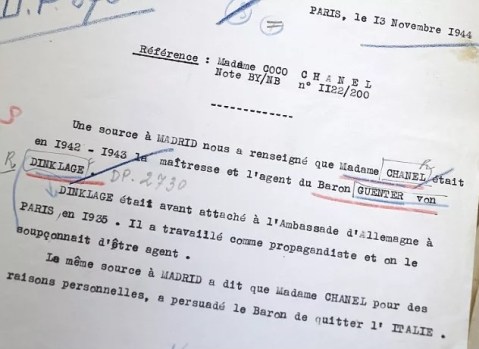
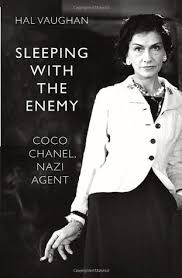 Another example comes from Hal Vaughan’s book ‘Sleeping with the Enemy: Coco Chanel’s Secret War’. He spent a lot of time reviewing American, German, French, and British archives, and says that Abwehr Agent 7124 whose code name was ‘Westminster’ went on missions around Europe to recruit new agents for the Third Reich, travelling to Spain with Baron Louis de Vaufreland, a Frenchman who worked as an agent for the Germans; his job was to find people who could be recruited or coerced to spy for Germany, and as Chanel knew the British ambassador to Spain she went with him as cover, and to offer him introductions.
After the publication of Hal Vaughan’s book a spokesperson for the Chanel company said that “Such insinuations cannot go unchallenged. She would hardly have formed a relationship with the family of the owners (the Wertheimers) or counted Jewish people among her close friends and professional partners such as the Rothschild family, the photographer Irving Penn or the well-known French writer Joseph Kessel had these really been her views. It is unlikely…We also know that she and Churchill were close friends for a long time. She apparently approached him about acting as an intermediary between the Allies and the Germans for a peace settlement known as Operation Modelhut. No one knows for sure exactly what happened or what her role was to be. There are several different versions and it will no doubt always remain a mystery.”
So I leave you with a question…Did Coco Chanel really support the Nazi cause or did she just do what she thought was necessary to retain her company in a time of war? Two things remain of interest to me. The first is her pre-war funding of Le Temoin which appears to show anti-semitic tendancies on her part. The second is the details of her relationship with General Walter Schellenberg who was chief of the German intelligence agency Sicherheitsdienst (Security Service) and the military intelligence spy network Abwehr (Counterintelligence) in Berlin and who sent Chanel on her mission to Madrid. Schellenberg was tried by the Nuremberg Military Tribunal at the end of the war and sentenced to six years’ imprisonment for war crimes; he was released in 1951 because he had an incurable liver disease. It is interesting to note that Chanel paid for his medical care and living expenses, supported his wife and family, and paid for Schellenberg’s funeral when he died – make of that what you will.








 Hedwig Eva Maria Kiesler, a Jew born in Vienna on 9th November 1914, is better known to the world as the Hollywood actress Hedy Lamar. As a child she was interested in acting and theatre, but she also had a passion for inventing things and at the age of 5 she was able to take apart and rebuild her old-fashioned music box. Her father was a banker who loved Hedy’s intellectual curiosity and interest in technology and would happily spend time explaining to her how things worked. Hedy grew up to be one of the most beautiful women in the world and began her acting career in Europe where at the age 16 she went to a film studio and got a walk on part. The young actress became world famous when she appeared naked in a film called Ecstacy which was banned by Hitler and denounced by the Pope. When she was 19 Hedy married a munitions tycoon, Fritz Mandl, who was allied with the Nazis even though he was Jewish; it was not a happy marriage. By 1937 it was clear that war would be inevitable; Jews were being systematically denied their rights which led to the death of Hedy’s father from stress and worry. Hedy left her husband and escaped to England with her mother where Hedy met the film director Louis B Mayer and went to Hollywood to work for him.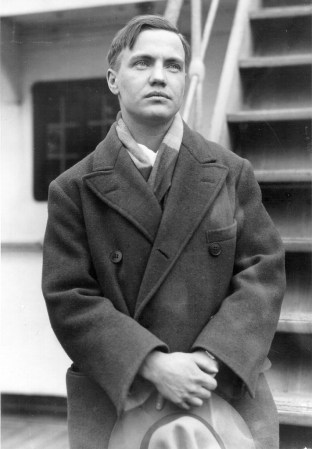
 This is where her friend the composer George Anthiel came in. George came up with the idea which would make Hedy’s concept work using the same system as that used by pianos which play themselves – the rolls activate piano keys so why couldn’t they activate radio frequencies in both the torpedo and the ship? The idea was for two rolls of card with holes in them (similar to those used by the pianos) to start at the same time and run at the same speed so the ship and torpedo could secretly communicate on the same pattern of frequencies; there were 88 frequencies, the number of keys on a piano, and it would be impossible for the enemy to jam these all at the same time as it would require too much power; it would also be almost impossible to crack the system as each pair of rolls could be uniquely created using a random pattern. George and Hedy took their idea to the National Inventors Council in 1941, and the Council put them in touch with a physicist at Cal Tech called Sam Mackeown, who was an expert on electronics. On 11th August 1942, U.S. Patent 2,292,387 was granted to Antheil and “Hedy Kiesler Markey”, Lamarr’s married name at the time. George and Hedy took the invention to the navy but they rejected it, and the US government seized her patent in 1942 as the ‘property of an enemy alien’.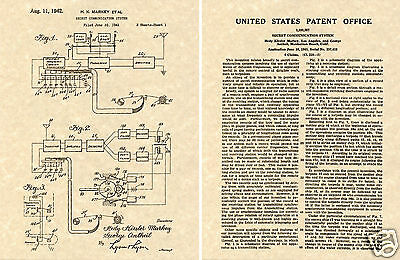







 In the uneasy post-war peace of occupied Germany, a British soldier is billeted to a bombed Hamburg hotel. Alex’s days are spent investigating Nazi war criminals, but it is a chance meeting with a German university professor in a shabby back-street bookshop that changes his life. Having befriended the professor and his wife, Alex falls in love with their only daughter, Lisa, only to discover that the professor may not be as innocent as he first appeared. The stale aftermath of a long and hideous war has left the old society in ruins. There are still many secrets to uncover and Alex has to ask himself what is more important – love or truth? As he digs deeper into the professor’s past Alex is forced to recognise that he cannot have both.






 Dorinda Balchin - Author