All posts by Dorinda Balchin

What’s in a name? – The ‘Union Flag’ or the ‘Union Jack’?

I was recently puzzling over a question whilst writing my next novel. Should I refer to the British flag as the ‘Union Jack’ or the ‘Union Flag’? Many people have different opinions on this so I thought it would be interesting to take a look at the history of the flag; after all, this is not just a symbol for the United Kingdom but for many other countries too*, an expression of the wide influence which Great Britain has had in the history and development of those countries.

So what is the history of the Union Jack?

The Union Jack actually incorporates the national flags of three countries – England, Scotland, and Northern Ireland. Its name even emphasises the fact that Great Britain is a union of nations, the full title of our country being ‘The United Kingdom of Great Britain and Northern Ireland’. As I said earlier, the flag is also called the ‘Union Flag’, and this emphasises the way that the union of our countries can change over time but we still hold together. The fact that some powers have been devolved to Scotland, Wales and Northern Ireland in recognition of their different national identities and needs does not detract from the essential unity of Great Britain. (Although Scotland has held a referendum to see if the country supports independence so far the majority of that country wish to remain in the Union).

The flag itself is an intricate design marrying together three different national flags, each one representing the patron saint of that country:

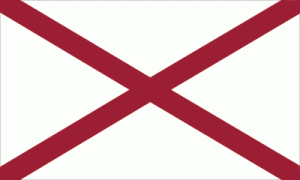
St George’s cross, the flag of England
St Andrew’s cross, the flag of Scotland
St Patrick’s cross, the flag of Northern Ireland

So where is the flag of St David of Wales? you may ask. Well, the first Union Flag was designed in 1606, and as Wales had already been united with England for centuries by that time the flag of St George was used to represent both. The Welsh still do have their own flag though, a red dragon, and this can often be seen being waved at sporting events by proudly nationalistic Welsh people.

The Welsh dragon

When King James VI of Scotland inherited the English throne on the death of Queen Elizabeth I (see my article ‘A British Game Of Thrones’) it was decided to create a new flag to celebrate this union. The final design had a blue background with the red cross of St George superimposed over the white cross of St Andrew. This became known as the Union Flag.

Although James was king of both England and Scotland these were still two separate countries and so the new Union Flag was only flown at sea until England and Scotland were finally united in 1707 under Queen Anne. While at sea the flag was flown from the jack staff at the bow of the ship, and this is probably where the name ‘Union Jack’ comes from.

Ireland didn’t join the Union until 1801, at which time it was felt that the Irish identity should also be represented in the Union Flag. This is when the cross of St Patrick was added and the flag became what we know it to be today, with the ‘Union Jack’ receiving Parliamentary approval as the national flag in 1908.

So that is how the flag of the United Kingdom of Great Britain and Northern Ireland came into existence. But does this help me in deciding what to call the flag in my novel? The official name is the Union Flag, but it is rarely called that and we British know and love it as the Union Jack. The characters in my novel would not be bothered about history or technicalities but would use the name that was known to everyone. So I have decided to go with the common usage of the time and refer to the Union Jack. I do hope no historians or vexillologists will be too offended by that!

*Flags which feature the Union Jack:

Commonwealth nations – Australia, Fiji, New Zealand, Tuvalu, United Kingdom

Overseas Territories – Akrotiri and Dhekelia, Anguilla, Ascension Island, Bermuda, British Antarctic Territory, British Indian Ocean Territory, British Virgin Islands, Cayman Islands, Cook Islands, Falkland Islands, Niue, Montserrat, Pitcairn Islands, Ross Dependency, Saint Helena, South Georgia and the South Sandwich Islands, Tristan da Cunha, Turks and Caicos Islands

Federal, Provinces, Territories and States – British Columbia, Hawaii, Manitoba, New South Wales, Ontario, Queensland, South Australia, Tasmania, Victoria, Western Australia

Flags which used to feature the Union Jack:

Canada, South Africa, Australia, Newfoundland

Please let me know if I’ve missed any!
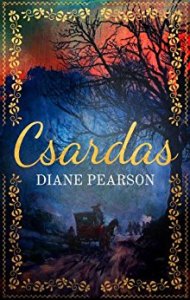
Recommended Read – Csardas by Diane Pearson

CSARDAS – taken from the name of the Hungarian national dance – follows the fortunes of the enchanting Ferenc sisters from their glittering beginnings in aristocratic Hungary, through the traumas of two World Wars.
From the dazzling elegance of coming-out balls, feudal estates and a culture steeped in romance, to terror and starvation in the concentration camps – no story could be more dramatic than that of Eva and Amalia Ferenc, whose fate it is to be debutantes when the shot which killed Archduke Franz Ferdinand in Sarajevo plunged Europe into the First World War. Their story is enthralling, tragic, romantic – and absolutely unputdownable.

Csardas is incredibly well researched giving a detailed and seemingly faultless history of Hungary from the feudal society which existed in the Austro-Hungarian empire before the First World War through to the creation of the communist state after the Second. With a clever choice of families to follow (aristocrats, wealthy half-Jews and poor serfs) Ms Pearson has been able to look at the key points in the history of Hungary from all perspectives in a narrative which is never ‘instructive’ but flows as a good story should.

The novel is well written giving a real feel of time and place whilst gently encouraging the reader to invest in the lives of its central characters who are believable and multi-layered. You will soon find yourself loving some and feeling less sympathetic towards others – the shallow young girl who never really grows up; the aristocrat whose experiences during World War One leave him mentally scared in a way that guides his future actions; the peasant boy who can’t commit to others because of his fear of loss…

The publisher’s description of this book may give the impression of a romance novel but it is much more than that. There are love stories intertwined throughout, but that is the nature of life itself; where Csardas excels is in the subtle way in which serious topics are covered from the depravities of war to the suppression of the lower classes and horrific treatment of Jews. Essentially this is a book which charts how life and culture in a country changes due to politics and war, giving the reader a fascinating insight into a country which we all know of but know little about.

The beginning of Csardas may seem a little slow to some readers as it sets the scene within Hungary at the beginning of the twentieth century and introduces the key characters, but this is necessary as it gives a great foundation for the engrossing story which follows. This is a book which I have read a number of times and no doubt will return to again in the future.

If you like well-written epic stories based on historical fact then Csardas is for you.

Csardas is available on Amazon

You can find out about other books by Diane Pearson here

You can find more of my Recommended Reads here

Yorkshire’s forgotten battle – Marston Moor

Today marks the anniversary of the Battle of Marston Moor on 2nd July 1644. This was an important battle in English history but few people know much about it. So why was there a battle on Marston Moor? Who was fighting and what impact did this have?

The English Civil War of the 17th century pitted Parliament against the King and was one of the defining moments in the development of the United Kingdom as a parliamentary democracy. There were a number of battles and skirmishes during the two civil wars (the first with King Charles leading his forces and the second whilst he was being held prisoner by Cromwell and Parliament), the three major battles being Edgehill, Naseby and Marston Moor.

The Battle of Marston Moor, which took place in the evening of 2nd July 1644, was critical for the control of the north and is believed to have been the largest battle ever fought on English soil in terms of numbers of combatants. Surprising as it may seem for a battle of such massive proportions and such a pivotal role it only lasted for about two hours. The action took place on open fields and moorland which still exist relatively unchanged, this has enabled historians to get a very good understanding of how the battle unfolded as most of the key features of the local landscape are still there to be seen by historians and visitors alike.

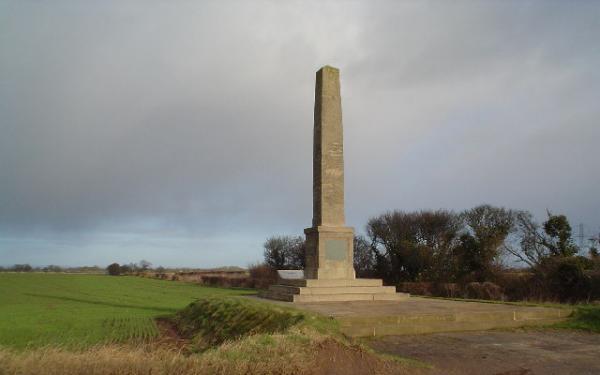
Memorial to those who fell during the Battle of Marston Moor.

At the outbreak of the conflict England was divided along lines of political persuasion and religious beliefs, families were torn apart and no community was immune to the terrible divisiveness of civil war yet, on the whole, the north of England tended to side with Parliament and was a centre of opposition to King Charles in the early part of the war. The prosperous city of York was the major religious centre in the north so control there was seen as vital – whoever held York would have a distinct advantage over their enemies.

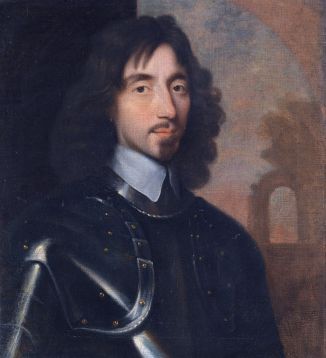
The Marquis of Newcastle led a Royalist army to York in the spring of 1644 and although he took possession of the city he soon found himself besieged there by Sir Thomas Fairfax who was leading a joint force of Parliamentary and Scottish men. King Charles was desperate to hold on to York and sent his nephew, Prince Rupert of the Rhine, to try to relieve the siege. Although young, Rupert had a reputation as a good leader in battle and so when Fairfax heard about the approach of the relief force he abandoned the siege and moved out towards Marston Moor (7 miles from York). Prince Rupert led the King’s forces into York on 1st July 1644 and, together with his command team, decided to pursue the enemy the following day. Unfortunately for Prince Rupert some of his commanders allowed their men to loot the city or take rest so his forces marched at different paces and only arrived on the moor near the village of Long Marston in dribs and drabs, disorganised and perhaps a little over confident after taking York. They arrived to find that Parliament already had control of the roads and so Rupert was forced to marshal his men on the desolate moors, setting up his front in fits and starts as his men arrived whilst the Parliamentarians were already organised in a good defensive position.

Prince Rupert of the Rhine by Anthony van Dyck

Although Rupert was at a disadvantage numerically – both sides had more or less equal cavalry forces of around 7,000, but the 20,000 combined infantry of the Scots and Parliament far outnumbered the 11,000 Royalists – he did have the advantage of protection offered by the varied geography of the moorland. The Royalists were able to position themselves amongst the numerous ditches and hedges which would impede attacks by the enemy, whether on horse or foot. Rupert felt confident that his left flank was particularly well defended in this way.

Fairfax’s Parliamentary forces occupied a low hill (barely 100 feet high) which gave them the advantage of higher ground on the flat moor and farmland, although a number of cornfields did make it difficult for him to deploy all of his forces. The Royalists tried to take advantage of this and seize a rabbit warren to the west of the fields so that they could infiltrate the Parliamentary positions, but they were forced back and Cromwell put the left wing of his cavalry there. Next to this was a very strong central force made up of more than 14,000 infantry and almost 40 artillery pieces; Sir Thomas Fairfax held the right wing with a cavalry of at least 2,000. Both cavalry wings were interspersed with musketeers and dragoons.

The Royalists were positioned on the moor, below the enemy and behind a drainage ditch which it was hoped would prevent, or at least disrupt, any cavalry charge. Like the enemy forces opposite, their wings were made up of cavalry and musketeers, the centre consisted of infantry and 14 artillery pieces, whilst Rupert held 600 cavalry in reserve behind these. As evening approached on 2nd July Rupert could hear the enemy singing psalms and presumed that they were getting ready to bed down for the night and there would be no attack before the morning. Yet, as the Royalists settled down to supper, the enemy attacked just as a thunderstorm broke over the moor.

The cavalry on the Royalists right wing was almost immediately driven back and Rupert was forced to commit his reserve of cavalry there, far earlier in the battle than he would have liked. The fighting was fierce but Cromwell eventually broke Rupert’s men and the Prince himself only avoided capture by hiding in a bean field!

There was also success for the Parlimentarians in the centre although their right wing initially had more difficulty when some of Fairfax’s forces were caught in a ditch where they were an easy target for the Royalists who forced them back. The battle ebbed and flowed chaotically for a time; at one point during the confusion of battle and the thunderstorm a number of Fairfax’s infantry believed they had been defeated and fled the field. Yet the Parliamentary centre stood firm against repeated charges by Royalist cavalry.

Oliver Cromwell

By this point it was almost dark, but the full moon was rising and it was possible to see confused men from both sides running away across the field. Taking advantage of the confusion Cromwell led his cavalry in a last charge against the tired and disorganised Royalist cavalry which eventually withdrew and retreated towards York. The final desperate stand was made by Newcastle’s ‘Whitecoats’ who fought fiercely, giving no quarter and refusing to surrender until just thirty of their number remained. In just two hours the Royalist forces had been defeated and, although a number of areas such as Bolton and Scarborough still held for the king, the north belonged to the Parliamentarians.

In the course of a battle which only lasted for two hours the Royalists lost around 4,000 men killed with an estimated 1,500 taken prisoner. In contrast the Scottish and Parliamentarian loses may have been as few as 300 killed (although some historians put this figure at over 1,000). During the battle Oliver Cromwell was able to show how a well-trained, disciplined and well-equipped army could win against the more experienced Royalists, and cemented his reputation as a great commander.

Marston Moor was a pivotal point during the English Civil War and, as such, I felt that I could not write ‘The Cavalier Historian without a description of the battle as seen through the eyes of one of my main characters, Thomas Hardwyke, a member of the Royalist cavalry and staunch supporter of Prince Rupert and the King.


Caring for your precious items – book conservation

Are you a lover of books? I am. I love the feel and smell of a new book, and I love the history which is part of an old book – what can it tell me about the past? about the person who owned it?

17th century Bible

Books, manuscripts, letters, newspapers, and other kinds of documents can be a very important source for historians. Not only do they give us information about what happened during a certain period of history, but the way they have been used can also tell us a great deal too, from the family history written in the front of a BIble to letters and photographs preserved between the pages. An old family Bible dating from the 17th century plays a role in my novel The Cavalier Historian, and Robert Hardwick, the main character, is keen to have it properly conserved. So why do books deteriorate and what can be done to limit this?

The condition of paper items can deteriorate for any number of reasons including:

Inherent vice – this refers to the general degradation of the book as it ages. Paper made from plant materials like hemp or linen are more durable than paper made from wood-pulp which becomes discoloured and unstable because of the lignin it contains. As a single book is made from a number of materials (the cover, pages etc will be made from different materials) these can degrade at different rates.

Pests –  Insects and vermin will feed on the cellulose, starch and protein in paper.

Environmental conditions – extremes of temperature and humidity, the quality of the air, and light (e.g. direct sunlight) can all damage books. The modern environment with central heating or air conditioning in many buildings has increased the amount and speed of damage to many books.

Handling A book which has been handled frequently can show many different kinds of wear and tear, from damage to the spine to wearing of the cover where it has been frequently taken down from a shelf.

So books and paper documents will suffer damage over time. Sometimes that is not a problem to the owner, if it is a cheap paperback novel, for example, it may just be recycled when it begins to lose its cover or pages. But what happens to something more valuable? There are two main ways in which a book may be conserved. On the one hand, preventative conservation aims to maintain and, if possible, enhance the condition that the book is in, and also to make sure that the risks of further deterioration are reduced by making sure that it is handled correctly and kept in the correct environmental conditions in the future. On the other hand, remedial conservation aims to repair the book with the minimum amount of changes so that the history of the book itself can be preserved as much as possible. The amount of work put into conserving a book can range from basic minimal stabilization to very complex work on both the pages and binding including structural, chemical, and cosmetic work.

Tools used in book conservation

Basic stabilization involves the minimum amount of work to slow the deterioration of the book. Strange as it may seem, this kind of work can be used for books at opposite ends of the spectrum – for items that have little value and so are not worth the cost, but also for those which are valuable historical objects or artifacts and so the history in the book itself needs to be preserved.

In The Cavalier Historian the aim of the work on the Bible was to have ‘minimal intervention’, in other words Robert wanted to maintain the integrity of the Bible and the story it had to tell about the Hardwicke family so the work was to be restricted to protecting against further damage rather than restoring it to its original condition. During my research of this topic whilst writing the novel I developed an interest in  book conservation and now, whenever I visit a museum or historical property, I find myself looking at the books on display with a a deeper interest, wondering how they have been  conserved and what stories they have to tell.

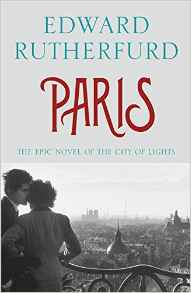
Recommended Read – ‘Paris’ by Edward Rutherfurd

City of love. City of splendour. City of terror. City of dreams.
Inspired by the haunting, passionate story of the city of lights, this epic novel weaves a gripping tale of four families across the centuries: from the lies that spawn the noble line of de Cygne to the revolutionary Le Sourds who seek their destruction; from the Blanchards whose bourgeois respectability offers scant protection against scandal to the hard-working Gascons and their soaring ambitions.

Over hundreds of years, these four families are bound by forbidden loves and marriages of convenience; dogged by vengeance and murderous secrets; torn apart by the irreconcilable differences of birth and faith, and brought together by the tumultuous history of their city. Paris bursts to life in the intrigue, corruption and glory of its people.

Author of Sarum, London and New York, Edward Rutherfurd illuminates Paris as only he can: capturing the romance and everyday drama of the men and women who, in two thousand years, transformed a humble trading post on the muddy banks of the Seine into the most celebrated city in the world.

Mr Rutherfurd has written an engrossing saga of interwoven stories of four families who lived and loved in the city of Paris, families which come from all aspects of society – nobility, bourgeois, revolutionary and labourer. The lives of these fictional families are skilfully entwined with the history of the city from its earliest days to the Second World War and beyond, which makes the novel ideal for someone who wants to get an overview of the history of Paris and how different social groups influenced, or were influenced by, events. Each family history is carefully plotted and although there are rather a lot of co-incidences these are necessary to bring the characters together in a complex yet coherent plot, ‘Paris’ is, after all, historical fiction not fact.

Mr Rutherfurd has obviously conducted a great deal of detailed research into the history of France and Paris which is evident in the complexities of both the culture and politics of France which he has handled with skill. Whilst the main portion of the novel covers the period from 1875 to the mid-1960’s this story is interspersed with cameos of the families from 1261 onwards, the abiding theme being the socialist and revolutionary spirit of many of the city’s inhabitants. This is an effective way of telling the story of Paris without overwhelming the reader with too much detail or including information just for the sake of it. Mr Rutherford seems to get the right balance here, and anyone who wants to find out more about any of the periods will be able to conduct further research for themselves.

‘Paris’ is a story of divided loyalties, lies, deceit, love, honour, and a whole raft of other emotions, all told against the backdrop of this vibrant city. One fascinating aspect of the novel is the descriptions of the landscape and architecture and how these changed over the centuries. The physical space of the city is so well written that you can feel yourself there, and anyone who has ever visited Paris will recognise the authenticity of the descriptions from Versailles to Notre Dame, the Eifel Tower to Montmartre.

Mr Rutherfurd has a writing style which is engaging and moves the story on at a good pace. The one thing which readers may find difficult to follow is the relationships of the characters and family histories but the author has provided excellent family trees to help with this, and the more you read the less you need to use them. What draws the reader in is the believable characters who elicit a variety of responses, from sympathy to anger; what is interesting is that you are able to see the history of France from many different perspectives and find your sympathies residing with different parts of society at different times. It takes a very clever wordsmith to create such a believable world for his characters to inhabit.

I would recommend ‘Paris’ to anyone who enjoys historical sagas. The novel is an easy and engaging read from which it is possible to learn a great deal whilst also being entertained. Based on my enjoyment of this book I shall certainly be reading more novels written by Edward Rutherfurd.

‘Paris’ can be found on Amazon

Mr Rutherfurd’s website can be found here

More of my Recommended Reads can be found here

The fruits that won the war – Mulberry Harbours

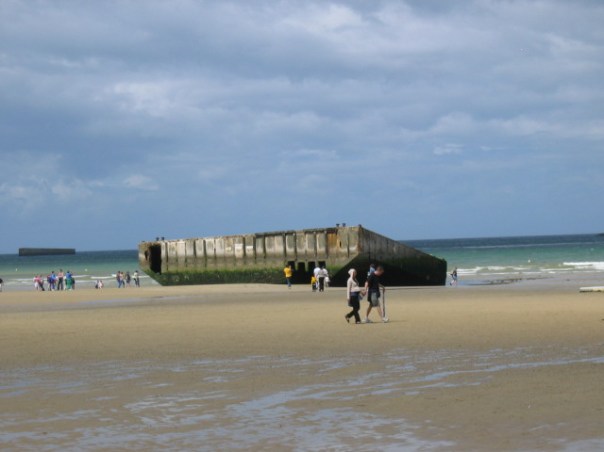
If you holiday in France you may like to visit Arromanches on the Normandy coast. This was the site of one of the Mulberry Harbours, an amazing engineering feat which helped to change the course of the Second World War. The remains of the harbour can still be seen today.

German coastal defences at Arromanches

Both the Allies and Hitler knew that an Allied invasion of Nazi held Europe was essential for the winning of the war. They also knew that any landing was unlikely to succeed without a safe harbour in Allied hands. Once the liberating forces had established a foothold on the Normandy coast enormous amounts of men and supplies would need to be landed to re-enforce the bridgehead before pushing on towards Germany. The problem for the Allies was that the Germans had occupied and heavily fortified all the ports on the northern coast of France. The disastrous Allied raid on Dieppe in 1942 showed that taking such ports would only be done with immense loss of life and would not be quick. What the Allies needed was access to a port that was not controlled by the Germans. Small fishing ports would not be suitable as the large ships needed to transport bulky supplies needed a deep port with harbourside cranes; the Allies therefore decided that if no such ports were available they would have to create their own.

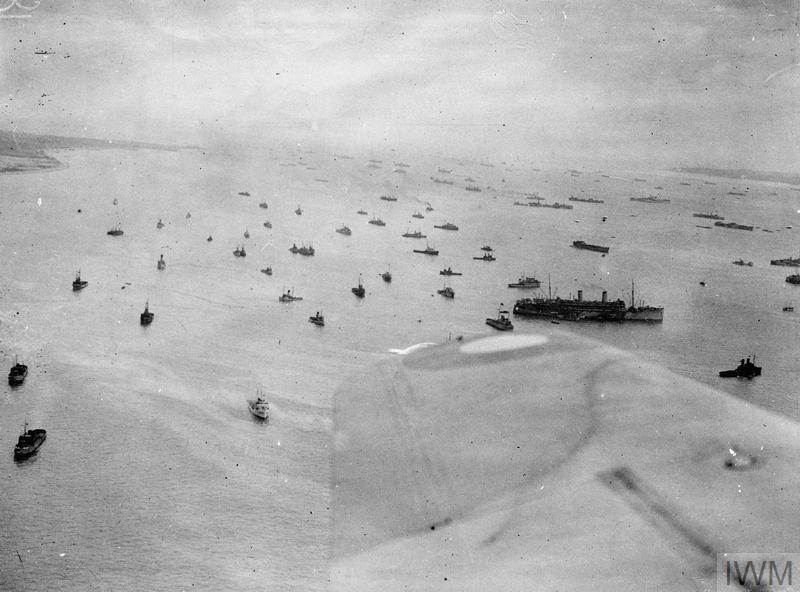
The plan they came up with was simple yet would be incredibly complex to achieve – the construction of a new harbour the size of Dover at the site of the invasion. The plan was to prefabricate the elements needed in Britain before towing them across the English Channel and creating a harbour off the landing beaches. The schedule was to complete the construction within two weeks of the D Day landings in June 1944. Winston Churchill knew that there would be enormous problems with this idea but was determined that it should work if the invasion was to be successful. A trial of three competing designs for the floating harbour was set up in 1943 with prototypes built and tested on the Solway Firth. Once the design was finalised the War Office could begin the prefabrication of the concrete caissons.

D Day Copyright: © IWM.

The invasion of Europe began on 6th June 1944, D Day, with thousands of Allied troops landing along the Normandy coast. Once the beachheads were secured the work on the floating harbours began, the first stage of which was to scuttle a number of old ships off the coast at Arromanches as temporary outer breakwaters (the Gooseberries) to protect the area where the harbour (the Mulberry) was to be built. The huge prefabricated caissons (water-tight concrete structures codenamed Phoenixes) were then sunk to provide the permanent breakwaters which would shelter the floating roadways and jetties.  Once the completed Mulberry Harbour was in place the Allies could begin unloading the supplies which would be so vital for their victory.

There were actually two Mulberry Harbours towed across the English Channel to support the Normandy beachheads. Mulberry A was constructed at Omaha Beach whilst Mulberry B (nicknamed ‘Port Winston’), was constructed off Gold Beach at the town of Arromanches. Once assembled the harbours could unload 7,000 tons of supplies a day. Each incredibly complex harbour had masses of pontoons which supported around 6 miles of flexible roadways ending in huge pier heads supported by underwater ‘legs’.

An incredible feat of engineering had both harbours almost fully functional when they were hit by a storm on 19th June. The Mulberry Harbours had been designed for summer weather not the worst storm to hit the Normandy coast for 40 years, and the harbour at Omaha beach was so badly damaged that it was beyond repair. This could have been a disaster for the Allied forces, but although the second Mulberry suffered some damage it survived the storm and continued to land supplies in support of the invasion. Although it had been designed to last for just ninety days Port Winston was in continuous use for ten months following D Day and in that time landed over half a million vehicles, two and a half million men and four million tons of supplies.

When the invasion had moved eastward and liberated ports from the Nazis the harbour was no longer useful and was abandoned. If you visit Arromanches today you can see the remains of the Mulberry Harbour from the beaches.

The scale and sheer audacity of the Mulberries took the Germans completely by surprise. At the Nurembeurg trials after the war Albert Speer, Reich Minister of Armaments and War Production for Nazi Germany, gave a German perspective on the Mulberry Harbours:

“To construct our defences we had in two years used some 13 million cubic metres of concrete and 1½ million tons of steel. A fortnight after the Normandy Landings, this costly effort was brought to nothing because of an idea of simple genius. As we now know, the invasion force brought their own harbours, and built, at Arromanches and Omaha, on unprotected coast, the necessary landing ramps.”

When we remember the troops who fought and died on the beaches of Normandy we should not forget those who designed and built the Mulberry Harbours which were so instrumental in making D Day and the invasion of Europe such a success.

The women who spied for Britain

The Invasion of France at the beginning of the Second World War is known as the Blitzkrieg – Lightning War – and it really was like lightning. It was just six short weeks from the start of the invasion on 10th May 1940 to the French signing an armistice with Germany on 22nd June. Yet although Germany had defeated the French army many French citizens were not ready to submit to the conquerors and so the British government set up the Special Operations Executive (SOE). Its instructions from Churchill were to ‘set Europe ablaze’ by helping to fight the Germans behind enemy lines.

German soldiers in Paris

Recruits to the SOE underwent commando training as well as learning how to use guns and explosives, to effectively sabotage enemy installations and transport, to use wireless radios, to be proficient in silent killing and unarmed combat. They also had to learn how to blend in and live in secret in occupied territory, sometimes for weeks or months at a time.

Many may find it surprising to know that women were members of the SOE right from the start. At first their role was only to work in the offices producing forged papers for the men who would be going into action (ration cards, passports etc.), or perhaps coding or de-coding messages from agents as well as transmitting these messages via wireless. It wasn’t until April 1942 that Churchill finally gave his approval for women to be sent as agents into Europe. Part of the reasoning for this was that women would be less conspicuous as they were always out and about – shopping or taking children to school etc. – men who were seen on the streets too frequently soon came to the notice of the Gestapo. So the SOE recruited women as wireless operators and couriers and, like the men, these women had to be proficient in the language of the country they were going to, know it’s customs etc. The ideal recruit would have spent some of their formative years in the target country and so would know how to ‘blend in’. In all 431 men and 39 women were sent as SOE agents to France during the Second World War, as well as agents sent to other occupied countries.

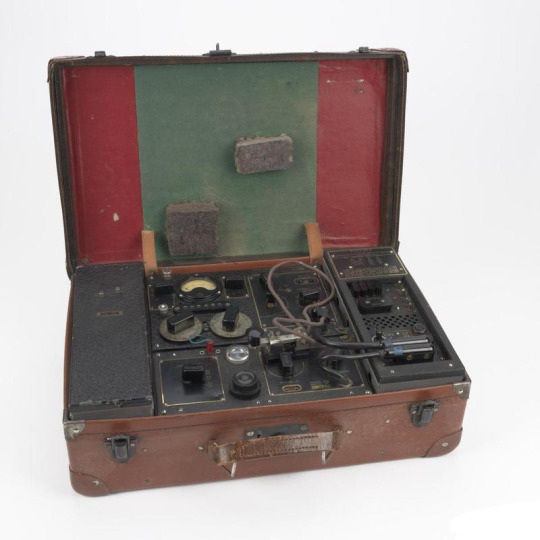
Paraset Mk II, 1943

It would be impossible to describe the ‘average’ female SOE agent as there was really no such thing. A recruit could come from an aristocratic background or be working-class, she might have only just left school or be a mature and experienced mother, she might be demure or a little wild; the one unifying factor was that they were prepared to go behind enemy lines as the only women to bear arms during the war. They knew what they were signing up for, the chances that they could be captured and tortured, sent to concentration camps or executed, but that didn’t stop them.

One of the first women to work for SOE was actually an American called Virginia Hall who was living in France when the Germans invaded. Although she was disabled (she had an artificial foot) she managed to escape to England where she was signed up by the SOE and went back to France as a ‘correspondent for the New York Post’ (America had not yet entered the war at this time and so was considered neutral). After some time the Gestapo became too interested in Virginia so she escaped over the Pyrenean mountains to Spain (which could not have been easy with her disability). When she got back to England Virginia joined the newly formed US equivalent of SOE, went back to France prior to D Day and, after the war, served in the CIA.

Virgina Hall

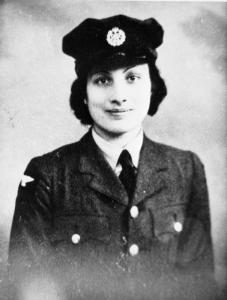
Another famous SOE agent was Noor Inayat Khan who was born in Russia, the daughter of an Indian prince and American. Noor grew up in Paris where she became known as a writer and musician, but when her family fled to England to escape the Germans she trained as a wireless operator with the Women’s Auxiliary Air Force. The SOE couldn’t ignore someone who spoke fluent French and could handle a wireless so they recruited Noor and she was sent to France in 1943. The network which she worked for was infiltrated and her colleagues arrested. Life was hard for Noor as she was forced to keep moving, finding a new place to stay every day in an effort to evade the Germans, carrying the all too conspicuous wireless with her. Noor continued to send reports to the SOE but her luck eventually ran out when she was betrayed and captured in October 1943. After spending months in solitary confinement Noor was sent to Dachau with three other female SOE agents where she was executed. Witnesses say that Noor spoke just one word at the end – liberté.

Noor Inayat Khan

Violette Szabo came from a very different background to Noor Inayat Kahn, a cockney working-class girl who had spent some time growing up in France and spoke the language well. She was married to a member of the French Foreign Legion, Etienne Szabo, who died at El Alamein. Violette had a one year old daughter but didn’t hesitate when the SOE came knocking at her door and immediately agreed to be sent to France, knowing the risks involved. Like Inayat Khan, Violette Szabo was captured and executed (at Ravensbruck concentration camp in 1945).

Violette Szabo

Although 13 of the women who were sent to France by the SOE were executed by the Germans and 2 others died of natural causes the other 24 survived until the end of the war. One of these was Odette Strugo Garay. Odette had a Czech father and a French mother. She was recruited by the SOE in 1944 after her husband, who was a Finnish RAF pilot, was killed in an accident. After undergoing her training, including four parachute jumps, Odette was sent to France, (she didn’t receive her RAF wings as she had not completed five qualifying jumps). After a time in France Odette returned to England via the route through Spain and on the way met the head of the escape network, Santiago Strugo Garay, who was later to become her husband. After the war Odette and  Santiago moved to Buenos Aires and it was there that she met the Air Attaché Wing Commander Dowling. During conversation she mentioned that although she had worked for the SOE and parachuted into France she had never received her RAF wings. He argued that her jump into France should count as a qualifying fifth jump and  Odette finally received her wings in 2007. She wore the badge every day until her death in 2015, proud of the contribution she had made to the work of the SOE in France.

Monument remembering all women who played a part in winninng the Second World War

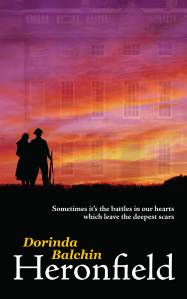
The 39 female SOE agents who served in  France were ordinary women who did extraordinary things and, like their male counterparts, those who survived the war never sought the limelight but slipped back into civilian life as though their experiences during the war had never happened. They all felt that they were just doing their duty, no more than any other soldier who fought the Nazis. The women who went into enemy territory as agents of the SOE were pioneers – back at home women were working in the factories, taking over the roles of men who were away at the front, but the women of the SOE showed that not only could women do the work on the Home Front which had been done by men but that they could also fight like the men too. In my novel Heronfield Angeline is a radio operator who is parachuted into France by the SOE, her story is my tribute to the bravery of all women of any nationality who were prepared to put their lives on the line to preserve the freedom of others.

Recommended Read – The Light Between Oceans by M L Stedman

A boat washes up on the shore of a remote lighthouse keeper’s island. It holds a dead man – and a crying baby. The only two islanders, Tom and his wife Izzy, are about to make a devastating decision.
They break the rules and follow their hearts.

After reading the above description I was expecting ‘The Light Between Oceans’ to be a romance/crime thriller, but in fact it turned out to be so much more. Set in Australia in the aftermath of the First World War it is a moving tale of how difficult it was for survivors of that conflict to integrate back into society, how their loved ones were affected by these shadows of men from the trenches, and how those whose husbands, brothers and sons never came back from the war struggled to understand the appalling waste and come to terms with their loss. This sounds like a novel in itself, yet it is purely the backdrop for a story packed with emotional highs and lows and a sympathetic understanding of human psychology.

The main characters of the novel struggle throughout with the concepts of right and wrong, and with putting these into some sort of acceptable order. Is it ever right to break the law to help a loved one who is suffering? Can love conquer all? Can we close our eyes to the suffering we may have unknowingly caused to someone else once that has been revealed to us? You will find yourself sympathising with Tom as he struggles to support the woman he loves, even though it goes against his conscience, and you will also find yourself sympathising with the other main characters too. ‘The Light Between Oceans’ is an incredibly well written novel with believable characters who draw you into their stories. Ms Stedman has great skill as a writer in that she is able to describe the places and environment which are inhabited by her story in a way which makes you feel as though you are there breathing the salty air, feeling the wind and rain etc. whilst at the same time she creates characters, including some very minor ones, whose lives you can fully appreciate and whose driving forces are wholly believable.

The themes of love and loss, fear, anger, and hope are played out against the backdrop of a lighthouse on a rocky island, The Light Between Oceans of the title, and Ms Stedman has clearly put a lot of time and effort into researching the life of a lighthouse keeper in early twentieth century Australia. Her writing is very descriptive and the reader feels an affinity for the small-town community on the mainland as well as the incredibly difficult life of the lighthouse keeper and his family. It is a period of Australian history which I was not familiar with yet, by the end of the book, felt wholly engaged with.

This book is a highly emotional and moving read, I can guarantee that you will go on a roller-coaster ride of emotions and be left pondering some big philosophical questions at the end. ‘The Light Between Oceans’ is certainly a book which will stay with you for some time to come and I heartily recommend it.

The Light Between Oceans can be found on Amazon

You can find out more about M L Stedman here

You can find more of my Recommended Reads here

A British Game Of Thrones

Imagine the scenario:
There was once a king of a northern country who had a distant claim to the throne of a country in the south. When the ruler of the southern land died childless the King of the North also became King of the South, and although there was one king to rule them both the two realms remained separate and continued with their longstanding enmities. When the king died his son came to sit on the thrones of both countries but the lords of the southern lands were not happy with how he ruled and so went to war against him. The land in the north supported the southern nobles for a time, then their support moved to the king, then shifted back to the nobles once more. Power ebbed and flowed until the king was finally captured and executed. What would happen now? Who would rule? Would the lands be united at last or continue divided and at war?

Sounds like the plot to a book in the style of A Game Of Thrones, doesn’t it? Yet this is real history. The history of Scotland and England. It is a history I had to grasp to enable me to write my novel ‘The Cavalier Historian’, and it is a part of the story which many people find fascinating. So, what was the situation between the two nations in the seventeenth century and how did that impact on the English Civil War?

James I

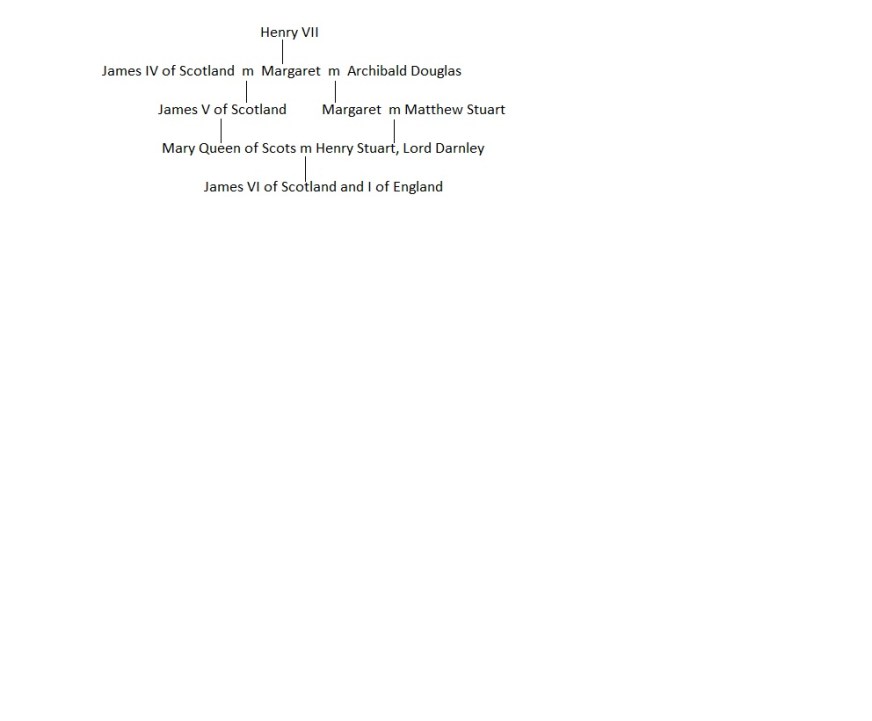
Queen Elizabeth I, daughter of Henry VIII and granddaughter of Henry VII, died childless. The next in line to the throne was James VI of Scotland, son of Mary Queen of Scots and great great grandson of Henry VII. James VI and I (as he is sometimes known) moved from Edinburgh to London; England and Scotland were now united under one monarch BUT this was a dynastic union only, the Stuarts reigned over two separate and distinct countries even though King James wanted them to be united as one.

Part of the problem which James I faced was that the Scottish Church would not accept the High Anglican Church of England. When his son, Charles I, succeeded him he introduced a Scottish version of the English Prayer Book in 1637. The Scots responded with anger and rioting, culminating in a meeting of the National Covenant in 1638 which overwhelmingly objected to the prayer book; and when the General Assembly met in November 1638 all bishops were expelled from the Scottish Church which became fully Presbyterian. Charles put together a military force to bring the Scottish to heel, but didn’t like using soldiers from his southern kingdom to invade his northern one, so a settlement was reached under the ‘Pacification of Berwick’. The peace didn’t last for long, hostilities broke out again and Charles’s English forces were defeated by the Scots at the Battle of Newburn.

Charles I

This was how Charles I found himself to be the king of two kingdoms with a history of dislike for each other and widely differing views on religion. Once civil war broke out in England, with parliament looking to exercise more control over the king, his taxes, and the religion of the country, things got even more complicated. The English Parliament entered into a ‘Solemn League And Covenant’ with the Scottish Church and Scottish troops played an important role in the defeat of Charles I, constantly playing one side against the other from the outbreak of war:

22nd August 1643 Charles I raised his standard in Nottingham, formally declaring war on Parliament.

August 1643 The Solemn League And Covenant promised to preserve the Scottish Church and reform religion in England and Ireland in return for Scottish help against the king.

6th May 1646 Charles I surrendered to the Scots in the hope that they would support him as their king against the old enemy, England. At the same time he was trying to negotiate with the English Parliament – unaware that the Scots were doing the same!

30th January 1647 The Scots handed Charles over to the English Parliament and he was imprisoned at Holdenby House in Northamptonshire.

November 1647 The king escaped but was soon re-captured. From his prison Charles I carried out secret negotiations with the Scots, hoping for uprisings in England to coincide with an invasion from Scotland which would free him and put him back on the throne.

28th December 1647 An ‘Engagement’ was signed, with the Scots agreeing to support the king as long as he imposed the Presbyterian Church on England for three years.

Spring 1648 The uprising began in Wales and England, but the Scottish forces were delayed which enabled Cromwell to put down the Royalist forces throughout most of the country although the king’s forces held out under a long siege in Colchester. When the Scots finally invaded they were defeated at the Battle of Preston on 17th – 19th August 1649. This effectively brought the Second English Civil War to an end.

Charles I was in prison in England throughout this second war, and at the defeat of his forces was put on trial for treason, and executed. With the death of Charles I Cromwell invaded Scotland and brought it into his Commonwealth, but after his death Charles II became king and Scotland became an independent country once more. It wasn’t until 1707, during the reign of Queen Anne, that the ‘Acts of Union’ were signed in England and Scotland in which the two separate states with their different legislatures but with the same ruling monarch were ‘United into One Kingdom by the Name of Great Britain’.

Union Flag

With such complex relationships between Scotland and England, as well as divisive politics and religion within England itself, it was perhaps inevitable that there would be conflict under Charles I. It is a period of history which makes for a great story and I thoroughly enjoyed the research I conducted for my novel ‘The Cavalier Historian’. I hope my readers will find the novel equally enjoyable!

Experience An English Civil War Battle Near You!

In England we are lucky with the resources available to us if we want to learn about the civil war which tore our country apart during the 17th century. As well as countless books on the subject you can conduct research online or maybe visit the National Civil War Centre in Newark, but to get a real experience of what life was like when parliament rose up against the king we have a number of wonderful re-enactment societies.

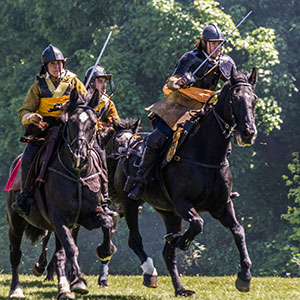
Cavalry (copyright Sealed Knot)

Both the Sealed Knot and the English Civil War Society provide authentic re-creations of both civilian and military life, and the information they provided was very helpful to me whilst I was conducting research for my novel ‘The Cavalier Historian’. You may think that re-enactment societies glorify war but that is far from the truth, and those who take part in these activities would say that their aim is to honour those who died in battle as well as to educate people about life in the 17th century. I can well remember the re-enactment of a battle which I attended at Faringdon in Oxfordshire some years ago with its guns and smoke, its sights and sounds of civil war. The battlefield commentary explained tactics and weaponry, and as I strolled around the campsite I was able to see authentic artefacts and clothing. I certainly felt that this was a great learning experience for the whole family.

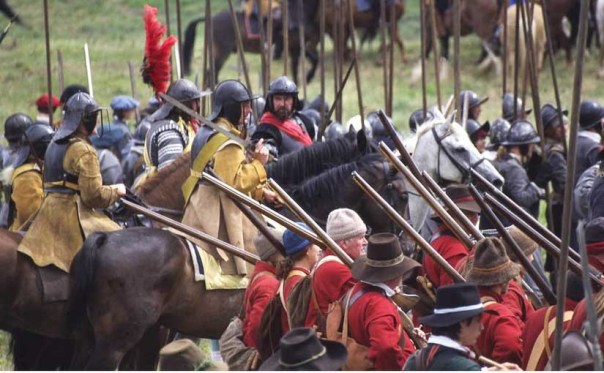
Musketeers (copyright Sealed Knot)

If you have never seen a re-enactment featuring Cavaliers and Roundheads I would heartily recommend it. Wherever you are in the country you should be able to get to an event hosted by either the Sealed Knot or the English Civil War Society. Maybe you will be lucky enough to see a full scale battle with hundreds of infantrymen on each side as well as artillery, cavalry, and a huge array of camp followers. Perhaps it will be the re-creation of a specific battle, or maybe just a fictional episode designed to demonstrate the art of 17th century warfare. If you are not able to get to a battle then maybe you can see a skirmish, which is much smaller and has a focus on infantry with only a few cannons or cavalry men.

Copyright English Civil War Society

Whatever event you are able to attend you should also have the opportunity to see what camp life was like during the civil war. Take the time to wander around the tented areas where you will see re-enactors dressed in authentic costumes and carrying out authentic trades. There may be blacksmiths and armourers, barber-surgeons and laundresses, as well as kitchen areas providing food for both the officers and ordinary soldiers.

Army camp (copyright English Civil War Society)

As well as re-enactments these two societies will also visit schools to give students a taste of 17th century life, or sometimes staff a whole house with a costumed population for a truly immersive experience (this is part of the premise of The Cavalier Historian). So, if you are interested in the English Civil War, or history in general, why not try to see a re-enactment this year? I’m pretty sure you won’t regret it!

Cannon (copyright Sealed Knot)

The Sealed Knot

The English Civil War Society

Lord Thomas Grey’s Regiment of Foote

Sir William Pennyman’s Regiment

National Civil War Centre

Upcoming events:

English Civil War Society Events

Sealed Knot Events