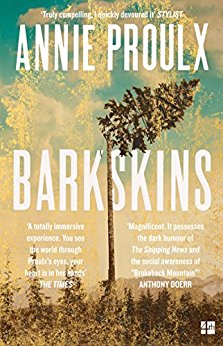
 Longlisted for the baileys women’s prize for fiction 2017
A New York times book of the year
From Annie Proulx, the Pulitzer Prize-winning author of The Shipping News and Brokeback Mountain, comes her masterwork: an epic, dazzling, violent, magnificently dramatic novel about the taking down of the world’s forests.
In the late seventeenth century two penniless young Frenchmen, René Sel and Charles Duquet, arrive in New France. Bound to a feudal lord, a “seigneur,” for three years in exchange for land, they become wood-cutters – barkskins. René suffers extraordinary hardship, oppressed by the forest he is charged with clearing. He is forced to marry a Mi’kmaw woman and their descendants live trapped between two inimical cultures. But Duquet, crafty and ruthless, runs away from the seigneur, becomes a fur trader, then sets up a timber business. Proulx tells the stories of the descendants of Sel and Duquet over three hundred years – their travels across North America, to Europe, China, and New Zealand, under stunningly brutal conditions; the revenge of rivals; accidents; pestilence; Indian attacks; and cultural annihilation. Over and over again, they seize what they can of a presumed infinite resource, leaving the modern-day characters face to face with possible ecological collapse.
Barkskins is a riveting read. I had assumed it would be just another historical novel following a few disparate characters but it turned out to be much more. Initially the reader is interested in the characters while the trees and forests are merely something of a backdrop, but as time passes in this wide-ranging novel it becomes obvious that these natural resources are not as limitless as the timber merchants think and we are led on an inexorable path towards ecological disaster. Have the Duke family realised in time that we need to do something to save our planet or is it all too late? The history of the development of the timber trade – the types of trees taken, the methods of cutting and working, the uses of the wood – is cleverly entwined in the story of these two families so that the reader absorbs a great deal of knowledge through osmosis, never feeling lectured to or bogged down with irrelevant information. The amount of research that Ms Proulx has conducted into the timber trade around the world – from North America to New Zealand – is impressive, as is the link to European trade, the whole coming together as an indictment on the dangers of colonialism.
Barkskins is cleverly written as a saga which follows the lives of two families arriving in North America at the same time and in the same condition but then following very different paths. The rich Duke family introduce the reader to the development of business and trade on the new continent while the Sel family show the awful impact that this immigration brought to the lives of the First Nation peoples of the United States, Canada and New Zealand. From the decimation of tribes by European diseases to the discrimination meted out to whole peoples considered to be ‘inferior’ simply because their culture and civilisation were not understood, to the scandal of the Canadian Residential Schools this is a novel which immerses the reader in a conflict of cultures which is still ongoing. Perhaps Ms Proulx in her last few chapters has presented us with a vison of hope in which there may be reconciliation as the First Nations people whose lives were once so closely entwined with the forest may now be the ones with the knowledge and skills to help us save our world from ourselves.
Barkskins is a long novel which might put some people off, but I urge you to read it. The plotting is a tightly-knit web, the characters well rounded – some engaging and loveable, others quite unpleasant, – the descriptions of the forests atmospheric, the prose as a whole beautifully written and engaging. If you are looking for something to keep you occupied on cold winter evenings then curl up with this book and lose yourself in a past world which has such relevance and meaning for our own.
Barkskins can be found on Amazon
You can find out more about Annie Proulx here
You can find more of my Recommended Reads here
 In the uneasy post-war peace of occupied Germany, a British soldier is billeted to a bombed Hamburg hotel. Alex’s days are spent investigating Nazi war criminals, but it is a chance meeting with a German university professor in a shabby back-street bookshop that changes his life. Having befriended the professor and his wife, Alex falls in love with their only daughter, Lisa, only to discover that the professor may not be as innocent as he first appeared. The stale aftermath of a long and hideous war has left the old society in ruins. There are still many secrets to uncover and Alex has to ask himself what is more important – love or truth? As he digs deeper into the professor’s past Alex is forced to recognise that he cannot have both.
 It is late summer in East Sussex, 1914. Amidst the season’s splendour, fiercely independent Beatrice Nash arrives in the coastal town of Rye to fill a teaching position at the local grammar school. There she is taken under the wing of formidable matriarch Agatha Kent, who, along with her charming nephews, tries her best to welcome Beatrice to a place that remains stubbornly resistant to the idea of female teachers. But just as Beatrice comes alive to the beauty of the Sussex landscape, and the colourful characters that populate Rye, the perfect summer is about to end. For the unimaginable is coming – and soon the limits of progress, and the old ways, will be tested as this small town goes to war.
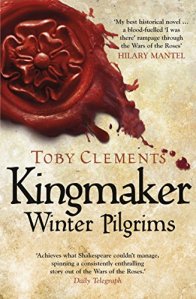 An enthralling adventure story, honest and powerful. The Wars of the Roses are imagined here with energy, with ferocity, with hunger to engage the reader.’ Hilary Mantel
 ‘How long do I have?’ I force a laugh.
 An awkward misfit, nine-year-old Fulke FitzWarin leaves his family for the household of Joscelin de Dinan, Lord of Ludlow. Once there, he begins to learn the knightly arts which he desperately hopes will free him from the shadows of his past.
 France, 1935: At the poor man’s end of the Riviera sits Le Rayol, a haven for artists, expatriates and refugees. Here, a world away from the rumblings of a continent heading towards war, Tom Nash has rebuilt his life after a turbulent career in the Secret Intelligence Service. His past, though, is less willing to leave him behind. When a midnight intruder tries to kill him, Tom knows it is just a matter of time before another assassination attempt is made. Gathered at Le Rayol for the summer months are all those he holds most dear, including his beloved goddaughter Lucy. Reluctantly, Tom comes to believe that one of them must have betrayed him. If he is to live, Tom must draw his enemy out, but at what cost to himself and the people he loves…?
 Julian Fellowes’s Belgravia is the story of a secret. A secret that unravels behind the porticoed doors of London’s grandest postcode. Set in the 1840s when the upper echelons of society began to rub shoulders with the emerging industrial nouveau riche, Belgravia is peopled by a rich cast of characters. But the story begins on the eve of the Battle of Waterloo in 1815. At the Duchess of Richmond’s now legendary ball, one family’s life will change for ever.
 (New York Times Bestseller)
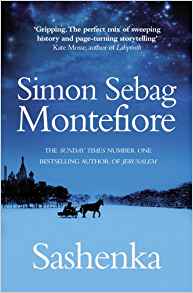 Winter, 1916. In St Petersburg, snow is falling in a country on the brink of revolution. Beautiful and headstrong, Sashenka Zeitlin is just sixteen. As her mother parties with Rasputin and her dissolute friends, Sashenka slips into the frozen night to play her role in a dangerous game of conspiracy and seduction.
 Dorinda Balchin - Author