Tag Archives: history

The Windsors at War – Part 3 Edward VIII, the Duke of Windsor

This is my third and final article about the British royal family during the Second World War. My pieces about King George VI and Princess Elizabeth (now Queen Elizabeth II) showed two individuals with a keen sense of duty who, despite their privileged position, tried to understand what it was like for the ordinary British citizen – staying in London during the Blitz, living on the same rations as everyone else, serving in the ATS etc. – but for the Duke of Windsor, formerly King Edward VIII, the role he played before and during the conflict is a more controversial issue altogether.

Edward VIII as a boy cadet

Prince Edward had trained in the Royal Navy from the age of 13, but at the outbreak of the First World War he was commissioned and served as a staff officer in the Grenadier Guards. After the war he toured many parts of the British Empire and took an interest in national affairs; his support for the unemployed made him incredibly popular with the working classes. But as the years progressed Edward appeared to develop a dislike for the official world he was forced to live in and began to cultivate friends from ‘high society’ rather than the aristocracy. 1930 proved to be a pivotal year for the future king as that is when he met and fell in love with Wallis Simpson, a married American. When George V died in 1936 and Edward became king his affair with Simpson was the subject of much speculation in the foreign press, but pressure was put on British newspapers to keep it quiet as Edward VIII was Head of the Church of England and, as such, would not be able to marry a divorcee. Under pressure to choose between the throne or the woman he loved Edward chose Wallis and abdicated saying ‘I have found it impossible to carry the heavy burden of responsibility and to discharge my duties as King as I would wish to do without the help and support of the woman I love.’ After his abdication Edward moved to France and the couple were married when Wallis was finally divorced in 1937. The new king, George VI, created his brother Duke of Windsor but refused to allow the new Duchess the rank of ‘Royal Highness’, something which the Duke and his new wife both resented. There were also conflicts within the royal family as to the financial worth of Edward who had hidden some of his wealth from his brother when the abdication settlement was worked out, relations were therefore frosty between the former king and his family. And so the scene was set for the role that Edward and Wallis would play during the war.

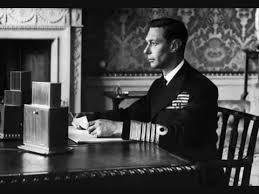
(You can listen to the Abdication Speech here)

During 1937 and 1938 the Duke and Duchess lived in France although they spent a lot of time traveling around Europe, including a visit to Germany where they met with Hitler, a visit which was well publicised in the German media. The Duchess, who always felt slighted by the British royal family and government, was treated like royalty during the visit with German aristocrats bowing and curtsying to her; Edward was inordinately pleased that the Germans treated her with the status and dignity which he felt she was due as his wife and yet was withheld from her by his own people.
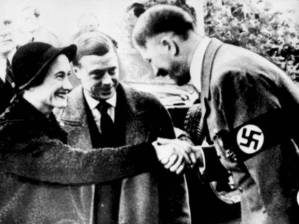
According to Albert Speer Hitler believed that Edward was friendly towards Germany so the fact that he was no longer king had a negative effect on the Fuhrer’s plans for Europe, as Hitler is reported to have said – ‘I am certain through him permanent friendly relations could have been achieved. If he had stayed, everything would have been different. His abdication was a severe loss for us.’ The Windsor’s visit to Germany went against the advice of the British government who felt that their opposition was vindicated when the Duke was seen to give a full Nazi salute on a number of occasions whilst in Germany.

The Duke and Duchess of Windsor visit Hitler

Some historians have defended Edward’s links with Hitler by saying that he saw fascist Germany as a barrier between western democracy and communism and that having seen the horrors of the battlefields of the Great War he was willing to appease Hitler to prevent such wholesale slaughter happening again. In May 1939 Edward gave a radio broadcast for NBC in which he appealed for peace. The recording took place on the First World War battlefields of Verdun where he said ‘I am deeply conscious of the presence of the great company of the dead, and I am convinced that could they make their voices heard they would be with me in what I am about to say. I speak simply as a soldier of the Last War whose most earnest prayer it is that such cruel and destructive madness shall never again overtake mankind. There is no land whose people want war.’ The speech was broadcast around the world but although many British newspapers published the transcript in full the BBC refused to air it as it seemed to be supporting appeasement.
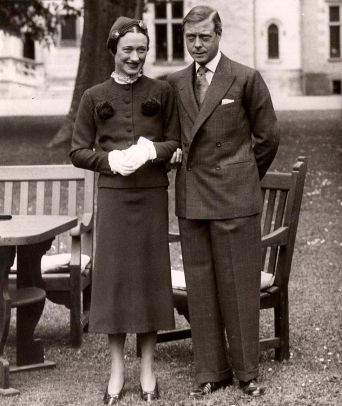
The Duke and Duchess of Windsor

It is difficult to assess just how much the Duke supported fascism and Nazi Germany although many believe that his words in 1940 were quite revealing when he said that ‘In the past 10 years Germany has totally reorganized the order of its society… Countries which were unwilling to accept such a reorganization of society and its concomitant sacrifices should direct their policies accordingly.’

When war broke out Edward hoped to be reconciled with his brother but George VI was still angry that his brother had abdicated. Rather than being given a royal role to play Edward was given a position as liaison with the French. Years later, in February 1949 Count von Zech-Burkersoda, who was the German Minister in the Hague at the outbreak of the war, said that the Duke had passed the Allied plans for the defence of Belgium to Germany which had helped the swift invasion of France and, consequently, led to the disaster at Dunkirk. After the fall of France the Windsors travelled to Madrid where the Duke appears to have been introduced to a plan for the Nazis to put him back on the throne with Wallis at his side, a not very subtle plan to use the former king against the established government in Britain. Edward travelled from Madrid to Lisbon where he is said to have received a number of telegrams with details of the plan to reinstate him on the throne in return for his support for Hitler. Copies of the telegrams (which were found in Germany at the end of the war) say that Edward had initially believed that he could never be king again after abdicating but that when he was told that it was possible that the British constitution could change after a Nazi victory ‘the Duchess in particular became very thoughtful.’ One telegram even suggested that the ‘Germans expect assistance from the Duke and Duchess of Windsor, the latter desiring at any price to become queen.’

The British were not aware of the telegrams at the time, but Edward’s reluctance to return to England forced Winston Churchill to threaten to court martial him if he did not immediately travel to London; then the Prime Minister offered him the position of Governor of the Bahamas as there were ‘fears for his safety’. The Windsors travelled to the Caribbean in 1940 and remained in post until the end of the war. In December 1940 the Duke gave an interview to Liberty magazine in which he was reported to have said that ‘Hitler was the right and logical leader of the German people,’ he went on to say that the time was coming for the American President to mediate a peace agreement between Germany and Britain. The former king said that he had been misquoted and misrepresented in the article, but the Allies were sufficiently worried that President Roosevelt ordered the Duke and Duchess to be placed under surveillance when they visited Florida in 1941. The Allies concerns were further enhanced when they received information (which may or may not have been true) that Wallis had slept with Ribbentrop (the German Ambassador) in 1936, was still in contact with him and passed secrets to him.

Governor of the Bahamas

After the war ended the Windsors returned to France to live, and the Duke never held another professional position after his Governorship of the Bahamas.

Just after the war ended the Americans found 400 tons of German diplomatic papers near Marburg Castle; included in the haul were around 60 letters, telegrams and other papers about the Duke of Windsor and his links to the Nazis. Amongst the documents were details of ‘Operation Willi’ which was the codename for the plan to conquer Britain, overthrow George VI and put Edward back on the throne. It appears that there was a concerted effort to manipulate Edward into helping the Nazi plan, including telling him that his brother, the king, planned to have him assassinated. Copies of the documents were sent to America, and Churchill appealed to the Americans and French to refrain from publication for at least 10 to 20 years, saying that the documents were ‘tendentious and unreliable’ and likely to leave the misleading impression that the Duke ‘was in close touch with German agents and was listening to suggestions that were disloyal.’ Eisenhower replied, saying that the telegrams were “obviously concocted with some idea of promoting German propaganda and weakening western resistance” and were “totally unfair” to the Duke. The telegrams were suppressed but not for as long as Churchill had hoped. They were eventually published in 1957. Included in the documents were statements attributed to the Duke saying that he was convinced that war could have been avoided if he had not abdicated as he was a firm supporter of compromise with Germany. Another telegram said that the ‘Duke believes with certainty that continued heavy bombing will make England ready for peace’ (some historians believe that his comment could have been the reason that Hitler shifted the focus of Luftwaffe actions in 1940 from the Battle of Britain to bombing cities). American naval intelligence also published a report from a German conference held in 1941 that said that the Duke was ‘no enemy to Germany’ and the only English representative with whom Hitler was willing to negotiate peace terms, saying that Edward was ‘the logical director of England’s destiny after the war.’ When he found out about them the Duke of Windsor said that the telegrams and documents were ‘complete fabrications…and gross distortions of truth’. Edward admitted in his memoirs that he admired the Germans but had never been pro-Nazi and that Hitler struck him as a ‘somewhat ridiculous figure, with his theatrical posturing and his bombastic pretensions.’

Marburg Castle

Some historians don’t believe that the Duke of Windsor knew about the plan to put him on the throne and that his contacts with Germany were more about working for peace and finding a place for himself and Wallis in government circles after his abdication, as well as making the Duchess feel important and a part of state affairs (something which the royal family never did). On the other hand Andrew Morton, the royal biographer, suggests that Edward was a Nazi sympathiser saying that he ‘was certainly sympathetic…even after the war he thought Hitler was a good fellow and that he’d done a good job in Germany, and he was also anti-Semitic, before, during and after the war’.

The Duke of Windsor’s attitude to Germany and conduct during the war is in stark contrast to that of his brother, King George VI, and his niece, Princess Elizabeth. There will always be controversy about just how much of a Nazi sympathiser he was and how deep his admiration and support for Hitler went but, if the historical documents are to be believed, then many people feel that he should never have been allowed to return to live in France after the war ended and that he certainly should not have received any further funds from Britain. True, he was socially ostracized and had very little contact with his family for the rest of his life, but many people felt that was far too lenient and he should have been tried for treason.

Whatever your view of the monarchy one could argue that the Windsors were a fair reflection of British society during the Second World War, from an appeaser and probable Nazi sympathiser to a prince who died for the Allied cause (Prince George), a princess who enrolled in the armed forces, and a king and queen who worked tirelessly to build morale and support the British people in their hour of need.

(The Marburg files appeared in a recent episode of The Crown, you can find out more about how the files were discovered here )

Bibliography:

Block, Michael. The Secret File of the Duke of Windsor. L

Donaldson, Frances Lonsdale. Edward VIII.

Roberts, Andrew, and Antonia Fraser. The House of Windsor. A Royal history of England.

Windsor, Edward, (Duke of). A King’s Story The Memoirs of H.R.H. the Duke of Windsor K.G.

Ziegler, Philip. King Edward VIII The Official Biography.
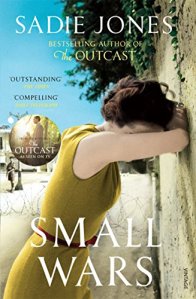
Recommended Read – Small Wars by Sadie Jones

Hal Treherne is a soldier on the brink of a brilliant career. Impatient to see action, his other commitment in life is to his beloved wife, Clara, and when Hal is transferred to Cyprus she and their twin daughters join him. But the island is in the heat of the emergency; the British are defending the colony against Cypriots – schoolboys and armed guerillas alike – battling for union with Greece.

Clara shares Hal’s sense of duty and honour; she knows she must settle down, make the best of things, smile. But action changes Hal, and the atrocities he is drawn into take him not only further from Clara but himself, too; a betrayal that is only the first step down a dark path.

Many people only have a limited understanding of the details of what is called the ‘Cyprus Emergency’ of the 1950’s which is the focus of the novel Small Wars. In 1914 Cyprus went from being a part of the Ottoman Empire to a British Protectorate, then a Crown Colony in 1925. From 1955 onwards there was a concerted effort by Cypriots to move from British rule and unite with Greece but, rather than unification, the end of the ‘emergency’ resulted in the creation of an independent Republic of Cyprus. Ms Jones has set Small Wars in the middle of this conflict and deftly incorporates the historical background into her novel. There are no long passages explaining the situation, but through the actions and dialogue of the main characters the reader comes to understand the complex politics with two Cypriot groups – Greek and Turkish – each striving for independence from Britain yet also opposing each other as the Turkish Cypriots did not want a union with Greece. It is a compelling story.

The British treatment of the Cypriots was brutal at times and over the years many previously supressed reports have come to light which show an unwarranted violence towards the civilian population; it is this premise which undermines Small Wars. Hal is a career soldier, as his family have been for generations, and his whole life is built on a foundation of honesty, fairness and honour. Under his command are many soldiers doing their National Service who do not want to be in Cyprus and are just counting the days to the time they can leave the army and re-join civilian life. During his time on the island Hal witnesses the ill-treatment of civilians, the cruel treatment of prisoners (torture is not too harsh a word), and violent clashes with militant Cypriots. Hal finds it difficult to reconcile what he sees with his vision of what the army should be and, unable to do anything about it, he retreats into himself. This, in turn, places a strain on his marriage as he cannot explain his feelings to Clara, the woman he loves as much as life itself. For her part, Clara has to adjust to life on an army base where she fears for her own safety and that of her young twin girls. The emotional conflict of Hal and Clara is at the core of this novel.

Small Wars is a multi-layered story – from the well-researched historical background to the disillusionment of an army officer who comes to realises that the British Army is not what he has always imagined it to be. It is a well written novel with evocative prose describing the scenery, the horrific aftermath of violent conflict, and life on an army base in the mid-1950’s. Ms Jones also deftly handles the dialogue which is sparse at times, reflecting the inner turmoil of people who know each other well but just cannot find the words to express their emotions. Yet, paradoxically, there is a tenderness and compassion at the heart of this novel which tempers the anger as the reader is drawn into the lives of a set of characters who are wholly believable; it is difficult not to be drawn to Hal and Clara in their difficult situation and find yourself hoping that they can overcome the trials that surround them and regain the love and trust which was the core of their marriage at the start of this novel.

This is, indeed, a novel about Small Wars – from national conflicts to personal relationships and, ultimately, the conflicts within ourselves; it is a well written novel, evocative of time and place yet with a theme which resonates with today’s world. A very good read and heartily recommended.

Small Wars can be found on Amazon

You can find out more about Sadie Jones here

You can find more of my Recommended Reads here


The Windsors at War – Part 2 Queen Elizabeth II

Queen Elizabeth II was a teenager during the Second World War and life for her was, in many ways, not dissimilar to that of other teenagers. Her father, King George, insisted that the royal family should not have any special treatment, they had the same rations as everyone else and even applied this to visitors to Buckingham Palace – including Eleanor Roosevelt, the wife of the American President!

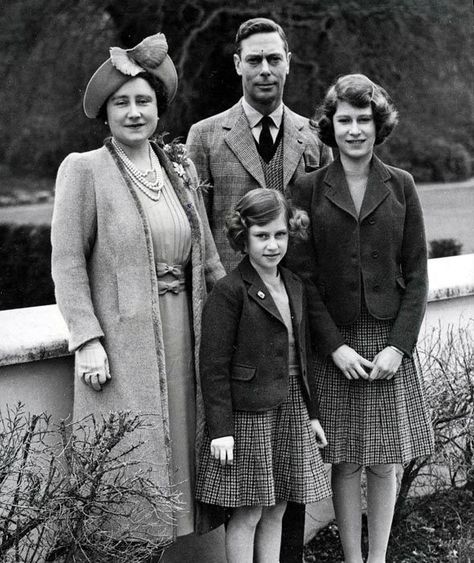
Princess Elizabeth was 14 years old when Britain declared war on Germany and her safety as heir to the throne was of great concern to many people. Viscount Hailsham, a well respected former Conservative politician, spoke for many when he suggested that Elizabeth and her sister, Princess Margaret, should be evacuated to Canada for the duration of the war. The Queen, however, was adamant that this should not happen and told the Viscount that ‘The children won’t go without me, I won’t leave without the King, and the King will never leave.’ This was a very public statement that the royal family intended to stay in the United Kingdom but, in private, King George VI made plans for the two princesses to be evacuated if, and only if, a German army landed in England and there was a real threat that the royal family might be taken prisoner. (see article on George VI) Although his children would be taken abroad to safety King George intended to stay after any invasion to help with the resistance.  This plan was kept secret in order to keep up the morale of the British people and, thankfully, there was never any need to put it into action. During the first winter of the war Elizabeth and Margaret stayed at the Balmoral estate in Scotland, moving to Sandringham after Christmas 1939 and then back to Windsor where they lived for the remainder of the war. Each year they ‘did their bit’ by putting on a pantomime to raise money for the Queen’s wool fund to buy wool for the manufacture of military clothing.

The relentless bombing of British cities in the Blitz meant that many children were evacuated to the countryside and, in October 1940, Princess Elizabeth broadcast a radio message to them on the popular Children’s Hour programme. Her message offered thanks to the host families and support for the children who were living with strangers in a strange environment. The core of her message was that the children should stay strong, and face the war with courage, determination, and hope. She said that ‘We are trying to do all we can to help our gallant sailors, soldiers and airmen, and we are trying, too, to bear our share of the danger and sadness of war. We know, every one of us, that in the end all will be well.  When peace comes,” she said, “remember, it will be for us, the children of today, to make the world of tomorrow a better and happier place.’ (Princess Elizabeth’s broadcast)

Although Elizabeth felt an affinity for the children of the United Kingdom her position as heir to the throne meant that she would have a unique role and responsibilities. In 1941, at the age of 15, she was appointed Colonel-In-Chief of the Grenadier Guards, and her first public appearance alone was a visit to inspect the regiment when she was 16. Yet she could sympathise with those who had lost family members in the war for she, too, lost her beloved uncle Prince George, Duke of Kent, who was the first member of the royal family to be killed on active service for 500 years. Mystery still surrounds the circumstances of his death; Prince George was an RAF pilot and set out alone on a secret mission, when his body was recovered from the hillside in Caithness where his plane had crashed he was found with a bag containing a large number of 100 Krona banknotes handcuffed to his wrist.

In 1944 Parliament changed the law to allow Princess Elizabeth to act as one of the five Counsellors of State who were senior members of the royal family who would effectively take over the role of the monarch should the King be incapacitated or out of the country. She performed this role when George VI went to Europe to visit the troops after the D Day landings. (see article on George VI)

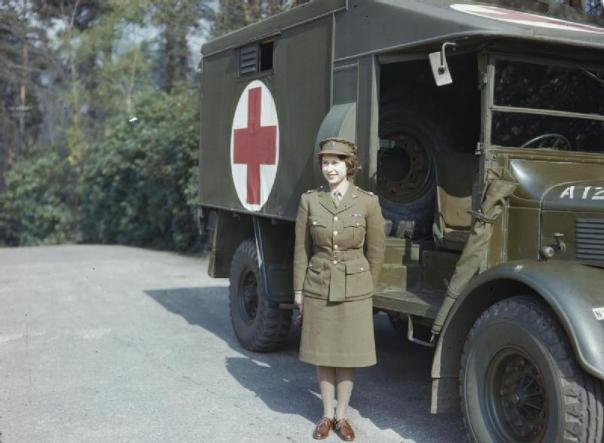
When she was 18 Elizabeth wanted to join the ATS but this was opposed by the King; it was not until February 1945 that he finally agreed and the princess signed up as an honorary Second Subaltern with the service number 230873. After five months of training as a mechanic and military truck driver in Camberley the future queen was promoted to the rank of honorary Junior Commander (the equivalent of a Captain in the army). Throughout her training Elizabeth worked for seven hours a day before returning to Windsor Castle at night; she appears to have taken her duties very seriously and, although some people were excited by her presence, it is reported that she was hard working and humble during the time she served in the ATS. The Queen is the only female member of the British royal family to have served in the armed forces. The ATS (Auxiliary Territorial Service) was the women’s branch of the army during the Second World War, but although the women had full military status they were only paid two-thirds of the wage of a man of the same rank even when serving overseas. Women in the ATS served in a number of roles from the mundane clerical to the most dangerous, including manning anti-aircraft guns (Mary, the daughter of Winston Churchill, served on anti-aircraft batteries for the duration of the war).

Watch a Pathe News report of the King, Queen and Princess Margaret visiting Princess Elizabeth on a driving course at a training centre.

There were great celebrations when the Allies finally achieved Victory in Europe. On VE Day, 8th May 1945, the royal family made numerous appearances on the balcony of Buckingham Palace to the cheers of massive crowds. The princesses Elizabeth and Margaret looked down to the joyful celebrations and wanted to join in; surprisingly, the King gave his permission for the sisters to go into the streets incognito. So the heir to the throne strolled down Whitehall arm in arm with her sister, possibly the only time that she has been able to be just one of the crowd, as she later described it ‘We asked my parents if we could go out and see for ourselves. I remember we were terrified of being recognised … I remember lines of unknown people linking arms and walking down Whitehall, all of us just swept along on a tide of happiness and relief.’

Although the Second World War ended in 1945 rationing was only phased out gradually and did not finally end until 1954. The royal family continued to follow the restrictions and Princess Elizabeth even saved up ration coupons to buy the material for her wedding dress in 1947.

Queen Elizabeth II is the only remaining living head of state in the world who served during the Second World War and remains the only female member of the royal family to have served in the armed forces.


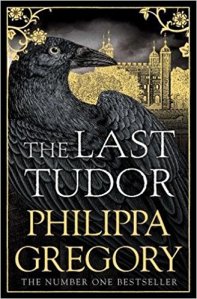
Recommended Read – The Last Tudor by Philippa Gregory

‘How long do I have?’ I force a laugh.
‘Not long,’ he says very quietly. ‘They have confirmed your sentence of death.  You are to be beheaded tomorrow.  We don’t have long at all.’

Jane Grey was Queen of England for nine days. Using her position as cousin to the deceased king, her father and his co-conspirators put her on the throne ahead of the king’s half-sister Mary, who quickly mustered an army, claimed her crown and locked Jane in the Tower. When Jane refused to betray her Protestant faith, Mary sent her to the executioner’s block. There Jane turned her father’s greedy, failed grab for power into her own brave and tragic martyrdom.

‘Learn you to die’ is the advice that Jane gives in a letter to her younger sister Katherine, who has no intention of dying. She intends to enjoy her beauty and her youth and find love. But her lineage makes her a threat to the insecure and infertile Queen Mary and, when Mary dies, to her sister Queen Elizabeth, who will never allow Katherine to marry and produce a potential royal heir before she does.  So when Katherine’s secret marriage is revealed by her pregnancy, she too must go to the Tower.

‘Farewell, my sister,’ writes Katherine to the youngest Grey sister, Mary. A beautiful dwarf, disregarded by the court, Mary finds it easy to keep secrets, especially her own, while avoiding Elizabeth’s suspicious glare. After watching her sisters defy the queen, Mary is aware of her own perilous position as a possible heir to the throne. But she is determined to command her own destiny and be the last Tudor to risk her life in matching wits with her ruthless and unforgiving cousin Elizabeth.

 The Last Tudor is a thoroughly absorbing novel which tells the story of the three Grey sisters – Jane, Katherine and Mary – and the roles they played during the lives of the last generation of Tudors – King Edward, Queen May and Queen Elizabeth. Cleverly crafted, Ms Gregory gives each girl her own voice and they each tell their story in the first person. The style of writing is different for each of the sisters which deftly portrays their differing characters and beliefs. I am well acquainted with the story of Jane Grey but knew little about her sisters; the author has produced a book here which focuses on these relatively unknown siblings and through their descriptions of their feelings for the important people of the time – love, envy, anger, hatred – we are given an insight into the events which shaped the Tudor dynasty. This is a very clever personalisation which makes the history accessible and never dull or slowing the pace of the story.

Jane Grey is the eldest, she has strongly held Protestant beliefs and holds anyone of the Catholic faith in contempt. In the telling of her story she portrays herself as a rather impatient young woman who says that she is dutiful and humble yet comes across as slightly arrogant. Jane truly believes that the reformed church is the only way to salvation and, as such, pities those who will never get to heaven. Religion is the focus of her life and she is politically naïve which makes her the perfect pawn for those who wish to bypass Princess Mary as heir to the Tudor throne. When Jane’s cousin, King Edward, dies and she is placed on the throne it is obvious that she is unwilling to play the part yet unable to do anything else. Her simple belief as a sixteen year old girl that everything will turn out right in the end is both touching and frustrating, and leaves you wondering if she really thought this or just convinced herself of the matter as reality was too frightening to contemplate. A rude awakening awaits the young queen when Princess Mary comes to claim what is rightfully hers…

The middle of the Grey sisters, Katherine, comes across as materialistic, vain and arrogant; she is fiercely jealous of Elizabeth I and feels deliberately slighted by her. Katherine’s belief that she is the true heir to the Tudor throne prompts her to marry without the queen’s permission; after all, in her view Elizabeth is an illigitemate usurper, and even Henry VIII had her declared as such by Parliament at one time. Katherine’s marriage leads to trouble for her and her family, and as the years go by there is a change in her character as her belief that she has been wrongly treated affects her physical and mental health…

The youngest sister, Mary, was very small (barely 4 feet tall) and initially seems to have stayed under the radar of Elizabeth I (no pun intended). However, Mary follows in the footsteps of Katherine, believing herself so insignificant that the queen will not care who she marries. I must admit to a little frustration at her actions, but the truth is that she did behave as Ms Gregory tells (although the historical fact is rather sketchy in places). Mary develops from a small, insignificant and unimportant courtier into a woman with surprising courage and strength of character, and a determination not to suffer the same fate as her sisters…

The Last Tudor is interesting in its depiction of Elizabeth I as seen from the perspective of her cousins – a selfish and troubled woman who seems to care little for the future of England. As such, it is a novel which portrays the difficulties of history – we can look back in time to individual views of events but it is not always possible to ascertain the truth, particularly of people’s feelings and motives. Ms Gregory has conducted a great deal of research whilst writing this novel (some of the letters of the Grey sisters are included at the end of the book) and gives an engrossing view of what happened and why from the perspective of the Grey family; others, of course, would have seen things in a very different light.

As with all Ms Gregory’s novels this one places the reader squarely in a time and place in history with vivid descriptions of life at the Tudor court – the food and drink, the revels, the political intrigue, the fears, the treasons. The author has used very skilled writing to tell the story of Elizabeth and her advisors, the search for a husband and an heir, the delicate political situation between England, Scotland, France and Spain, in such a way as to convey an understanding of the scene quite briefly (as it is the backdrop to the story of the sisters not the main plot), yet in enough detail for the reader to understand its impact on the three young women.

The Last Tudor is one of the best historical novels I have read in a long time which gives us a clever telling of the politics of the court of Elizabeth I through the lives of three young women, and which has made me rethink some of my previous views on the glorious reign of Elizabeth I, as such it has inspired me to look once more at that whole period of history. If you like historical fiction and have enjoyed books by Philippa Gregory in the past I can guarantee that you will enjoy this latest offering. And if you have never read one of her novels? Then this would be a very good place to start.

The Last Tudor can be found on Amazon

You can find out more about Philippa Gregory and her books here

You can find more of my Recommended Reads here

The Windsors at War – Part 1 King George VI

King George VI was a reluctant monarch. He grew up with the expectation that his elder brother would become king, a situation he was more than happy with as he was a rather shy man who suffered from a stutter. Unfortunately for George his plans for himself and his family were turned on their head when his brother, King Edward VIII, abdicated in December 1936 so that he could marry Wallis Simpson. George suddenly found himself in a position he had never wanted and, what was worse, at a time of impending crisis. But George also had a profound sense of duty and honour, things he found sadly lacking in his elder brother, and vowed to be the best monarch he could as the world faced up to the growing threat of Nazi Germany.

George VI had served in the Royal Navy during the Great War and was present at the Battle of Jutland in 1916 when Britain lost 14 ships and over 6,000 men. As with many of his generation the King wanted to avoid another war like the one which had blighted his youth and so was in favour of Chamberlain’s policy of appeasement, but as time passed he realised that this was hopeless and war against Germany was unavoidable. In 1939 George VI travelled to America and Canada in an effort to build support for the inevitable conflict. By 3rd September of that year, the day that Britain declared war on Germany, he was resigned to what was to come; he wrote…

“As 11 o’clock struck that fateful morning I had a certain feeling of relief that those 10 anxious days of intensive negotiations with Germany over Poland, which at moments looked favourable…were over. Hitler would not and could not draw back from the edge of the Abyss to which he had led us. Despite our protestations that the Polish Question could have been settled without force, Hitler had taken the plunge.” The King went on to compare his situation in 1939 to the one he had been in at the outbreak of war in 1914 when he was “keeping the middle watch on the bridge of HMS Collingwood… Today we are at War again, and I am no longer a midshipman in the Royal Navy.” The King obviously felt that Edward VIII had shown a great lack of character, and remarked in his diary that, before the abdication, he had “never expected to have all this responsibility on me”.

On the day that war was declared the King spoke to the nation in a radio broadcast, something he always found difficult as those who have seen the film ‘The King’s Speech’ will know. In his address George VI said “In this grave hour, perhaps the most fateful in our history…for the second time in the lives of most of us we are at war. Over and over again we have tried to find a peaceful way out of the differences between ourselves and those who are now our enemies. But it has been in vain…The task will be hard. There may be dark days ahead and war is no longer confined to the battlefield, but we can only do the right as we see the right and reverently commend our cause to God…with God’s help we shall prevail. May He bless and keep us all.”

(You can listen to the full speech here.)

King George VI made it a matter of principle that, no matter how busy he was, he would write a diary entry every night for however long the war lasted, and his writings give an insight into the reluctant monarch, his relationship with his government, and his sense of duty and service.

In May 1940 Chamberlain resigned as Prime Minister and the King, along with many others, wanted Lord Halifax to take his place; the monarchs role in appointing a Prime Minister is, however, little more than a symbolic confirmation of the will of the ruling party and George was reluctantly persuaded that Winston Churchill should be made Prime Minister. The King initially found Churchill difficult to get along with, but as time passed they developed a deep respect for each other and a close personal relationship, meeting for lunch every Tuesday to discuss the war in private in a very open and frank way.

At the outbreak of the war some of the King’s closest advisors suggested that he should move from London to the countryside to avoid enemy attacks, but both he and the Queen were adamant that they would stay in the capital as a symbol of strength and unity. George VI was not reckless, however, and personally set up the Coats Mission which was to be enforced if a German army invaded the British Isles. The key to this was the creation of a personal bodyguard of Coldstream Guards and Royal Lancers led by Major Coats to protect the King, the Queen and the Princesses Elizabeth and Margaret. The Lancers had specially adapted armoured cars which were to be used to take the royal family from Buckingham Palace to either Windsor or one of four other country houses which had been secretly prepared to conceal them, and where they would be met by the Coldstream Guards. King George was firm in his instructions that the royal family should not be handed over to the enemy and the guard were to fight to the last man if necessary. The second stage of the plan was to fly the Princesses abroad whilst the King and Queen remained behind to bolster resistance.

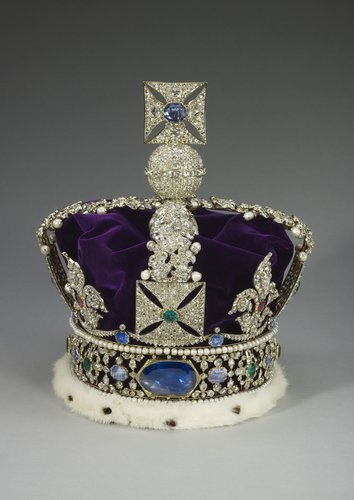
Thankfully the invasion never came and the Coats Mission was never put into operation, but there were other actions which did take place to ensure the safety of the royal family and Britain’s heritage. Hiding the Crown Jewels in a biscuit tin is just one example. This may sound like a comedy sketch but it did, in fact, happen. Some of the most precious jewels, including the Black Prince’s Ruby from the Imperial State Crown, were taken to Windsor Castle where they were put into a biscuit tin and buried under what is known as a sally port (a secret exit which could be used in an emergency). A large hole with two chambers protected by steel doors had been dug in preparation and was accessible by a trap door which, reportedly, still exists today.

The royal family spent most of the war at Buckingham Palace, although they often spent the night at Windsor Castle during times of heavy air raids. The King and Queen were at Buckingham Palace on 13th September 1940 and narrowly missed injury or death when two bombs exploded in the courtyard. In a letter to her mother-in-law the Queen wrote that they had gone to the Palace to collect some possessions after a previous bombing raid when they heard the approach of a German plane closely followed by the scream of falling bombs. At the first explosion they all dived for cover, after the second they all made their way to the shelter. The Queen describes how everyone remained calm whilst the three people who had been injured were treated. She later went on to say that “I am glad we have been bombed. It makes me feel we can look the East End in the face.”

King George VI believed that he had an important role to play in keeping up the morale of the British people and so frequently visited bomb sites and munitions factories, accompanied by the Queen who took a great interest in what was being done to help people whose homes had been destroyed in the bombings. The Royal couple were also interested in the war work which was being done by civilians, often women, and their visits had a profound effect. The Ministry of Supply found that production figures inevitably dropped on the day of a royal visit, but the workers found it such a morale boost that they worked even harder and the weekly production figures always rose after such a visit. Both King George and Queen Elizabeth were compassionate by nature and also toured hospitals to visit wounded civilians and troops.

In his role as monarch George VI held the ranks of Admiral of the Fleet, Marshal of the Royal Air Force, and Field Marshall, and he made a particular effort to visit every type of unit within the armed force; whenever he toured work places or inspected troops he would invariably do so in uniform. The king often visited troops in the UK, but it was not always so easy for him to do so abroad because of fears for his safety, although he did visit military troops in France in December 1939 during the ‘Phoney War’, Malta and North Africa in 1943, Normandy 10 days after D Day in June 1944, southern Italy in July 1944 and the Low Countries in October 1944. His trip to the Mediterranean in 1943 is an example of how he saw his role as that of a ‘morale booster’ for armed forces and civilians alike as he inspected the Roya Navy (and also the US Navy), the Merchant Navy, the Royal Marines, the Army, and the Royal Air Force before going on to the island of Malta. As well as visiting troops George VI also took a keen interest in the planning and strategy of the war and it was after he made a personal request to be kept informed that Dwight Eisenhower briefed him on the plan for Operation Overlord – the invasion of Europe via the Normandy beaches in 1944.

King George VI created the George Cross which is awarded “for acts of the greatest heroism or for most conspicuous courage in circumstance of extreme danger” and can be awarded to civilians as well as members of the armed forces. During the war air raid wardens, fire men, policemen and other individual civilians were awarded the George Cross, but one of the best known awards went to Malta. The people of the island had suffered dreadfully when besieged by the Germans and Italians who bombed the island round the clock. Malta held a strategically important position in the Mediterranean and so the people were determined not to give in even though whole towns and villages had been reduced to nothing but rubble, and there was a terrible food shortage. King George made a personal decision to award the George Cross to the island of Malta saying that “To honour her brave people I award the George Cross to the Island Fortress of Malta to bear witness to a heroism and devotion that will long be famous in history”. During his visit to North Africa in 1943 King George was determined to visit Malta and spent a day touring the island where he was greeted by cheering crowds and the ringing of the island’s church bells.

Although he was the monarch George VI believed that he and his family should share the same difficulties and dangers as his subjects. He insisted that the royal family should have the same rations as everyone else and follow all other war time directives; what’s more, this also applied to visitors. When Eleanor Roosevelt, the wife of the American President, visited Britain she commented on her time at Buckingham Palace which was unheated and boarded-up and where she was only allowed limited bathwater and was served rationed food. The royal family also knew what it felt to lose a loved one to the conflict with the King’s brother and the Queen’s nephew both killed.

Prince George, Duke of Kent, was a member of the Royal Air Force and set off alone on a mission about which little is known. His plane crashed into a hillside in Caithness in Scotland, and his body was found with a briefcase full of 100 Krona banknotes handcuffed to one wrist.

After sharing the dangers and deprivations of a country at war it was only fitting that the royal family shared in the jubilation when victory was finally achieved in Europe. At 6pm on the 8th May 1945 the King made a broadcast to the country, and during the afternoon and evening of that day the royal family made eight appearances on the balcony of Buckingham Palace as the city celebrated VE Day, huge crowds cheering the royals who had refused to leave Britain and stayed to play an active part in the war effort. King George VI and Queen Elizabeth had become symbols of national resistance, as had Princess Elizabeth who served in the ATS. The man who had only reluctantly taken on the role of king at his brother’s abdication had proven to be the one most fitting to lead his country in a time of war and, as such, was greatly loved. It is sad that he did not live long enough to enjoy the fruits of peace as he died in February 1952, aged 56, the beloved king of a country which still had another two years before rationing was finally over.

Shadows and Strongholds by Elizabeth Chadwick

An awkward misfit, nine-year-old Fulke FitzWarin leaves his family for the household of Joscelin de Dinan, Lord of Ludlow. Once there, he begins to learn the knightly arts which he desperately hopes will free him from the shadows of his past.

Joscelin’s youngest daughter, Hawise, befriends Fulke when he most needs it. But as the years pass, an enemy to Ludlow changes their friendship unalterably, forcing them onto opposite sides of a cruel divide.

When the menace to Ludlow intensifies, Fulke must confront the future head on or fail on all counts, all the while desperate to know if Hawise stands with or against him.

Shadows and Strongholds is the early part of the story of a family who appear in Ms Chadwick’s novel Lords of The White Castle, which is itself based on the history of the FitzWarin family as it was told in a rhyming story written in the thirteenth century – the sort of story told to pass long winter evenings in the great hall. After completing that book the author felt compelled to tell the story of the early life of the key characters, and I am glad that she did! This is a tale steeped in the tensions and conflicts of a time which may not be well known to many readers but which is a fascinating period of English history, telling the story of the lords of Ludlow and Whittington against the broader backdrop of a country riven by civil war. The competing claims for lordship of Ludlow and Whittington castles are well documented, as is the outcome (no spoiler here!), but what is compelling for the reader is the fact that many of the key players in this novel are unknown to us so we don’t know how they will be affected by events, creating an exciting plot line which draws you in.

The original writer of the medieval tale is known to have been free with chronological order and some facts, Ms Chadwick has often followed his lead as this creates a great story line, and as Shadows and Strongholds is a work of historical fiction most readers will be happy with that. After all, this is not an academic historical account of the times but, instead, the author immerses the reader in the sights and sounds of a bygone age, the structure of a society which is unfamiliar to us, the violent conflicts between barons and those in authority which would be impossible in England today but which moulded and influenced the political scene in a much more turbulent time.

Those who are already familiar with Ms Chadwick’s work will recognise her style in this novel – a well written character driven story based on detailed research. The characters are well rounded, with the young Marion in particular drawing a sympathetic response despite her actions (which stem from a traumatic event in her childhood). In the modern world Marion would have been given psychiatric counselling and would most likely have turned out very differently, but understanding of mental problems in the twelfth century was limited, and Ms Chadwick has used this to develop a character whose interactions with those around her are pivotal to the plot. As well as Marion and the other characters about whom we know little but their names there are also brief appearances in Shadows and Strongholds by key players in history, such as Henry II, and the interplay of these characters is what makes for an exciting story. Added to this is a strong evocation of period through the careful use of language with the novel written in an easy to read style yet utilising a number of medieval words for clothing and objects which we no longer have, further infusing the reader with a sense of time and place.

Shadows and Strongholds will appeal to both fans of Ms Chadwick and those new to her work. If you enjoy good historical fiction, politics and battles, family life and romance, good strong plot-lines, well rounded characters and authentic dialogue then this book is for you. I enjoyed it, and Lords ofThe White Castle is now on my list of books to read.

Shadows and Strongholds can be found on Amazon

You can find out more about Elizabeth Chadwick here

You can find more of my Recommended Reads here

Recommended Read – House of the Hanged by Mark Mills

France, 1935: At the poor man’s end of the Riviera sits Le Rayol, a haven for artists, expatriates and refugees. Here, a world away from the rumblings of a continent heading towards war, Tom Nash has rebuilt his life after a turbulent career in the Secret Intelligence Service. His past, though, is less willing to leave him behind. When a midnight intruder tries to kill him, Tom knows it is just a matter of time before another assassination attempt is made. Gathered at Le Rayol for the summer months are all those he holds most dear, including his beloved goddaughter Lucy. Reluctantly, Tom comes to believe that one of them must have betrayed him. If he is to live, Tom must draw his enemy out, but at what cost to himself and the people he loves…?

House of the Hanged is a thriller with the majority of the story set in the mid-1930’s when the threat of war hangs over Europe once more, but no one is sure whether it will be fascist Germany who is the enemy, or communist Russia, or maybe a combination of the two.

The novel begins almost twenty years earlier in revolutionary Russia with the main character, Tom, failing to save the life of the woman he loves. The story swiftly moves on to the years leading up to the outbreak of the Second World War where Tom has given up working for British Intelligence and settled down in the south of France. As the novel progresses we learn more about Tom’s work, how it affected him, and how he is now trying to redeem himself, put the past behind him, and enjoy a life of peace. Each year Tom invites friends to join him at his villa for the summer; he also extends a welcome to refugees, particularly from Russia, as though his efforts to help them may in some way atone for not saving his love. After the thrilling opening the pace of the novel slows as we settle into the relaxed lifestyle of cocktail parties, sailing, swimming etc. in the south of France, but there is already a feeling that this year will not be like those which have gone before. When an attempt is made on Tom’s life the pace quickens again as he begins to question those around him – one of the people he is close to, perhaps someone he loves, has betrayed him.

Mr Mills has created a cast of well-drawn and believable characters in this novel, and the reader will enjoy learning about them and how they could be involved in the attempts to kill Tom. Is the threat to him linked to the current political climate, or has his past in Russia finally caught up with him? (Don’t worry, no spoilers here!) Tom is so unsure of the people around him that he keeps the danger to him a secret; all is calm on the surface, but the author has deftly created an undercurrent of fear and suspense which draws the reader in, helped in no part by his skilled writing, particularly in dialogue. Mr Mills has obviously researched this period of European history and has therefore been able to contrast the relaxed lifestyle of a particular social group on the French Riviera with the tension of a continent edging ever closer to all-out war. He has an evocative style which leaves the reader feeling immersed in a particular place and time – it is almost possible to feel the heat of the Mediterranean sun, the coolness of the water and the everchanging breeze – yet, at the heart, this is a well-paced cat and mouse thriller in which the pace is not slowed by the historical detail.

House of the Hanged is a classic spy story which would make a great holiday read for anyone who likes historical fiction, mysteries and intrigue. I will certainly be trying other books by this author.

House Of The Hanged can be found on Amazon

You can find out more about Mark Mills and his work here

You can find more of my Recommended Reads here

A wartime Christmas

Children who grew up during the long years of the Second World War had a difficult life, they certainly had little idea of the type of Christmas festivities which had been enjoyed by their parents or older siblings in earlier years. With food shortages, rationing, and manufacturing focused on the war effort, these children had far less too enjoy than those who had gone before. But what was worse for most families was the fact that they had to spend the festive season without their loved ones – many husbands, fathers, brothers, and sons were fighting overseas, or were prisoners of war; many women were in the services or carrying on vital war work, many children had been evacuated and would be spending Christmas far from home with strangers. And many families had empty chairs at their tables which would never be filled again – family members killed in action or bombing raids.

As well as the sadness of separation Christmas luxuries were also hard to come by, even basic foods were scarce and people had to improvise by finding creative substitutes for festive ingredients. The black market did a roaring trade  in December but, even so, few people were able to buy gifts which  meant that many of the presents unwrapped on Christmas morning were homemade and practical. The government even encouraged people to ‘Make it a War Savings Christmas’, buying bonds and supporting the war effort rather than giving presents.

Poster issued by the National Savings Committee. © IWM (Art.IWM PST 16433)

Making Christmas look as festive as possible was more difficult from 1941 onwards because it was impossible to buy Christmas wrapping paper thanks to the Ministry of Supply ruling that ‘no retailer shall provide any paper for the packaging or wrapping of goods excepting foodstuffs or articles which the shopkeeper has agreed to deliver’. This effort to save paper  impacted on many aspects of life, including making it difficult to wrap Christmas presents and keep them a surprise. The shortage of paper also meant that it was almost impossible to find decorations so these, too, were homemade, often using old newspapers which had been painted in festive colours.

Children at Fen Ditton Junior School (Cambridgeshire) making paper chains for Christmas..© IWM (D 23619)

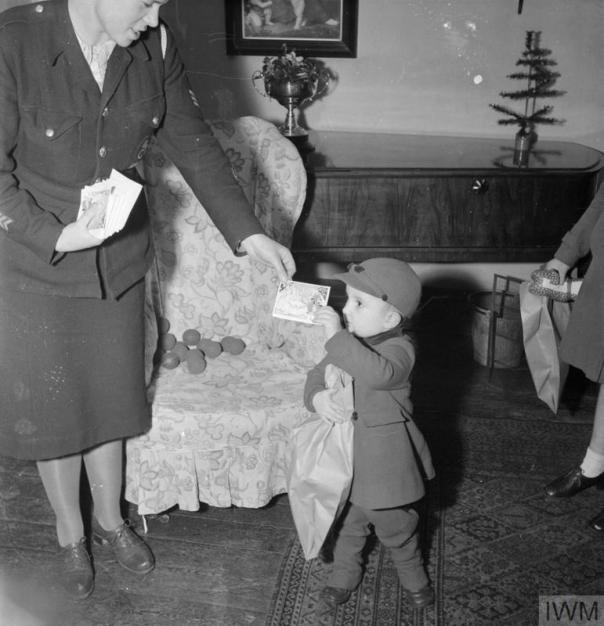
Britain’s allies understood the hardships of people back in the United Kingdom and set up charities to help. In America many of these charities came together under the umbrella of the British War Relief Society whose aim was to send food and clothes to those in need. In this photograph a young boy called Derek Cunningham received a Christmas card and gifts from the BWRS in Canning Town (London).

© IWM (D 23296)

American soldiers were also encouraged to spend Christmas with their English allies in an effort to integrate more closely as they were often resented by the locals for being ‘overpaid, oversexed, and over here!’ Most GI’s had never been abroad before so to be spending Christmas away from their families was difficult for them. The idea was that civilians would invite an American to spend Christmas Day with them and, in return, the soldiers would bring gifts (nylon stockings, chocolate, cigarettes, chewing gum etc.). Rationing meant that the British had limited food supplies so each soldier who accepted an invitation was given special rations from the PX for every day that they spent with a host family (the PX was the Post Exchange which was the American equivalent of the British NAAFI). Despite initial misgivings the programme proved a huge success.

© IWM (EA 10182)

Added to the sadness of Christmas without family members and the hardship of trying to find food and presents during a time of rationing, was the fear of the enemy. In 1940 London had been bombed for 57 consecutive nights leading up to Christmas, and no one believed that Christmas Eve would be any different. Fearing for their safetly many people spent the night before Christmas in air-raid shelters rather than waiting at home for Father Christmas to call. It could be a very dark and dreary begining to what should be a festive season.

A Shelter in Camden Town under a Brewery: Christmas Eve, 1940, by Olga Lehmann. © IWM (Art.IWM ART LD 1899

Some places which offered shelter did thier best to raise people’s spirits with decorations and maybe even a little tree. This picture, by Edmund Knapp, depicts the crypt of St Martin-in-the-Fields church (close to Trafalgar Square) which was used as a canteen by firewatchers, ARP wardens, and people whose homes had been bombed. The church itself was damaged by the massive bombing raid on 29th December 1940 but the crypt remained intact and in use for the remainder of the war.

Ready for Christmas: the Canteen under St. Martin’s-in-the-Fields, 1941, by Edmund Knapp © IWM (Art.IWM ART LD 800)

Despite the hardship of a war-time Christmas some pre-war rituals remained, such as carol singing and pantomimes, and the BBC tried to help with the festive cheer by broadcasting a special radio programme for Christmas Day. In 1939 this programme included a Christmas speech from King George VI. Although there had been previous broadcasts by monarchs this message had particular meaning as it was the first year of the war. As well as praising the  armed forces the king ended with a message of hope from the poem ‘God Knows’ by Minnie Louise Haskins:

I said to the man who stood at the Gate of the Year, “Give me a light that I may tread safely into the unknown.” And he replied, “Go out into the darkness, and put your hand into the Hand of God. That shall be to you better than light, and safer than a known way.”

George VI’s speech was listened to by everyone who could get close to a radio, instilling a sense of common purpose as the country faced an uncertain future. It was to be six long years before the king gave his next Christmas message in a time of peace.

May I take this opportunity to send you all best wishes for  a happy and peaceful  Christmas, and hope that 2018 is all that you dream it will be.

Belgravia by Julian Fellowes

Julian Fellowes’s Belgravia is the story of a secret. A secret that unravels behind the porticoed doors of London’s grandest postcode. Set in the 1840s when the upper echelons of society began to rub shoulders with the emerging industrial nouveau riche, Belgravia is peopled by a rich cast of characters. But the story begins on the eve of the Battle of Waterloo in 1815. At the Duchess of Richmond’s now legendary ball, one family’s life will change for ever.

Right from the start Belgravia immerses the reader in life in Victorian times with its detailed descriptions of two families. The initial scenes at a grand ball on the eve of Waterloo cleverly introduce the families who will become the main protagonists two decades later, as well as giving an initial insight into a society where class and position were all important. But things were changing in the nineteenth century, and this novel deftly portrays the currents of prejudice faced by wealthy self-made families when they came into contact with those with inherited wealth. This conflict is the backdrop to a story of love and loss, hope and fear, prosperity and debt, and as such it draws us in.

As always, Mr Fellowes has created a cast of characters who are all too human, with all the strengths and foibles which we possess ourselves. We can feel sympathy for some whilst others draw feelings of anger or even contempt from us as they live life in their ivory towers, expecting everything but giving nothing in return. The detailed research conducted by the author places these characters in an authentic historical setting where such behaviour was the norm, and it is a testament to skilled writing that we see the events of the novel through the eyes of Victorians and not our own with our two hundred years of hindsight. Belgravia immerses us in the past with its descriptions of houses, parties, costumes and transport of a bygone age; I found the description of the development of central London and its architecture during that period particularly interesting.

As with Downton Abbey Mr Fellowes cleverly interweaves the lives of the wealthy with those of their servants creating a novel which is well-paced with interesting plot twists to keep the reader wanting to find out more. With a deft touch the author gives us light romance, humour, mystery, suspense, scandal, conflict, and murderous intent. Belgravia is a classic love story which would appeal to anyone who loves books in a similar style to that of Jane Austin.

Mr Fellowes is able to bring the past alive for us is a way which helps us to understand the social and political conflicts of a time which, in some ways, is not too different from our own where reputation is all important for many people. If you like historical fiction, and enjoyed Downton Abbey, then I can pretty much guarantee that you will enjoy Belgravia.

Belgravia can be found on Kindle

You can find out more about Belgravia here

You can find more of my Recommended Reads here

The Orphan’s Tale by Pam Jenoff

(New York Times Bestseller)

In Nazi-occupied Holland, seventeen-year-old Noa snatches a baby from a train bound for the concentration camps, fleeing with him into the snowy wilderness surrounding the train tracks.

Passing through the woods is a German circus, led by the heroic Herr Neuhoff. They agree to take in Noa and the baby, on one condition: to earn her keep, Noa must master the flying trapeze – under the tutorage of mysterious aerialist, Astrid.

Soaring high above the crowds, Noa and Astrid must learn to trust one another…or plummet. But with the threat of war closing in, loyalty can become the most dangerous trait of all.

In this novel Noa, a Dutch teenager who falls pregnant after a one-night stand with a German soldier, is disowned by her family and forced to give up her baby. She later comes across a train pulling a cattle truck full of Jewish babies en-route to a concentration camp, and impulsively takes a child – partly because of her horror at the situation and partly because of the loss of her own child which has left her feeling guilty and bereft. Noa gets lost in a snow storm and expects to die, but is rescued by a travelling circus where she makes a strange alliance with Astrid who has her own complicated history as a Jew who had once been married to a German officer. The premise of this story may seem far-fetched but, surprisingly, it is based on a number of true stories from the Second World War. In her notes at the end of the novel Ms Jenoff explains how she came across two stories in the Yad Vashem archives whilst doing research for her job as a diplomat for the U.S. State Department handling Holocaust issues in Poland. The first story was an account of a boxcar full of babies being sent to a concentration camp, the second was the story of a German circus which had sheltered Jews during the war (the owner, Adolf Althoff, was named Righteous Among The Nations by Yad Vashem). The author has taken these stories and woven them together to create a fictional circus with characters and incidents which give us a glimpse of the fear and hardship of those who put humanity above nationality during one of the darkest periods of the 20th century.

Using parallel narratives Ms Jenoff tells an inspiring story of two very different women brought together by war; characters who are believable because they are so flawed – capable of generosity and selflessness at times, and at other times quite reckless and selfish; women who are changed for the better by the tragedies they have to endure. I must admit that I found Noa’s almost instant love for Luc, and his for her, rather improbable; for me this is the weakest part of the novel but, setting that aside, it does help the author to explore one or two other themes connected to war and conflict, particularly how a family (in this case Luc’s) can be divided by their beliefs and by what they feel is the best way for them to protect the people around them. Noa also seemed rather reckless at times as she knowingly did things which could jeapordise the safety of others but, having said that, one must remember that the character is just seventeen years old and I’m sure that the characteristic traits of a teenager could not be totally surpressed even during a time of war! The focus of this novel is on the relationship of these two women rather than the war itself, and I find this to be one of the strengths of the book. The two women journey from jealousy and suspicion to a grudging respect, and then even love for each other.

Ms Jennoff has also shown a detailed knowledge of circus life in her writing. The atmosphere of the circus ring is vividly evoked – the excitement and glamour as seen from the perspective of the customers. Yet this is well contrasted with life behind the scenes – the shabbiness, the hard work, the lack of privacy, the monotony. The author also conveys how life became much more difficult for German circuses during the war as restrictions were placed on them by the Nazis, yet the determination that ‘the show must go on’ shines through, particularly as the circus brings a feeling of normality and escapism to the people of towns and villages living under German occupation.

‘The Orphan’s Tale’ has a well-structured plot which is well paced with the tension rising steadily to the ultimate climax in the big top. Interestingly the pivitol role is a baby who has no words to speak and no actions which influence the tale; the purpose of his character is, in my view, to be a symbol for all those who were victims of the Nazis. The child represents every Jew, or gypsy, or homosexual, or disabled person taken by the regime; it doesn’t really matter who he is or where he came from, the underlying current of this novel is that he should survive to tell the tale and to live a life denied to so many others. ‘The Orphan’s Tale’ is historical fiction with a focus on how ordinary people survive during times of conflict and upheaval rather than on the key events of the war. If you are fond of character driven  historical novels you will probably enjoy this.

The Orphan’s Tale can  be found on Amazon

You can find out more about Ms Jenoff here

You can  find more of my Recommended  Reads here