A British Game Of Thrones

Imagine the scenario:
There was once a king of a northern country who had a distant claim to the throne of a country in the south. When the ruler of the southern land died childless the King of the North also became King of the South, and although there was one king to rule them both the two realms remained separate and continued with their longstanding enmities. When the king died his son came to sit on the thrones of both countries but the lords of the southern lands were not happy with how he ruled and so went to war against him. The land in the north supported the southern nobles for a time, then their support moved to the king, then shifted back to the nobles once more. Power ebbed and flowed until the king was finally captured and executed. What would happen now? Who would rule? Would the lands be united at last or continue divided and at war?

Sounds like the plot to a book in the style of A Game Of Thrones, doesn’t it? Yet this is real history. The history of Scotland and England. It is a history I had to grasp to enable me to write my novel ‘The Cavalier Historian’, and it is a part of the story which many people find fascinating. So, what was the situation between the two nations in the seventeenth century and how did that impact on the English Civil War?

James I

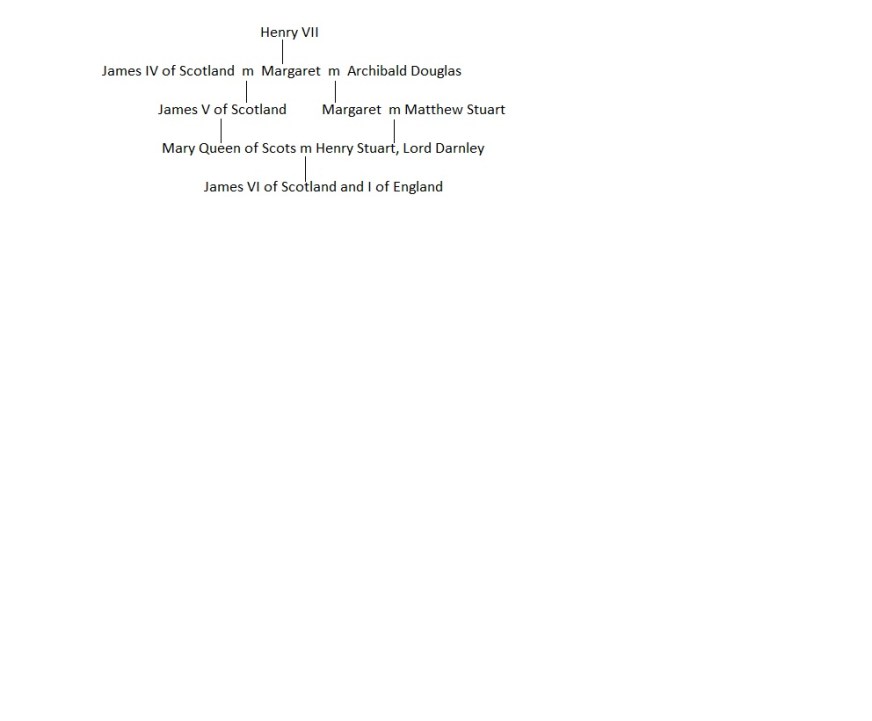
Queen Elizabeth I, daughter of Henry VIII and granddaughter of Henry VII, died childless. The next in line to the throne was James VI of Scotland, son of Mary Queen of Scots and great great grandson of Henry VII. James VI and I (as he is sometimes known) moved from Edinburgh to London; England and Scotland were now united under one monarch BUT this was a dynastic union only, the Stuarts reigned over two separate and distinct countries even though King James wanted them to be united as one.

Part of the problem which James I faced was that the Scottish Church would not accept the High Anglican Church of England. When his son, Charles I, succeeded him he introduced a Scottish version of the English Prayer Book in 1637. The Scots responded with anger and rioting, culminating in a meeting of the National Covenant in 1638 which overwhelmingly objected to the prayer book; and when the General Assembly met in November 1638 all bishops were expelled from the Scottish Church which became fully Presbyterian. Charles put together a military force to bring the Scottish to heel, but didn’t like using soldiers from his southern kingdom to invade his northern one, so a settlement was reached under the ‘Pacification of Berwick’. The peace didn’t last for long, hostilities broke out again and Charles’s English forces were defeated by the Scots at the Battle of Newburn.

Charles I

This was how Charles I found himself to be the king of two kingdoms with a history of dislike for each other and widely differing views on religion. Once civil war broke out in England, with parliament looking to exercise more control over the king, his taxes, and the religion of the country, things got even more complicated. The English Parliament entered into a ‘Solemn League And Covenant’ with the Scottish Church and Scottish troops played an important role in the defeat of Charles I, constantly playing one side against the other from the outbreak of war:

22nd August 1643 Charles I raised his standard in Nottingham, formally declaring war on Parliament.

August 1643 The Solemn League And Covenant promised to preserve the Scottish Church and reform religion in England and Ireland in return for Scottish help against the king.

6th May 1646 Charles I surrendered to the Scots in the hope that they would support him as their king against the old enemy, England. At the same time he was trying to negotiate with the English Parliament – unaware that the Scots were doing the same!

30th January 1647 The Scots handed Charles over to the English Parliament and he was imprisoned at Holdenby House in Northamptonshire.

November 1647 The king escaped but was soon re-captured. From his prison Charles I carried out secret negotiations with the Scots, hoping for uprisings in England to coincide with an invasion from Scotland which would free him and put him back on the throne.

28th December 1647 An ‘Engagement’ was signed, with the Scots agreeing to support the king as long as he imposed the Presbyterian Church on England for three years.

Spring 1648 The uprising began in Wales and England, but the Scottish forces were delayed which enabled Cromwell to put down the Royalist forces throughout most of the country although the king’s forces held out under a long siege in Colchester. When the Scots finally invaded they were defeated at the Battle of Preston on 17th – 19th August 1649. This effectively brought the Second English Civil War to an end.

Charles I was in prison in England throughout this second war, and at the defeat of his forces was put on trial for treason, and executed. With the death of Charles I Cromwell invaded Scotland and brought it into his Commonwealth, but after his death Charles II became king and Scotland became an independent country once more. It wasn’t until 1707, during the reign of Queen Anne, that the ‘Acts of Union’ were signed in England and Scotland in which the two separate states with their different legislatures but with the same ruling monarch were ‘United into One Kingdom by the Name of Great Britain’.

Union Flag

With such complex relationships between Scotland and England, as well as divisive politics and religion within England itself, it was perhaps inevitable that there would be conflict under Charles I. It is a period of history which makes for a great story and I thoroughly enjoyed the research I conducted for my novel ‘The Cavalier Historian’. I hope my readers will find the novel equally enjoyable!
Experience An English Civil War Battle Near You!

In England we are lucky with the resources available to us if we want to learn about the civil war which tore our country apart during the 17th century. As well as countless books on the subject you can conduct research online or maybe visit the National Civil War Centre in Newark, but to get a real experience of what life was like when parliament rose up against the king we have a number of wonderful re-enactment societies.

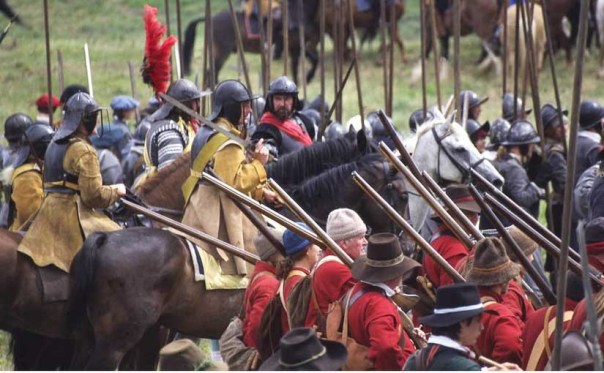
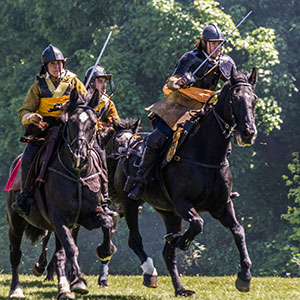
Cavalry (copyright Sealed Knot)

Both the Sealed Knot and the English Civil War Society provide authentic re-creations of both civilian and military life, and the information they provided was very helpful to me whilst I was conducting research for my novel ‘The Cavalier Historian’. You may think that re-enactment societies glorify war but that is far from the truth, and those who take part in these activities would say that their aim is to honour those who died in battle as well as to educate people about life in the 17th century. I can well remember the re-enactment of a battle which I attended at Faringdon in Oxfordshire some years ago with its guns and smoke, its sights and sounds of civil war. The battlefield commentary explained tactics and weaponry, and as I strolled around the campsite I was able to see authentic artefacts and clothing. I certainly felt that this was a great learning experience for the whole family.

Musketeers (copyright Sealed Knot)

If you have never seen a re-enactment featuring Cavaliers and Roundheads I would heartily recommend it. Wherever you are in the country you should be able to get to an event hosted by either the Sealed Knot or the English Civil War Society. Maybe you will be lucky enough to see a full scale battle with hundreds of infantrymen on each side as well as artillery, cavalry, and a huge array of camp followers. Perhaps it will be the re-creation of a specific battle, or maybe just a fictional episode designed to demonstrate the art of 17th century warfare. If you are not able to get to a battle then maybe you can see a skirmish, which is much smaller and has a focus on infantry with only a few cannons or cavalry men.

Copyright English Civil War Society

Whatever event you are able to attend you should also have the opportunity to see what camp life was like during the civil war. Take the time to wander around the tented areas where you will see re-enactors dressed in authentic costumes and carrying out authentic trades. There may be blacksmiths and armourers, barber-surgeons and laundresses, as well as kitchen areas providing food for both the officers and ordinary soldiers.

Army camp (copyright English Civil War Society)

As well as re-enactments these two societies will also visit schools to give students a taste of 17th century life, or sometimes staff a whole house with a costumed population for a truly immersive experience (this is part of the premise of The Cavalier Historian). So, if you are interested in the English Civil War, or history in general, why not try to see a re-enactment this year? I’m pretty sure you won’t regret it!

Cannon (copyright Sealed Knot)

The Sealed Knot

The English Civil War Society

Lord Thomas Grey’s Regiment of Foote

Sir William Pennyman’s Regiment

National Civil War Centre

Upcoming events:

English Civil War Society Events

Sealed Knot Events

Horror in the beech forest – the liberation of Buchenwald, 11th April 1945

Would you like to visit somewhere called ‘Beech Forest’? It sounds idyllic, doesn’t it? But our impressions change immediately we find out the German for ‘Beech Forest’ – Buchenwald. Today marks the anniversary of the liberation of that infamous place.

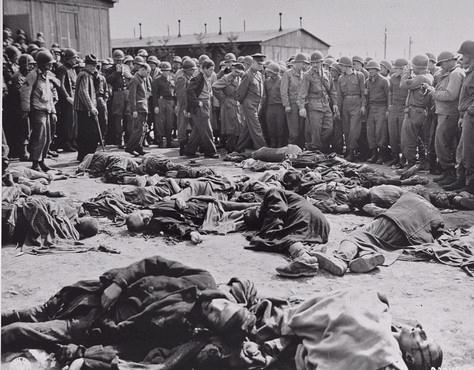
The concentration camp at Buchenwald was built just 5 miles north of Weimar, on the slopes of Ettersberg mountain, and was the largest complex of its kind in Germany with a main camp as well as 139 subsidiary camps and extension units. Established before the Second Wold War began, most of the original inmates of the camp were criminals or political prisoners who arrived in July 1937. The number of prisoners rapidly increased during 1938 when ‘undesirables’ who opposed the Nazi ideal or were considered to be antisocial elements were incarcerated in Buchenwald. After the outbreak of war in 1939 the numbers of inmates increased dramatically when many Polish prisoners were interred. It is believed that around 239,000 prisoners from 30 countries passed through the hell of the Buchenwald camps during the eight years from 1937 to 1945. No-one knows exactly how many people died there as some of the records were incomplete, but estimates range from 43,000 to 56,000. The conditions in the camp were horrendous, many of the inmates died of disease or because of medical experimentation, and over 8,000 Soviet prisoners of war were shot in an area of the camp designed for that specific purpose. These estimates of the numbers who died don’t include the inmates who did not survive the death march from Buchenwald in April 1945, or the camps which they were moved to.

Prisoners during a roll call at the Buchenwald concentration camp.
— US Holocaust Memorial Museum

The prisoners held in Buchenwald were an amalgam of the kinds of people whom Hitler believed had no place in his Reich – Jews, the mentally and physically disabled, Roma gypsies, Freemasons, Jehovah’s witnesses, political prisoners, prisoners of war, homosexuals, criminals – but rather than simply killing them as happened in many of the other camps, these people were used as forced labour in local factories which were a part of the German war effort (mainly armament factories), or in the Buchenwald quarry. Like Auschwitz there was a slogan above the gates at Buchenwald; in Auschwitz the sign read Arbeit macht free which translates as ‘work sets you free’, in Buchenwald the message was Jedem das Seine, the literal translation of this phrase is ‘to each his own’ but the understood meaning in German is much more sinister – ‘everyone gets what they deserve’.

As World War Two was finally drawing to a close in the spring of 1945 the prisoners in Buchenwald began to hope that they might actually survive their ordeal. On 4th April the US 89th Infantry Division liberated the subcamp at Ohrdruf as they moved eastwards towards the Russian armies which were advancing from the opposite direction. By this time the Germans knew that they could not win the war and, with the Allies getting ever closer, the 6th April saw the start of the evacuation of over 28,000 prisoners from Buchenwald and the satellite camps in an effort to hide what had been happening there. Almost 8,000 of these prisoners died during the march to other camps further east. Some of the prisoners who remained in Buchenwald had built a secret short-wave transmitter and were able to send a Morse code message on 8th April saying ‘To the Allies. To the army of General Patton. This is the Buchenwald concentration camp. SOS. We request help. They want to evacuate us. The SS wants to destroy us.’ Only three minutes later they received a reply – ‘KZ Bu. Hold out. Rushing to your aid. Staff of Third Army.’  Most of the SS had already fled and, on receiving this message, the jubilant prisoners took control of the camp, effectively freeing around 21,000 of their fellow inmates.

At 3.15pm on 11th April 1945 four soldiers from the 6th Armoured Division of the US Army were the first Allies to reach Buchenwald where they were greeted as hero’s by the survivors, some of whom even found the strength to throw their liberators in the air in celebration. (The clock at the entrance gate of Buchenwald is now stopped at 3.15 as a memorial).

Although the prisoners were delighted at their liberation and able to celebrate for a short time, most of them were so ill that the Americans wondered if they would survive to enjoy their freedom. As Edward Murrow reported for CBS – ‘I asked to see one of the barracks. It happened to be occupied by Czechoslovaks. When I entered, men crowded around, tried to lift me to their shoulders. They were too weak. Many of them could not get out of bed. I was told that this building had once stabled 80 horses. There were 1,200 men in it, five to a bunk. The stink was beyond all description…As we walked out into the courtyard, a man fell dead. Two others, they must have been over 60, were crawling toward the latrine. I saw it, but will not describe it.’

Allied soldiers liberate Buchenwald

The American soldiers were hardened men who had fought hard all the way from the beaches of Normandy but Buchenwald was almost beyond their comprehension, when Eisenhower entered the camp he said that “Nothing has ever shocked me as much as that sight.” The American liberators described finding lampshades made out of human skin and being shown where the land had been fertilised with the ashes of the dead. These horrific sights influenced their attitude when they arrived in Weimar the next day. The civilians in the town, just five miles from the camp, said that they hadn’t known what was happening there even though they had seen thousands of trains arriving laden with prisoner and none leaving. Elie Wiesel, arguably the most famous survivor of Buchenwald, later said that some of the inmates took jeeps and drove into Weimar where the American GI’s stood by and watched as the newly liberated men looted homes, killed German civilians, and even raped some of the German women. After what they had seen the soldiers felt little inclination to intervene and stop the former prisoners from taking their revenge.

Sadly, the liberation on 11th April 1945 was not the end of Buchenwald as a concentration camp. Between then and 10th February 1950 it was a ‘special camp’ run by the Russian NKVD. Finally, in October 1950, the Russian authorities decided to demolish the camp although parts were retained as a reminder of the atrocities committed by the Nazis during the Second World War. Today those remains contain a memorial and museum to the memory of the thousands who died in one of the most notorious of all concentration camps.

The Buchenwald Memorial

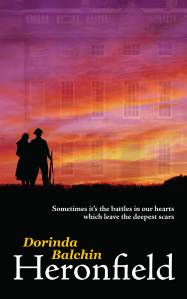
During the Second World War Buchenwald was the destination for many spies and resistance fighters who were captured in occupied France. In my novel Heronfield Tony was a member of the SOE and, as such, would have been sent to Buchenwald. I found writing that particular section of the book harrowing although the words I wrote in no way reflect the true horrors that the prisoners endured. In my own simple way I hope that my work can be seen as a tribute to all those who were sent to Buchenwald and other concentration camps simply because of their race, politics, religious beliefs or disabilities.

Sources

Official Memorial Site, Buchenwald and Mittelbau-Dora Memorials Foundation.

Film footage from 1945 inside Buchenwald Concentration Camp, British Pathé.

Buchenwald, jewishgen.org.

Guide to the Concentration Camps Collection, Leo Baeck Institute, New York City 2013. Includes extensive reports on Buchenwald collected by the Allied forces shortly after liberating the camp in April 1945.

Holocaust Research Project

United States Holocaust Memorial Museum

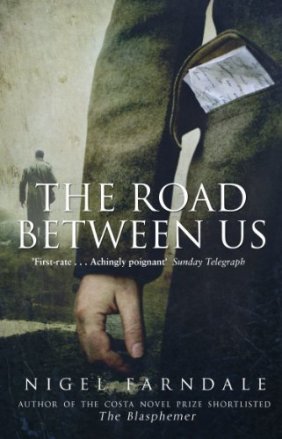
The Road Between Us by Nigel Farndale

1939: In a hotel room overlooking Piccadilly Circus, two young men are arrested. Charles is court-martialled for ‘conduct unbecoming’; Anselm is deported home to Germany for ‘re-education’ in a brutal labour camp. Separated by the outbreak of war, and a social order that rejects their love, they must each make a difficult choice, and then live with the consequences.
2012: Edward, a diplomat held hostage for eleven years in an Afghan cave, returns to London to find his wife is dead, and in her place is an unnerving double – his daughter, now grown up. Numb with grief, he attempts to re-build his life and answer the questions that are troubling him. Was his wife’s death an accident? Who paid his ransom? And how was his release linked to Charles, his father?

As dark and nuanced as it is powerful and moving, The Road Between Us is a novel about survival, redemption and forbidden love. Its moral complexities will haunt the reader for days after the final page has been turned.

‘The Road Between Us’ is a thought provoking novel which touches on subject matter which can make it uncomfortable reading at times. Following the stories of a father and son (one during the Second World War and the other set in the present day) Mr Farndale weaves a picture of love and loss, of discrimination and cruelty, yet also of loyalty and hope. During the war Charles loses his commission for ‘conduct unbecoming’ and spends the rest of the conflict searching for and attempting to rescue his lover, Anselm, who had been deported to Germany for ‘re-education.’ In the present Charles’s son, Edward, is released after eleven years in captivity and is also searching for love and hope, both of which he has buried deeply in order to survive his long period of isolation and deprivation.

Mr Farndale has approached the difficult subjects in his novel with respect and sensitivity. His descriptions of place and character are vivid, making the reader feel as though they are there and drawing them into the story. Even though some of the subject matter is difficult I found myself wanting to read more, to discover what made these characters tick and how they came to terms with aspects of their lives which were so troubling at times. It is the mark of a great novel to keep you reading under such circumstances, the key here being the believable characters who are drawn so sympathetically.

The historical context of ‘The Road Between Us’ has been well researched which gives a depth of plausibility to the story – the ‘re-education’ workcamps, the treatment of homosexuals etc. The dialogue has an authentic ring which brings the characters to life, dialogue which reflects the authors understanding of human psychology and encourages the reader to look deeper into themselves. All in all, this is a very moving story and compelling reading; it has a great narrative, the feel of both thriller and love story, intelligent and literary writing.

If you like historical novels which explore the human condition with depth and sensitivity then I heartily recommend ‘The Road Between Us’ to you.

(I have deliberately avoided going into details of this story as it would be difficult to do so without spoiling it for you!)

‘The Road Between Us’ can be found on Amazon

You can find out more about Nigel Farndale on his website 

You can read more of my Recommended Reads here

Hitler’s guidebook – The Baedeker Raids

Have you ever used a Baedeker Guidebook when on holiday? The first of these travel guides was published in the 1820’s and were a ‘must have’ for travellers. But did you know that there was a series of air raids on England during the Second World War which got their name from these guidebooks? So why did the Germans use these books to target historic towns and cities in Britain during the spring of 1942?

guide-book

The intensive bombing of the German blitz ended in May 1941 when Hitler re-targeted his resources on his invasion of Russia; this meant that attacks on Britain were confined to hit-and-run raids on coastal towns. At the same time night bombing by the RAF was being scaled down as it was felt that the type of raids which targeted individual factories or military bases were ineffective. It was not until March 1942 that the RAF resumed their raids with new heavy bombers, improved navigation, new tactics, and a new commander, all of which helped to make these attacks much more devastating than those carried out earlier in the war. Instead of the previous attempts at precision bombing of factories and power stations the focus was now on area bombing. Planes would target a single area where there was not only the possibility of destroying military targets and factories but also affecting the morale of the civilian population. On 28th March 1942 the RAF bombed the city of Lűbeck in northern Germany. The historic centre of the city, known as the ‘Old Town’, consisted mostly of wooden buildings and was almost totally destroyed; over 1,000 people were killed.

Mass grave for the victims of the bombing of Lubeck

Nearby Rostock was bombed a month after the destruction of Lübeck. The two attacks shocked the Nazi leadership, and also the civilian population of Germany who had suffered little under previous RAF raids. The change of British tactics was very effective; Goebbels said that “the damage was really enormous” and “it is horrible… the English air raids have increased in scope and importance; if they can be continued for weeks on these lines, they might conceivably have a demoralizing effect on the population.” He described the raid on Rostock as more devastating than those before, saying “Community life there is practically at an end… the situation is in some sections catastrophic… seven tenths of the city have been destroyed… more than 100,000 people had to be evacuated… there was, in fact, panic.” Hitler was furious and determined that the Luftwaffe would retaliate in kind. On 14th April he ordered that “the air war against England be given a more aggressive stamp. Accordingly when targets are being selected, preference is to be given to those where attacks are likely to have the greatest possible effect on civilian life. Besides raids on ports and industry, terror attacks of a retaliatory nature are to be carried out on towns other than London.” Hitler’s aim was twofold, as well as revenge for the RAF raids he hoped that such attacks would break the morale of the British people and lead to a swifter end to the war.

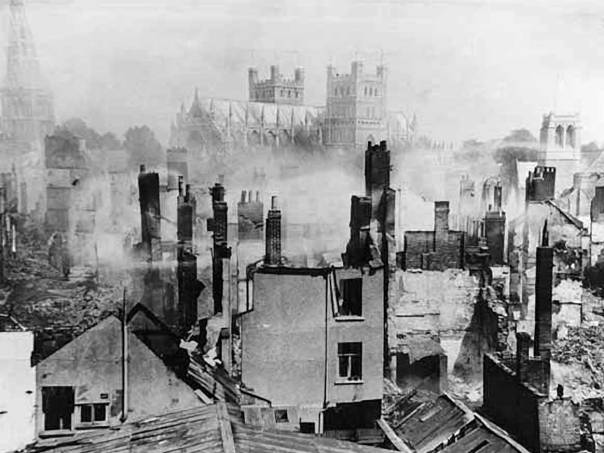
Exeter after the bombing

The first retaliatory raid took place on Exeter on 23rd April. Much of the city was damaged and around 80 people were killed and 55 wounded. The next day Baron von Sturm (a spokesman for the German Foreign Office) said “’We shall go out and bomb every building in Britain marked with three stars in the Baedeker Guide.” von Strum’s comments led to the raids being called the ‘Baedeker Raids’ by both the Germans and the Allies. Although Goebbels agreed with the tactic he was furious with von Strum for his thoughtless, off-the-cuff comment. Goebbels  had wanted to take the moral high ground, describing the British attacks as ‘terror bombing’, but now von Strum had effectively admitted that the Germans were deliberately targeting cultural and historical sites. Exeter was bombed again within hours of von  Strum’s statement. A third raid on Exeter took place on 3rd May when high explosives, incendiaries and parachute mines were dropped by 90 planes, devastating the city’s shopping centre. 163 people were killed and 131 seriously injured in the attacks on the town which was poorly prepared for such raids, as were the other locations chosen from the guidebook. (Intersetingly, Hitler forbade any bombing of the beautiful Blenheim Palace in Oxfordshire as it was the place where Churchill had been born; Hitler was determined to live  there after he had invaded and subdued the UK).

Goebbels in 1942
Goebbels in 1942

Each of the Baedeker raids involved between 30 and 40 bombers which flew two sorties each night. This meant that each raid would begin with a period of bombing lasting one and a half to two hours. There would then be a lull of two to three hours while the Germans returned to base to re-arm and re-fuel. Finally, another bombing run like the first.

Exeter was not the only city to be targeted. 400 people were killed in raids on Bath on two consecutive nights (25th + 26th April), during the raid the railway station was put out of action and communications severely affected. After the raids on Bath Goebbels reported that Hitler intended to “repeat these raids night after night until the English are sick and tired of terror attacks” and that he “shared [Goebbels’] opinion absolutely that cultural centres, health resorts and civilian centres must be attacked… there is no other way of bringing the English to their senses. They belong to a class of human beings with whom you can only talk after you have first knocked out their teeth.”

Bath after the raid
Bath after the raid

The 27th of April saw 90 tons of bombs dropped on Norwich; the city was attacked again on the 29th. In all, 222 people died during these raids on Norwich. It was the turn of York on 28th April when high explosive bombs and incendiaries caused a huge amount of damage, including the destruction of the medieval Guildhall. In May there were more raids on Cowes, Norwich, Hull, Poole, Grimsby and Canterbury. The RAF responded by sending 1,000 bombers in a massive raid on Cologne.

The German raids on historic cities in England during April and May 1942 were responsible for 1,637 civilian deaths and left another 1,760 injured. Over 50,000 homes were destroyed along with some important buildings such as the Bath Assembly Rooms and the Guildhall in York. But the raids did not cause as much damage as Hitler had hoped, and rather than breaking the morale of the British people it strengthened their resolve to defeat the enemy at all costs. German bomber losses were high and this, coupled with the need for Hitler to reinforce his troops in North Africa and Russia, resulted in a scaling back of attacks to hit-and-run raids on the coast. The Luftwaffe did occasionally raid towns and cities of historic and cultural importance in the months that followed (Ipswich, Poole, Norwich, Bristol, Swansea and Colchester), but these raids were much smaller (about 20 aircraft instead of 40+) and the damage was more limited; even so, by the end of the year over 3,230 people had been killed and 4,150 injured in German air raids on Britain. There were some attacks on towns of no military or strategic value in 1943, but by 1944 the Germans gave up their ‘Baedeker Raids’ as they were ineffective and the losses to the Luftwaffe were unsustainable. London once again became the target, along with the ports which Hitler believed would be used for the Allied invasion of Europe.

cologne
Cologne

In my novel, Heronfield, Bath holds a special significance for two of the main characters, and it is through the eyes of Sarah that we see the significance of the bombings, and the resilience of the civilians whose resolve was strengthened rather than broken by the Baedeker Raids.

Heronfield

Grayling, A. C.  Among the dead cities

Price, A. Blitz on Britain 1939–1945

Terraine, John The Right of the Line

Recommended read – ‘A Town Like Alice’ by Nevil Shute

a-town-like-alice

Jean Paget is just twenty years old and working in Malaya when the Japanese invasion begins. When she is captured she joins a group of other European women and children whom the Japanese force to march for miles through the jungle – an experience that leads to the deaths of many. Due to her courageous spirit and ability to speak Malay, Jean takes on the role of leader of the sorry gaggle of prisoners and many end up owing their lives to her indomitable spirit. While on the march, the group run into some Australian prisoners, one of whom, Joe Harman, helps them steal some food, and is horrifically punished by the Japanese as a result.

‘A Town Like Alice’ is a classic which loses none of its appeal with the passage of time. The description of life for the English women and children who are unwanted prisoners of the Japanese, forced to march for months on end by Japanese officers who refuse to take responsibility for them, is harrowing. You would be forgiven for saying that something as inhumane as that could never have happened – but it did, though in Sumatra not Malaya. Mr Shute met with one of those women after the war, and this novel is a tribute to her strength and endurance and that of those who were held with her, and those who died during their long captivity.

You may also be forgiven for thinking that the story must be depressing, it is not. This is a novel of hope not despair. Mr Shute uses his characters to show us the good in humanity, the willingness to help others despite personal cost – Joe, the Australian soldier, who stole to feed the women, with tragic consequences; Jean’s struggles as she tries to cope with the ‘normality’ of England after the war, unable to begin life again because of a burden of guilt she carries from her time as a prisoner; the kindness and support show to Jean by her solicitor, Noel. Mr Shute skilfully weaves a believable plotline which takes Jean back to Malaya and on to Australia, searching for answers and for a purpose in life. Can she re-build her life in a new country in ‘a town like Alice (Springs)’ which Joe told her so much about?

This is a well-researched and well written novel in which Mr Shute immerses the reader in life in three very different locations – war-torn Malaya, bombed out London and the developing outback – with the effortlessness of a master wordsmith. This is a story of ordinary people with an extraordinary tale to tell; a timeless tale of love and loss, of romance and redemption. ‘A Town Like Alice’ is one of the books I’ve read more than once and always enjoy coming back to. If you have never read this modern classic you really must give it a go.

‘A Town Like Alice’ can be purchased from Amazon

You can find out about more about the life and work of Nevil Shute at the Nevil Shute Norway Foundation

Call the midwife?- pregnacy and childbirth in the 17th century

Did women receive antenatal care during the 17th century? And if so, were men involved? These are questions I have been asked by people who have read my recent novel, The Cavalier Historian. It is a fascinating topic, and one which may cause you a few surprises!

Before the 17th century pregnancy and childbirth were the exclusive domain of women with male doctors only occasionally being called in to help with difficult deliveries. During the mid-17th century, however, some doctors began to take a more active role in childbirth although this was limited to the process of delivery with no real attempts at gynaecological surgery. It was not until the beginning of the 1700’s (50 years after the setting in my book) that forceps were introduced and, as the use of anything mechanical was seen as unsuitable for women, ‘man midwives’ began to appear. Initially they were called in to help with difficult deliveries, but by 1720 ‘man midwives’ and doctors were beginning to attend normal deliveries.1

Childbirth was a dangerous event during the 16th and 17th centuries and in Britain at that time the chances of a woman dying were about one in forty. In some countries, such as France, it was even higher. But, as Benjamin Roberts explains in his book Through the Keyhole: Dutch Child-rearing Practices in the 17th and 18th century, that does not mean that there was no antenatal care. As you would expect, there was a great difference in the experience of women depending on such factors as wealth and poverty, rural or urban residence, and the family being ‘enlightened’ or ‘unenlightened’. Care in pregnancy had certainly been a focus for some doctors in Germany as early as the period of the Reformation where male doctors were publishing books on the subject well before the civil war broke out in England. In 1513, for example, the German physician Eucharius Rosselin first published Rosengarten (The Rose Garden), which became the standard text for the more educated midwives who were able to read. Rosselin worked for Katherine, the wife of Henry IV, Duke of Brunswick-Luneburg, who wanted him to supervise the midwives in the city of Worms. His work led him to the conclusion that the high mortality rate in childbirth was due in no small part to careless and substandard work by midwives; his book was written to counter this. Rosengarten was an over-night success, and not just in Germany – by the mid-16th century it had been translated into all the major European languages with the English translation, The Birth of Mankind’ being published in 1540.

In addition to Rosselin the Lutheran preacher Johannes Coler was also publishing about pregnancy and childbirth. His work, Haussbuch, was published in six parts between 1591 and 1605. For Coler, the focus was on providing useful guidance for both mothers and fathers during pregnancy whilst Rosselin was more concerned with the final stages of pregnancy as well as with childbirth itself. Both authors offered advice on good diet for the pregnant woman.

For me, the most interesting book by an English author is ‘Observations in Midwifery’ by Percival Willughby, a doctor who wanted to improve the standards of midwifery and so save lives. In his book Willughby records the details of almost two hundred births he attended and where he criticises the ignorance and superstitious practices of many midwives (including placing the placenta on the baby’s head to prevent sore eyes). Willughby also describes situations where the death of a child, and maybe the mother as well, was as a direct result of the ignorance of the midwife. The first birth that Willughby wrote about could have resulted in such a disaster without his intervention. The incident took place in 1630 when he was asked by a country gentleman in Derbyshire to visit his wife. The local midwife apparently believed that the woman was already in labour and was trying to force the birth of the child. Willughby found that the woman’s waters had not yet broken so he gave her a calming drink (milk, camomile, sugar and egg yolk) to help her sleep. The pregnancy continued without further upset and the baby was born a month later.

Dr Willughby was definitely ahead of his time in the care of women during pregnancy, and also in improved care during childbirth. For some unknown reason ‘Observations in Midwifery’ was not published until after Willughby’s death when a number of hand-written copies were made, but the book was not actually published until 1863. There are two known hand-written copies still in existence, one of which is held by the Royal Society of Medicine, London.

Willughby was not unique amongst English doctors of that time for in his book he records a conversation which he had in 1642 with a Dr Harvey, a conversation in which they shared information about pregnancy and childbirth. So, to answer those questions about The Cavalier Historian: it was not the norm for women to receive antenatal care during pregnancy at the time of the English Civil War, but for a noble woman it would not have been unheard of. I like to imagine that the doctor in my book may have come into contact with Willughby or with the books of Rosselin and Coler, and that these had informed his care of a pregnant woman; and he would most certainly have been called in to assist with a difficult delivery when things went wrong.

In conclusion, pregnancy and childbirth were dangerous times for a woman in the 17th century. Ignorance and superstition were rife amongst the poor uneducated midwives, but if one were wealthy enough and of a high enough social standing it might have been possible to receive more enlightened antenatal care. Those women were the lucky ones.

References:  1 Royal College of Obstetricians and Gynaecologists;    Through the Keyhole: Dutch Child-rearing Practices in the 17th and 18th century by Benjamin Roberts

Observations in Midwifery by Percival Willughby

Thank you Whispering Stories for a lovely Author Interview

I’d like to thank Stacey for her lovely write up of our interview about my life and writing. I do hope  you can take a look and find out a little more about me and my writing.

As most of you know I now live back in the UK but the beautiful photo of ‘where I write’ is actually the view I had from my desk at Lakeside where most of ‘The Cavalier Historian’ was written. I was very lucky to have probably the best view in the world from an office!

140

The poisoned witches – a scientific explanation for witchcraft

What would you do if someone told you that there was a witch living in your town or village? Most people in the western world of the 21st century would smile and treat it as a joke at best, and at worst as someone trying to stir up trouble. But things would have been very different in the past.

During the Middle Ages witches were thought to be behind many illnesses from fevered nightmares to sick animals and dying children. This supposed interference in the natural order of things was known as bewitchment and struck at regular intervals, blighting the lives of thousands of people over hundreds of years.

During the period of the 15th to 17th centuries bewitchment reached epidemic proportions with over 40,000 men, women and children in Europe being executed as witches.  It was not only the poor who believed in witchcraft, even well-educated people of the time feared the supernatural and the Vatican sent out a decree warning people against bewitchment.  England was no different to the rest of Europe and many witch finders made it their life’s work to hunt down witches, one actually took 250 people before the courts in just two short years. Witches were greatly feared, and witchcraft was punishable by death.

220px-uk_warboys_sideaA well-known example happened at a manor house in the village of Warboys near Cambridge in 1589 when a mysterious illness struck down the five little daughters of the Throckmorton family and seven of their maidservants. The illness bore all the hallmarks of witchcraft, and fear spread throughout the village. The distraught family called in doctors and church leaders to try to diagnose what was wrong (at the time many doctors were willing to accept the idea of witchcraft after all other available explanations for an illness had failed).  The sick victims at Warboys had all the classic symptoms of bewitchment – hellish visions, often of wild animals (one said she saw a cat tearing her flesh off); the bodies of those affected went into violent fits and writhed in agony on their beds.  Once it was decided that witchcraft was the source of the problem someone had to be blamed and, as with most cases at the time, it was an innocent local misfit, Alice Samuel, who was singled out.  Standard practice was to torture a witch, who would often be branded or held under water; witchcraft was so feared that it didn’t matter how much the accused suffered as  any method used to see the curse of bewitchment lifted was deemed totally acceptable.  Many people believed that if you scratched a witch to draw blood it would help to relieve the suffering of the person who had been bewitched and so this was done to Alice on several occasions.  After a year of continuous pressure Alice Samuel finally confessed to being a witch. As punishment, and to keep the village safe in future, she was hanged, along with her husband and daughter.
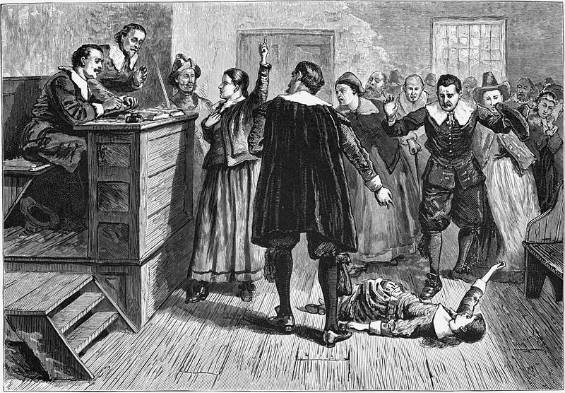
salemAnother well know incident of witchraft happened in Salem on the east coast of America.  The Salem Witch trials of 1692 played out in a very similar way to the Alice Samuel case, and Arthur Miller later wrote about what happened in his play The Crucible. In December1691 many settlers in Salem had been struck by a horrifying disease, similar in its symptoms to what happened in Warboys and, as in England, it was believed that the Devil was responsible. The town doctor was convinced that what was happening was the result of witchcraft, particularly as eight girls said that they had been bewitched; for the next year the young girls regularly testified in court against other town members. Based on the evidence of the children 152 people were imprisoned on charges of witchcraft, and although none of them confessed 19 men and women were found guilty and executed as witches.

Linnda Caporael
Linnda Caporael

So what was going on? Was there simply a widespread primitive belief in the devil and witchcraft, or was there something else behind these incidents? Professor Linnda Caporael is a Behavioural Psychologist who studied what happened at Salem. Many people believe that the girls had made it all up, but Linnda could think of no reason why they would have done that, or kept up the pretence for so long. The more she studied, the more she began to believe that most of what the girls had experienced had not been faked, particularly when they suffered from severe convulsions. Another factor which made her question accepted belief was that the girls were not the only ones to have experienced visions, many other men, women and  children in the village reported hallucinations to the doctors and clergymen. When Linnda re-read another account it made her think that the symptoms were very similar to those experienced by people who had taken LSD (acid) which is an hallucinogenic drug from the 1960’s. People who have taken LSD say that they experience hallucinations like living nightmares which are very similar to what the victims of witchcraft said in Salem.  This left Linnda with one big question – if the cause of witchcraft was LSD, where had the drug come from?

220px-albert_hofmann_oct_1993
Albert Hofmann

LSD did not exist in the 15th to 17th centuries, in fact it was not until 1943 that the Swiss neuro-physiologist Albert Hoffman experimented with a natural fungus called ergot whilst looking for medical applications for a drug.  As part of his experiments he made an extract from the ergot fungus, accidentally spilling some of it onto his hand.  Within hours he began to hallucinate. When he finally recovered from the horrific hallucinations he set to work and derived LSD from the extract.

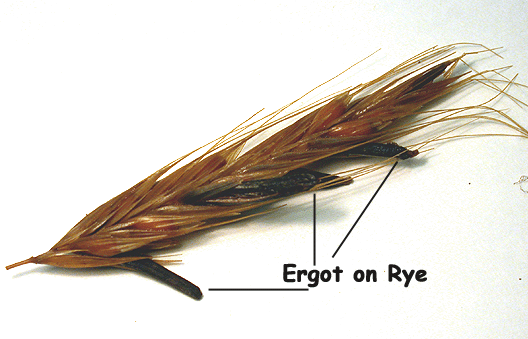
Linnda Caporael began to look at ergot poisoning as a possible explanation for bewitchings.  The descriptions of the effects of the drug on people which she found in medical books matched the symptoms from Salem and she was convinced that she had found an explanation for witchcraft in nature.  The next question, then, was how the settlers had come into contact with the drug? As it was not only the settlers in Salem who were affected by witchcraft but their animals as well (cattle acted strangely and died of no natural causes) Linnda began to wonder if a food common to both humans and animals could be the source, so she began looking at grain.  The dominant crop in Salem was rye, so the question now was to find out how ergot could have got into the rye fields. To help her Linda looked at the work of fungal toxicologist, Professor Maurice Moss.

A fungus contaminates its host and gradually replaces the original seed with its own material so, Linnda surmised, if the rye in the fields was contaminated with ergot then the bread would have been contaminated too. This was important to her theory because the nerve toxins now contained in the bread would account for the hallucinations, pin pricking sensations, the feeling of insects crawling beneath the skin and the powerful fits which meant that the sick people could barely be held down by their friends and family.  Ergotamine (taken from the word ergot) is a drug used in Holland to treat migraines and has been shown to have constrictive powers which can lead to convulsions, and to the blood draining from the skin causing pricking sensations.

ergotonrye

Linnda then turned to look at the environment which, again, supported her theory. Ergot thrives in wet, damp soil, and in 1691 the Salem crops had been planted in low marshy ground.  For a mass infection of the harvest to take place it would have needed a warm wet spring and summer; the spring of 1691was stormy and wet and was followed by a wet summer, the crop grown in Salem was rye.  Most of the sickness was on one side of the village where the homes backed onto the western farms with swampy marshlands. Rye was also the staple diet in Europe in the Middle Ages which, if Linnda  Carpoael is correct, could explain the witch persecutions which took place so frequently; particularly as the poor peasant classes were hit most, and rye was their staple diet.

An historian by the name of Professor Mary Matossian has mapped outbreaks of witch trials which were localised in Britain – these were mainly, but not exclusively, in Essex and East Anglia – the surprising result is that the outbreaks coincided with the main rye growing regions.  As the weather conditions at the time were different to today, with wetter and warmer summers, the conditions were ideal for the formation of ergot on rye.

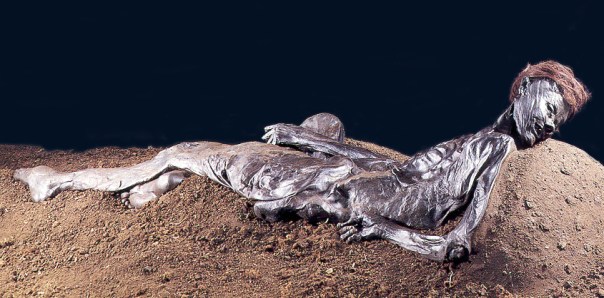
Grauballe man

Supporting scientific evidence for this theory about the causes of witchcraft comes from the ‘peat bog man of Grauballe’.  He was buried in a bog in Denmark during the Iron Age and found in 1952.  The man had been murdered with a knife and club then dumped naked into the bog – his throat had been cut from ear to ear and a blow to the right temple had fractured his skull.  Although this sounds brutal this ritual was often carried out if someone was thought to be possessed by demons, the fracturing of the skull would allow the demon to escape and the victim could rest in peace. A post mortem was carried out on the Grauballe man in 1952 and his stomach contents showed that his last meal had largely comprised of ergot.  Chemical tests on a gut sample showed that ergot alkaloids were present, therefore the man would have been hallucination, convulsing, vomiting etc. and would probably have been killed as a witch.

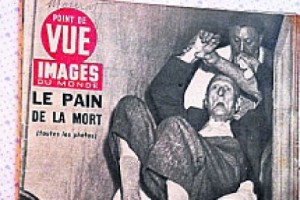
The most recent case of a mass poisoning happened in 1951 when an entire village in France had ergot poisoning caused by infected bread.  In Pont St Esprit (Provence) in August of that year 250 people were struck down, several were taken to hospitals and psychiatric asylums in the weeks which followed.  They were sick, had stomach cramps, couldn’t sleep, suffered from violent convulsions and terrifying hallucinations.  Many had to be strapped down to stop them jumping out of windows to escape their torment.  At least five people died during the outbreak and when ergot poisoning was finally found to be the cause many people did not believe the explanation.  The Bishop of Nimes was called in to exorcise the devil from the bakery which had been the source of the outbreak.  Interestingly, a dog which had been fed on scraps of the rye bread ran in circles and was biting at rocks until it broke its teeth on them and then died.  This was an exact parallel to what happened to the animals in Salem.

affaire-pain-rend-fou-avait-300x200

Cover_Kindle_front coverSo, was witchcraft really a problem in the past, or were bewitchments caused by ergot poisoning?

I am fascinated by the fact that scientific research is constantly revealing more about our past.  I have come to believe that the misinterpretation of ergot poisoning is responsible for reports of witchcraft over the centuries, and this is what lead me to write the conclusion to the story of Rebekah and Simon in my novel ‘The Cavalier Historian’.